Thursday, 30 July 2009

God in a Box?

Vestries often contain lovely things — treasures the public, sadly, never gets to see. In High Wycombe recently, I was very struck by this holy and intriguing object, and couldn't help wondering what manner of cubist Messiah might lie inside. I notice he likes to be a particular way up, too.

He’s definitely got more God-in-a-box appeal than average, and could well be the most intresting Hidden Vestry Object in Bucks.

Unless anyone out there knows better....

Wednesday, 29 July 2009

Velcro and Teflon in Pastoral Care

Teams offer the best pastoral care, not primadonnas. One particular reason has struck me recently — the complexity and depth of damage in some people’s lives in a consumer society can exhibit in a tendency to shop around. “I've tried 11 vicars — none of them was any good, so now I'm trying you, bishop.” Dangerously, this can hook into our own need to be needed, flatter our own sense of drama and, when the velcro attaches, we’re stuck — and so are they.

Ministry, and especially deliverance ministry, is one sphere of life where it really doesn’t pay to shop around. Every time a priest introduces boundaries to the conversation you bail out and find another, until, presumably, you can find one who mirrors your dis-ease perfectly = can reinforce your problem precisely. The only hope of healing usually lies in picking a small selection, if not one, taking the blindest bit of notice of any of them, and then sticking with the pastoral relationship for long enough for something good to happen. From the point of view of clergy, we can best offer help by communicating together and integrating care, not flying solo.

When people ask for deliverance ministry, it’s best to offer an organic integrated package where specific spiritual needs emerge as a strand within a holistic and relational approach, not zap-u-up pyrotechnics, silly voices, and cliché storylines from the Hammer House of Horrors. The whole key is not to make a drama out of a crisis. We centre carefully on the health, personal, relational, and spiritual realities involved, and go gently. Whereupon, I find, healing comes swifter and sooner than anyone usually expects.
Reblog this post [with Zemanta]

Sunday, 26 July 2009

Harry Patch: Last of the Old Brigade

The death yesterday of Harry Patch, last Britisih veteran serviceman of the First World War, is a milestone which can’t fail to move anyone with any historical imagination. I rather sympathise, in principle, with Damian Thompson’s suggestion of a state funeral in the Abbey, family willing.

Some five and three quarter million British War Medals 1914-20 were issued. The death of Mr Patch the plumber marks the end of all that, as living memory. My father, 28 years a soldier, took us to beatings of retreat in the sixties where anyone over 70 had seen service in the First World War. Thank goodness the voices of that generation have been increasingly recorded since the groundbreaking 1964 BBC Documentary The Great War.

Some 30 years ago I had a close personal encounter with Harold Macmillan at a St Catherine’s Day dinner in Balliol. With utter simplicity and a painfully clear memory Mr Macmillan, who had been shot up as a guardsman during the retreat from Mons, described the lives, hopes and characters of fellow students from the lost class of 1914, under half of whom survived, pinpointing who had lived on which staircase, and what talents had been lost by their deaths.

One of the great experiences of my ten years in Reading was meeting, eventually officiating at the funeral of, Charlie Evans, like Harry Patch a survivor of Passchendaele. He returned passionate to do something for his mates who hadn’t made it (three quarters of his platoon); joined the Post Office Union and the Labour Party, and ended up as a much loved mayor of Reading — there’s a road on the Amersham Road estate named after him.

The world I grew up in may well have been a more respectful, safer, more decent place because pretty much everyone a certain age, soldier or civilian, male or female, from plumbers to politicians, had undergone the experience of real danger and gut-wrenching fear; of doing without and having to make the best of things. Nobody would wish that on a dog, but this experience generaly gave most of them a particular perspective on life and people. Unlike our politicians, they did not acquire knowledge of war primarily from movies. Large numbers of young men were abruptly brought to an awareness of their own limitations, the need to look out for others, tolerance of different people they would never have met in a month of Sundays had they not been drafted into the Services. Some lost God, and some found God, but many found something of themselves we struggle to understand.

This whole stream of our culture is now almost extinguished, although there may be a few civilians who lived through it left. I am not sure where this leaves us in our own Great War for Civilisation. I am optimistic enough to believe young people have a great underlying spirit and capacity for altruism, that comes out when really necessary. I love the way our children’s generation network and care for each other. Plainly the ravages of ego, selfishness and materialism come much more easily to us, and them, than to Mr Patch’s generation — another reason to respect our young people, who have so much more confused and confusing a world of which to make sense.

Living in a society which generally idolises the latest and trivialises the past, we all have an amnesia problem. It’s hard to think Mr Patch’s death will help with that, but I hope some strand of corporate memory and respect will transmit forward, and increase our chances of recovering some greater measure of our core values — corporate understanding, fellow feeling, dignity, and self-respect — before it’s too late. Just pray it doesn't take a disaster like the wars of the 20th Century to get us there...

Saturday, 25 July 2009

Out of the (Student Loans) Labyrinth

An exhilerating feeling of achievement sweeps through me, to have completed three epic struggles;
  • Steph’s student finance application
    for next year, a simple matter of confirming how many kids we’ve got.

  • Shaking off the vicious Pink Spambot Succubus attached to my Twitter account.

  • Renewing Family Tax Credits; we need the money, without which our children end up living on squirrels in the woods. This had to be done by the end of July.
  1. This evening’s silver spoon goes to HMRC for Family Tax Credit, where after a short delay the whole matter was dealt with on the phone, with the right paperwork to hand, in under five minutes. Their agent dealt with a potentially snaggy private matter kindly, efficiently, and speedily on the phone. Top Drawer!

  2. The Wicked Pink Spambot Succubus has been off and on my Twitter account most of this week. It came back for four messages 24 hours after its original demise, sporting a new and previously unheard of web address. The general effect was very cat-and-mouse, like a U-Boat movie. At one point it seemed to be changing my password back as fast as I could change it to lock it out — a distinctly unnerving business. I wonder whether the Twitter API itself was doing strange flaky things. I have since been doing a roaring trade in helping fellow sufferers. My fear was that my whole Twitter account would become unusable. I am very grateful to followers for their kindness and understanding. After four days, it looks as though I’m clear.

  3. Grand Labyrinthine Wooden Spoon, however, gloes to the Student Loans Company. All Lucy and I had to do was click four buttons to confirm we hadn't had any more kids, or, I suppose, given any away, in the past year. How long can it take to click a mouse eight times? The answer is just over two hours of craziness, trying to get in, juggling passwords, getting locked out, changing secret answers, staring at blank screens, phoning the helpline times 2. The guy who helped us the second time round did his best, but it still took another half hour of high jinks with him on the line, and at times apparently as bemused as us, before Lucy could confirm her details.
Let’s celebrate endeavour and struggle, good and bad, noble and pointless. Edwin Muir’s Labyrinth is still, to my mind, the best blank verse to be had in modern English:

THE LABYRINTH

Since I emerged that day from the labyrinth,

Dazed with the tall and echoing passages,

The swift recoils, so many I almost feared

I’d meet myself returning at some smooth comer,

Myself or my ghost, for all there was unreal

After the straw ceased rustling and the bull

Lay dead upon the straw and I remained,

Blood-splashed, if dead or alive I could not tell

In the twilight nothingness (I might have been

A spirit seeking his body through the roads

Of intricate Hades ) — ever since I came out

To the world, the still fields swift with flowers, the trees

All bright with blossom, the little green hills, the sea,

The sky and all in movement under it,

Shepherds and flocks and birds and the young and old,

(I stared in wonder at the young and the old,
For in the maze time had not been with me;
I had strayed, it seemed, past sun and season and change,
Past rest and motion, for I could not tell

At last if I moved or stayed; the maze itself

Revolved around me on its hidden axis

And swept me smoothly to its enemy,

The lovely world) — since I came out that day,

There have been times when I have heard my footsteps

Still echoing in the maze, and all the roads

That run through the noisy world, deceiving streets
That meet and part and meet, and rooms that open
Into each other — and never a final room
Stairways and corridors and antechambers

That vacantly wait for some great audience,

The smooth sea-tracks that open and close again,

Tracks undiscoverable, indecipherable,
Paths on the earth and tunnels underground,
And bird-tracks in the air — all seemed a part

Of the great labyrinth. And then I'd stumble

In sudden blindness, hasten, almost run,

As if the maze itself were after me

And soon must catch me up. But taking thought,

I'd tell myself, “You need not hurry. This

Is the firm good earth. All roads lie free before you.”

But my bad spirit would sneer, “No, do not hurry.
No need to hurry. Haste and delay are equal
In this one world, for there's no exit, none,

No place to come to, and you'll end where you are,

Deep in the centre of the endless maze.”

I could not live if this were not illusion.

It is a world, perhaps; but there’s another.

For once in a dream or trance I saw the gods

Each sitting on the top of his mountain-isle,

While down below the little ships sailed by,

Toy multitudes swarmed in the habours, shepherds drove

Their tiny flocks to the pastures, marriage feasts

Went on below, small birthdays and holidays,

Ploughing and harvesting and life and death,

And all permissible, all acceptable,

Clear and secure as in a limpid dream.

But they, the gods, as large and bright as clouds,

Conversed across the sounds in tranquil voices

High in the sky above the untroubled sea,
And their eternal dialogue was peace
Where all these things were woven, and this our life

Was as a chord deep in that dialogue,

As easy utterance of harmonious words,

Spontaneous syllables bodying forth a world.


That was the real world; I have touched it once,

And now shall know it always. But the lie,

The maze, the wild-wood waste of falsehood, roads

That run and run and never reach an end,
Embowered in error — I’d be prisoned there
But that my soul has birdwings to fly free.


Oh these deceits are strong almost as life.

Last night I dreamt I was in the labyrinth,

And woke far on. I did not know the place.

Friday, 24 July 2009

Guitar shopping for beginners

School holidays, and first family project was getting Nick a proper guitar. He's had an OK but not great MFI Plywood special for a while now, but not full size, and now friends were bugging him at parties and putting it on YouTube, and he’s spending hours with his guitar, he really does need a half decent one. So, armed with wee pot of dosh from an amazing and beloved aunt who died in 1999, we headed for Britain’s own Tin Pan Alley.

Contrary to expectation this is not a fantasy location off Harry Potter. Guitar shops proliferated, more than wot we’d had hot dinners, so we nuzzled round with the whole family (minus Catherine) in tow, sizing up possibilities, then zeroed in on Wunjo Guitars in Denmark Street to see what they could do for us. Brian was amazing — no silly sales pitch; just sized up the job, sat Nick down, tried a few possibles, narrowed it down to two, then one ideal guitar — an entirely Nick led process. He than did us a doable deal and banged a bit of dosh off. This was helpful, as when you go to a world class place to buy anything you get an amazing selection of good stuff, but you can end up paying through ye nose. Not here.

So, for the family record, here’s the dream Machine — a Cort MS710 — Flamed Maple, rich tone, and a bit of welly especially with pick-up. It will only get better with age and constant playing. A thing of beauty is a joy for ever! Topped off with a celebration meal at the Rainforest café and, don’t laugh, a Snog in Brewer Street this has to be one of the more amazing family days out for a while...

Tuesday, 21 July 2009

Pastoral Care: Good Shepherds?

We speak often about Pastoral Care, but what do we mean? I was struck, visiting St Francis of Assisi Terriers, by the Gospel, where we are told Jesus saw the people as “sheep without a shepherd” an image drawn from the Old Testament. Ezekiel the prophet saw the whole people
wandering aimlessly on the mountains and high hill… scattered over all the surface of the earth; with no one to search or seek for them.
Jeremiah 23 34 introduces the great promise of the Messiah, a righteous branch of Jacob, thus:
I myself will gather the remnant of my flock out of all the lands where I have driven them, and I will bring them back to their fold, and they shall be fruitful and multiply. I will raise up shepherds over them who will shepherd them properly, and they shall fear no longer, or be dismayed, nor shall any go missing.
There is a deep hinterland to Jesus’ proclamation “I am the Good Shepherd; I know my own and my own know me; the Good Sepherd lays down his life for the sheep

The prime willingness of the shepherd is to take responsibility — to centre attention and work on the needs of the sheep, not the shepherd; freely to give time, loving attention and care. Clergy and other ministers do all sorts of good things and bad things, noble things and silly things, but should you observe any of these characteristics in anyone in a pastoral role, don’t ignore it:
  1. Be very afraid of pastors who have may faults, but being wrong is never one of them.

  2. Be very afraid of people in pastoral roles, for whom everything that happens in their lives is about themselves, not the other people involved.

  3. Be very afraid of people in pastoral roles who blame everyone else for their messes.
If you fulfil a pastoral role and notice these traits in yourself, get onto your Spiritual Director and do something about it. I remember when I was in my late twenties having a minor scrape in the car and going to amazing lengths mentally to convince myself it was all the other person’s fault. It was a learning moment. Fault is rarely simply with one side or the other, but all of us need to learn how to accept responsibility for our feelings and acts, before we can go on to the basic willingness to accept responsibility which lies at the heart of any pastoral calling

And what of God’s shepherding for the sheep of his pasture the flock of his hand? Well, unless you have a few handy sheepdogs running round and round in circles, you can drive cattle, but you have to lead sheep. If you wave your arms about and make a noise at sheep, they become worried and run away. Drive them, their instinct is to spread out and there’s a great danger one or more will bolt.
“The Lord is my shepherd. He leads me to green pastures; he leads me by still waters.”
Many things drive us and pressurize us, especially in the high tech, litigious competitive South of England. Not God. And, I hope, not Church either. It’s important to remember this because there is a human tendency to create a god in our own image. Round here, that false god will often take the form of a demanding angry maniac, who doesn’t tolerate mistakes and works himself into a right old lather driving people to ever greater heights, usually, especially if we are Male, new heights of pretending, fantasy and BS. The False God will also, like as not, be a religious maniac.

There is absolutely no evidence that the God and Father of our Lord Jesus Christ is any of these things. He leads where he has been before; he does not drive us. Therefore we are invited to follow him. There is no question of driving us or bullying us, playing hardball, or sorting us out. Just love. I am the good shepherd, says the Lord. My sheep know my voice.

Here’s a picture of a pastoral community on a journey — Rabari nomads of Gujarat. What has this model to say about how we do Church as a pilgrimage, not an institution? Pilgrimage is the classic image of the people of God in the Old Testament, desert wanderers.
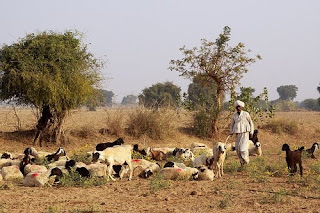
This is how these people pastor sheep. In the daytime the shepherds take their flocks out into the fields, they all come together for the night. As many as five thousand sheep from several different flocks are crowded together. The shepherds take turns keeping watch. Some sleep while others patrol the perimeter of the whole enclosure. The patrolling shepherds bang their staffs and rattle things in the dark to scare away predators or thieves and to reassure the sheep that they are being protected.

We are the sheep of his pasture, the flock of his hand. Think of the all the different voices we hear during each day, clamouring for our attention, angling for a response. Apparently we in the West are bombarded by three thousand advertising messages per day. Add to them the constant clamour of media voices, telling us what we should want, how we should live, how to measure ourselves against everybody else. . . this is the way to insanity! Our task, then, is to learn to recognise the shepherd’s voice, and thus to respond to his teaching; to model our ambitions and our lives on his care, and so to reflect it in all our methods in other words to love our neighbour as ourselves. People look to pastors, ordained or not, for trust, compassion, stability and hope. These fruits are the measure of our work.

Monday, 20 July 2009

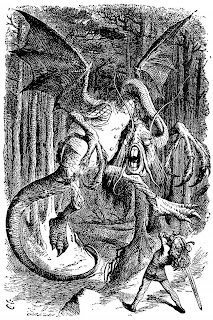
Beware the Jabberwock, my Son

Interesting times battling against “followersfree.com” an evil Twitter Spambot thing! This is a first for me, and, let it be said, entirely my own silly fault. Whilst in the general Twitterstream at the weekend, I noticed a grow your numbers scheme called “followersforfree.com.” This, I thought, was a reincarnation of a similar automated scheme Twitter banned earlier this year which included the ability to follow/ unfollow people en masse. I have at the same time been trying to get round a change in the Twitter display that doesn't show immediately whether you can direct message people you follow, in other words whether they are following you. I thought I’d try and see if this site held some way of getting multiple follow/ unfollow/ people listed, as this is a classic pattern indicative of activity by spammers and the like. Big mistake.

Do not touch this site with a bargepole. The advice Twitter itelf gives is good — never give out details to any scheme that claims to be able to build your numbers. Within minutes I found this evil SpamBot was sending out a message in my name, which had transferred across to publish through Facebook.

I then tried to unsubscribe, and blow me down, it sent out another spam in my name to say I'd unsubscribed. I tried changing my Twitter password, but it kept on changing back! I tried suspending access privileges on my account, but it hadn't got these in the first place. Every time I changed password, out went another evil Spam message!

Twitter has currently limited my acccount’s ability to change password, probably as a reaction to all the gyrations. I am wondering whether the evil bot has some way of changing my password back (I can’t see how that would work). In the meanwhile I need to say:
  1. Nobody else has got infected through this. It's just an annoyance.
  2. There is no evidence this SwineFlu of Evil Bots can touch you unless you go to their site and engage. So just don’t.
  3. Nor is there any evidence that it can infect anyone else through you. It just sends out messages plugging itself as though you had sent them from your Twitter account.
  4. I have now had three clear hours without any message going out in my name — touch wood.
  5. I never did find out how the thing from the Swamp’s unfollow unfollowers routine works.
  6. The story may not be entirely over, but I believe it is for now. I am retreating back to my cave to clean the Exorcist style green puke off my cassock, and rub out a few bits of Jabberwocky spam that got splashed around the place in my name. It's all in a day's work, I suppose, and an interesting learning experience...

Friday, 17 July 2009

Time passing, beloved

A rather marvellous week of silver wedding jollifications with family and friends. Lucy, like me, get a bit embarrassed about ballyhoo, but we did have fun marking a quietly amazing 25 years together. I meant to post earlier in the week this rather marvellous poem by Donald Davie. It first intrigued me as an English teaching assistant 35 years ago, and I always wondered whether I would ever be able to own such words from the inside.

God has been very good to us both, way beyond our deserving.
Time passing, beloved

Time passing,
and the memories of love
Coming back to me,
carissima, no more mockingly
Than ever before;
time passing, unslackening,
Unhastening, steadily; and no more
Bitterly, beloved, the memories of love
Coming into the shore.

How will it end? Time passing and our passages of love
As ever, beloved, blind
As ever before; time binding, unbinding
About us; and yet to remember
Never less chastening, nor the flame of love
Less like an amber.

What will become of us? Time
Passing, beloved, and we in a sealed
Assurance unassailed
By memory. How can it end,
This siege of a shore that no misgivings have steeled,
No doubts defend?

Thursday, 16 July 2009

Harry Potter and the Halfblood Prince

There may be one or two inhabitants of desert islands or Tibetan monasteries who do not know who the halfblood prince is, or which well-known Potter character dies in this movie, and it’s a matter of honour and Britsh reserve as much as common decency to let them discover for themselves. However, if you had forgotten, you will be able to refresh your memory this summer in cinemas up and down the land.

The Potter oevre continues to unfold reliably, with a few touches of fun but no major revelations or amazements this time out. Each separate film is a fresh pearl on the string, or whatever Stockhausen said about tone rows, so as well as consistency it needs development and individual colouring sufficient to stand up alone. In these terms, this film is a bit flatter in tone than some of the series, but will probably not disappoint any but the most diehard Potterholics. One problem is that the climax of this movie, involving death of said famous Potter character, is clearly a set-up for the next outing. In years to come when all six, or seven, films are shown back to back, this will not be a problem. For now it leaves a slightly awkward taste in the mouth. The kids are great, and apparently the Vatican, after a slightly false start branding HP as Satanic Propaganda has now decided he is a Good Thing after all. The Obamas agree. Who wouldn’t? This week we are potion making, so, potion-making fans, you’re in for a particular treat. The kids, of all ages, are brilliant.

Hogwarts is lumbering, however, through embarrased fumbling UK adolescence. As the wand work gets ever more ingenious and competent, our chums become more spotty and sweaty — a unique kind of bottled up, so embarrassed and, well, British, that it should keep the colonials chuckling as they stare in horror at the sheer repressed gormlessness of it all. Some bonkeroid neocon think tanks believe the Caucasian population of Europe is dooomed. One reason non-Caucasians are breeding so voracoiusly, if they are, is that, unlike the middle class Brits, they acquire the skill to ask a girl out before the age of 40. So, Hogwarts ain’t no Casino Royale. Buffy at the same age would have the lot of them for breakfast. But you probably knew that.

The darkness quotient is sufficient unto the day thereof, but probably a tad lighter than last time out. We in our local fleapit, were delighted by a little voice among us at the end of some serious CGI fireworks in a cave piping up and saying “is the scary bit over now?” Even at the tender age of seven, she obviously understands how the genre works. There are a few genuine laughs on screen, too. It’s all very good natured.

Whilst not exactly Christian propaganda à la Narnia, the conceptual and imaginative framework within which the story works continues to be almost entirely Western Christian love, sacrifice and atonement theology. Indeed we learn during this film that there is officially more power in the blood of Harry Potter than in the blood of Albus Dumbledore. Eat your heart out, Billy Graham. The marque is far from exhausted, however, and a big finish will be along in one, or perhaps two, movies’ time. I can’t wait but, sadly, I and several million others will have to.

Wednesday, 15 July 2009

Looking back in joy, forward in hope

Normal service has been a bit slow over the past few days because of our silver wedding anniversary on Bastille Day. The kids mugged us on Saturday with a susprise party in the garden for a few old stagers, we had a day together yesterday. We are really grateful to family and friends who have sent good wishes and even presents. We much look forward, God willing, to an even more cosmic next 25 years. The possibilities are almost as exciting as the ones a French TV commercial implies you get with a certain well-known make of laptop:

MacBook New Feature from COREANOMAC on Vimeo.

Monday, 13 July 2009

What’s really going on out there

Timothy Garton Ash is one of the very few people around with the depth and breadth of historical understanding to produce genuine contemorary history. His new Book, Facts are Subversive, contains short essays, mostly originally written for newspapers, but far too good to let go for tomorrow’s fish and chip wrapping. At this year’s Kirchentag I was struck by the skill, good humour and perspective TGA brought to a shared seminar with Bundeskanzlerin Angela Merkel. He knows his way round the issues of the age, and has real critical insight about Europe (“If the EU were to apply to join the EU it would be refused”) without losing his grasp on the positive achievements of the whole project.

These essays range from big questions of definition and identity (“Islam in Europe”) to well known flashpoints (“The strange toppling of Slobodan Milosevic”, “9/11”) and contemporary predicaments (“Beauty and the Beast in Burma”). His main interests, as Oxford professor of European Studies, have been foreign policy — there is an extraordinary insider’s account of an attempt to brief George W. Bush about Yoorp, and another about Obama’s inauguration. To every subject he brings deft precision, like a peanuts cartoon — inscape in context.

TGA’s standpoint is classically Liberal
. He articulates what the word could and should mean as more than just a hysterical reactionaries’ catch-all ra-ra term of abuse.
Only when we are prepared to allow our own most sacred cows to be poked in the eye can we credibly demand that Islamists, Turks and others do the same. This is a time not for erecting taboos but for dismantling them. We must practise what we preach.
TGA is also highly articulate about the difference between secularism and new model atheism.
I do not believe there is a God and therefore assume that some 2007 years ago a couple called Joseph and Mary just had a baby. But what a man he turned out to be! Like the great Swiss historian Jacob Burckhardt, I can’t get anywhere with Christ as God, but as a human being Jesus Christ seems to me a constant and wonderful inspiration — perhaps even, as Burckhardt put it, “the most beautiful figure in world history.” And some of his later imitators didn’t do so badly, either.
As historians get down to work on Bush foreign policy, TGA draws up a preliminary balance sheet, measured against the administration’s stated aims at the outset. He is no knee-jerk anti-Republican, indeed much of his journalism as I remember from the period tried to encourage people to stand back and give Bush what benefit of the doubt they could. As the roll begins to be called up yonder, however, as a former advisor to Bush, he has to conclude:
In every vital area of the wider Middle East, American policy over the last five years has taken a bad situation and made it worse
He then forensically sketches the whole “amazing bloody catastrophe ” —
  • Afghanistan worse (more dangerous and hospitable to terrorists),
  • Pakistan worse (even more unstable, radical and effective as a clearing station and training camp for terrorists from all over the world)
  • Iraq worse (now radicalised and unstable),
  • Iran worse (newly prestigious, confident and dabbling in WMD),
  • Israel worse (more worried, less secure and self-confident),
  • Palestine worse (with a new radical terrorist government)
  • Lebanon worse (Bush scored an accidental early goal in the Cedar revolution, but latterly managed to muck it all up by undermining the very government he had supported, so, on balance, less stable).
  • Egypt, the Islamists are now scoring at the ballot box as well as with their AK47’s: worse.
The score is 8-1, then. The 1 was Gaddafi. We can credit Bush with a phenomenal performance, especially when his team was the only superteam in the league, with no serious opposition. Again and again, he played blinders, kicking the ball into his own net, stunning the occasional goalkeeper in the process. Hucknall Town played Manchester United and after 90 minutes the score is 8-1 to the giantkillers, 7 of them own goals, and the Manchester goal itself is a cracked and wobbling ruin with bigger holes in the net. Such is the trainwreck courageous and innocent young men and women are now dying to try and recover, as, tragically, horribly, the coffins come home.

For me, the jewels in the crown of this collection, however, are TGA’s essays on Gunther Grass and George Orwell. Most of the pieces are very short. Keep this book for train journeys and occasional reading. Agree or disagree with his conclusions, it flags up the real issues, remarkably consistently for a collection of occasional pieces. TGA lays out in historical order the events and alarums of our age in a way nobody else has yet managed, and I salute it as a tremendous and surprisingly readable achievement.

Saturday, 11 July 2009

Licensed Insanity, or what?

Just capping off thoughts about the God I don’t believe in, whilst on a train I noticed a story online from the New Zealand Herald that definitely belongs in the “Don’t try this at home” tray:

A 55-year-old man who beat his daughter over the head with a lump of concrete when she refused to go to his Mormon church “does not understand what all the fuss is about,” Hastings District Court has heard.

Judge Geoff Rea said on February 22 this year Muliipu had become involved in an argument with his daughter who refused to attend church. He chased her down the street and back into the house picking up a lump of concrete along the way. He then whacked her over the head in a bedroom with the concrete causing skin on her head to split and start bleeding. They were both “covered in blood” and he kicked her in the face causing bruising...

Defence lawyer Roger Stone told the court Muliipu had been angry his daughter refused to go to church. He had been under stress before the incident. He was a “proud” man who was “disappointed” his daughter had elected not to follow his Mormon faith...

Judge Rea said a probation officer's report made “grim reading” because he “still does not understand what all the fuss is about.” He had been ejected from an anger management course because of his views and had an inability to understand “whacking someone on the head is unacceptable.” In the circumstances there was only one response and that was imprisonment. Muliipu was sentenced to 12 months in jail.

Enthusiasm and sincerity are not enough. As Jesus’ scribes and pharisees strugged to see, religious commitment is validated not in its own terms alone, but by its fruits. Put another way, human anger does not work the righteousness of God... Crazy is crazy.

Thursday, 9 July 2009

The God I don’t believe in

Some pastoral disasters, along with many reactions to authority, have an interesting a whiff of Sylvia Plath’s “daddy, daddy you bastard, I’m through” about them. Our images of father figures certainly play out in our images of God, for good or ill. Like the Policeman in the sky, the Omnicompetent Fat Controller the Atheists rightly reject, “Almighty Gawd,” is a long way away from the God and Father of our lord Jesus Christ — more like Blake's nightmare vision of Nobodaddy — manipulative, angry, vengeful, controlling. Nobodaddy deals in Certainty not Clarity, Ideology not Mystery, Status not Reality, Politics not Truth, Control not Trust. He is less than half the truth. He uses words as weapons, not the creative impulse to make the world.

Cue a poem by Martin Bell:
Instruction for my Godson
(To William Redgrove)

God help me, I’m supposed to see you’re told
All about God the Father. So my beard mutters:
There are always two Fathers, one Good and one Bad.
You can always tell the Bad One, he’s always around.
Particularly first thing in the morning,
Scruffy and screaming for a razor-blade,
Wondering who to eat up for his breakfast —
He won’t eat you however much he shouts.
I’m not trying to sell you bad old Nobadaddy,
Learn to shrug off his sessions on his throne
Farting thunderbolts and belching clouds.

The Good One has a different way with Clouds; he watches.
He knows fifty-seven ways at least of looking at them,
He addresses them politely, and his looking
Can hold them still in the sky.
Martin Bell


Wednesday, 8 July 2009

Why ordination? Why today?

I was overjoyed to ordain three stipendiary Petertide priests for Buckinghamshire at St Mary’s Aylesbury on Sunday evening. In an age where everything seems consumer driven, functional and changing, Western churches can easily lose the script about the meaning of ordination. I gave the candidates some words from the Evangelical theologian and translator Eugene H. Peterson:
The pastors of America have metamorphosed into a company of shop-keepers, and the shops they keep are churches. They are preoccupied with shop-keepers’ concerns — how to keep the customers happy, how to lure customers away from competitors down the street, how to package the goods so that the customers will lay out more money.

Some of them are very good
shopkeepers. They attract a lot of customers, pull in great sums of money, develop splendid reputations. Yet it is still shop-keeping; religious shop-keeping, to be sure, but shop-keeping all the same... “A walloping great congregation is fine, and fun,” says Martin Thornton, “but what most communities really need is a couple of saints. The tragedy is that they may well be there in embryo, waiting to be discovered, waiting for sound training, waiting to be emancipated from the cult of the mediocre.”

The biblical fact is that there are no successful churches. There are, instead, communities of sinners, gathered before God week after week in towns and villages all over the world. The Holy Spirit gathers them and does his work in them. In these communities of sinners, one of the sinners is called pastor and given a designated responsibility in the community. The pastor’s responsibility is to keep the community attentive to God.
That last sentence is the great clue to ordination. Peterson goes on to explain exactly what it is people need from ordained priests in our kind of society, and why:
We need help in keeping our beliefs sharp and accurate and intact. We don’t trust ourselves — our emotions seduce us into infidelities. We know that we are launched on a difficult and dangerous act of faith, and that there are strong influences intent on diluting or destroying it. We want you to help us: be our pastor, a minister of word and sacrament, in the middle of this world’s life.

Minister with word and sacrament to us in all the different parts and strands of our lives — in our work and play, with our children and our parents, at birth and death, in our celebrations and sorrows, on those days when morning breaks over us in a wash of sunshine, and those other days that are all drizzle. This isn’t the only task in the life of faith, but it is your task. We will find someone else to do the other important and essential tasks. This is yo
urs: word and sacrament. One more thing: we are going to ordain you to this ministry and we want your vow that you will stick to it. This is not a temporary job assignment but a way of life that we need lived out in our community.

We know that you are launched on the same difficult belief venture in the same dangerous world as we are. We know that your emotions are as fickle as ours, and that your mind can play the same tricks on you as ours. That is why we are going to ordain you and why we are going to exact a vow from you.

We know that there are going to be days and months, maybe even years, when we won’t feel like we are believing anything and won’t want to hear it from you. And we know that there will be days and weeks and maybe even years when you won’t feel like saying it. It doesn’t matter. Do it. You are ordained to this ministry, vowed to it.

There may be times when we come to you as a committee or delegation and demand that you tell us something else than what we are telling you now. Promise, right now, that you won’t give in to what we demand of you then. You are not the minister of our changing desires, or our time-conditioned understanding of our needs, or our secularized hopes for something better. With these vows of ordination we are lashing you fast to the mast of word and sacrament so that you will be unable to respond to the siren voices.

There are a lot of other things to be done in this wrecked world and we are going to be doing at least some of them, but if we don’t know the basic terms with which we are working, the foundational realities with which we are dealing — God, kingdom, gospel — we are going to end up living futile, fantasy lives.

Your task is to keep telling the basic story, representing the presence of the Spirit, insisting on the priority of God, speaking the biblical words of command and promise and invitation.
From the sublime to the ridiculous, I have to record one magical moment — the sort of thing that makes this job such complete joy at times. As we came out of the Church, just the new priests, Rosie the chaplain and I, a photographer came round. “That man,” said David Cloake with his local knowledge, “was the first on the scene of the Great Train Robbery.” “Really?” said Paul Collins, former Police Officer. “I always thought that was Ronnie Biggs.”

Monday, 6 July 2009

Dumb versus Intelligent Conservatism

I used to take the Daily Telegraph seriously. It was sometimes over to the right of the gentleman on the left, but it was good for sport and contained an extensive compendium of what was going on around the place. In a slightly contrarian way, I have always valued Conservative insights as food for thought, even, no especially, if I didn’t entirely agree with their starting points. Neil Davies’ Flat Earth News said significant things about the decline and fall of Fleet Street as a serious source of comment, and this week I noticed one story, nothing to do with religion, that really says a lot about the kinds of dogs to which the Telegraph is presently going.

Screamed the Telegraph story, and I smelt a rat. Is this our old friend “Rape is really the Victim’s fault?” I wondered. When I worked in a prison, I noticed it was the story rapists used to tell themselves, anyway. I never did believe it, myself.

Said the Leicester University press release. Notice, and ponder, the difference. Now you know how the subs at the Telegraph view this subject.

But what of the story itself? As explained by Dr Ben Goldacre, this is what happened. Sophia Shaw, MSc student, conducted some research for a dissertation. The point of making trainee scientists write such things is to learn how to turn tentative preliminary research into disciplined scientific conclusions. She hasn’t yet done this for her, as yet unfinished, dissertation. Turned into a press release, à la Flat Earth News, her work became the germ of the Telegraph story. Not surprisingly, she objects to her work being manipulated and turned into rubbish by the Telegraph for its own idiotic purposes.

Looking at hot button issues, let’s turn to the grand-daddy of them all, the gay issue in Church. I turned not to the Telegraph, but to Cranmer, for a genuinely perceptive, intelligent Conservative take:
...dear readers and communicants, homosexuality is not an issue worthy of schism: it is simply not of the order of the sort of debate that used to divide the Church: the divinity of Christ, for example, or the nature of his humanity – the great controversy at the Council of Nicea in AD325 – or even over liturgy or the transforming nature of infant baptism. The issue of homosexuality affects only a tiny minority of its adherents: it is of distinctly secondary, even peripheral, scriptural importance.

The role of the Bible in addressing the modern question of the place of the homosexual in the church is complex, not least because where it is mentioned in Scripture, the authors give little sustained consideration of the issue as it manifests in the modern world. The nature of a biblical perspective will invariably be affected by the questions posed of the Bible, by the particular hermeneutic employed, and by the unavoidable perspective which each scholar brings to his or her reading of the Bible. While some may have an instant negative reaction, others seek to understand the debate in the different and changing circumstances in which we now live. Still others, who may identify themselves as homosexual Christians, struggle to express either their feelings or their thoughts on the issue. They are themselves divided into those who acknowledge that homosexuality is a sin and therefore a call to celibacy, and those who assert that they also are made in God’s image and therefore seek to express their sexual desires in an intimate, monogamous relationship.

That God established an objective, moral order in creation, and continues a work of re-creation through Jesus, is a source and standard of all that it beautiful, good and true. If such a moral order means anything, there may be no via media on the issue of homosexuality. Accepting theological diversity is not the same as tolerating all beliefs and practices, because ultimately the Church is called to be holy because God is holy (Lev. 19:2; Mt. 5:48). We cannot as Christians just give way to ‘you believe this, I believe that’ approach to being together, or moving apart, in the Church. Nor even can we be content with the rather cheap model of ‘reconciled diversity’, meaning benign tolerance, which many Christians find an easier option to the costlier pursuit of real, ‘visible’ unity. We need to continue to struggle together for the truth, to find the right and godly balance between the call to solidarity and the recognition of difference. Presently, nowhere is this more important – especially in the Anglican Communion – than in the area of sexuality.

But Cranmer is persuaded that the whole issue may really be a non-issue because the wrong question is being asked. His Grace posited a few days ago that the modern era is sex-obsessed: we live in a consumer society, and there is little that is marketed without a glance, a wink, a flirt, a breast, or allusions to sexual intercourse, because ‘sex sells’. If one were to judge by the media (which is more frequently a mirror to society than a catalyst for change), the fascination with people’s sex lives is now more important than politics, religion, philosophy or even Mammon. Jesus may have had to address the latter as the dominating idol of his era; his judgement was that one may not serve both God and Mammon (Mt. 6:24). But he did not enter into discussion on the fiscal minutiae of cash, credit, bonds, shares, loans or interest; a macro-warning not to be obsessed with Mammon was sufficient. If one were to apply the same principle to the modern idol – ‘Eros’ – it is doubtful that Jesus would address its sub-divisions (gay, bi, straight, oral, anal, tantric); he would most likely directly challenge society’s obsessive fixation with Eros, and by so doing confront both those who prioritise issues of sexuality and those in the church who presume to judge them.

By devoting so much time and effort to the ‘gay issue’, instead of challenging society by deconstructing the question or focusing on poverty and wealth (for example), the church is simply showing itself to share the same obsessions as the world. Paul allowed no compromise on the restriction of sexual activity to heterosexual, monogamous marriage. But such an ethic seems almost utopian to our sex-besotted age, in which it appears at times that one’s identity is made to reside in one’s sexual organs and their untrammeled exercise. The issue for the Church of England is that this debate has been blown out of all proportion; it is neither a battle for the soul of the church, nor an issue worthy of schism. It is a question utterly peculiar to this era, and those on both sides of the divide – both politicians and theologians – might consider toning down the rhetoric and the apologetics, and instead preaching a message that, contrary to society’s thinking, sexual expression is neither a necessary line of inquiry in every human interaction, nor an essential component in human fulfilment.
If, as is suggested here, we do indeed live in a society which has a basically gormless, obsessional, and corrupt over-sexualised self-image, playing along with its assumptions about how these things work is less than the best we can do. Church has to position itself somewhere other than as the thrower of custard pies from the midst of the fray, whether from right to left or left to right. Rather it exists to bear witness to the Scriptures and our tradition — a deeper, richer, more ancient and meaningful wisdom. We offer it as a resource to our society, which it may care to take more seriously when it has had enough of its current obsessions and becomes seriously interested in human beings — a truer, more humane vision of what we could be than simply whizzing down the slide, as Philip Larkin used to say “like free bloody birds.”

I have also been chortling over the Archbishop’s recent run in with Facebook, who took a dim view of His Grace’s ecclesiastical title, whilst simultaneously allowing that old scoundrel Cardinal Wolsey to keep his. After a surreal correspondence with various cheery FB Sockpuppets, in the best traditions of cussed Englishness, His Grace refused to take the sleight lying down and set himself up with a new account in the magnificent name of “Ayatollah Cranmer.” Right wing, but fun. Inexplicably, he was allowed his new moniker. Draw your own concusions...

Sunday, 5 July 2009

Intex: A bigger splash

Now in its third year, the splash pool is turning out to be the best £150 we ever spent on eBay. With clergy family barbecues coming on, our whole family extends a cordial welcome to its other afficionados, hoping the weather this year will be up to it. With new solar heating the water has reached temperatures of up to 32 degrees recently, four or five degress higher than it ever managed with its original 7Kw electric heating.

With school friends etc,. it gets hours of use many days. One first this year was adoption and families workers on a staff day here using it for a teambuilding game with paper boats. On a cloudier Sunday, I just wanted to try and convey the full solemnity of the naturally Anglican way our children have been interpreting the instructions printed in six languages on the side, about not jumping in:
Related Posts Plugin for WordPress, Blogger...