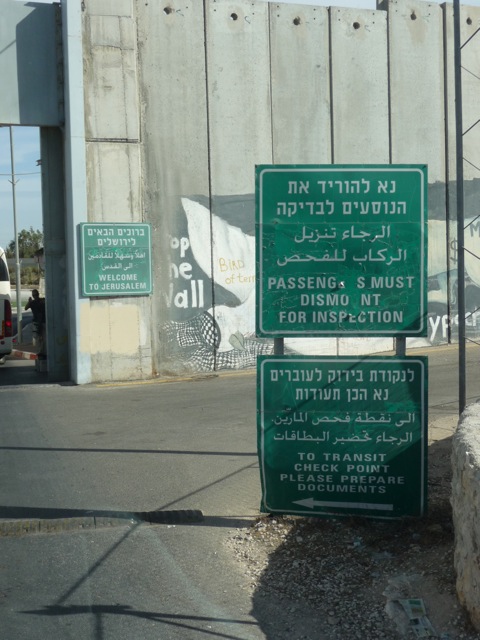
From the joys and strains of pilgrimage, and a greater pilgrimage to follow? I must remember to leave a couple of days R&R after my next ten days without a day off. Still a bit pie-eyed, here’s a final selection of pictures, from a glorious dawn over Jerusalem to a Cat up Mount Zion who reminded me of the legendary Marcel, whom Lucy and I met out here in 1983. Compare Max the Cat, shortly after my return.


There is a special challenge in doing a Holy Land pilgrimage. We all have a Jerusalem of the mind, which we carry around in us as we imagine the stories of the Bible. Its sites are strangely shapeless and placeless, rather like a theme park where everything relates to everything else, but nothing is really anchored in the place on earth it is situated. For many Western Europeans this Jerusalem of the mind is a place of quiet contemplation, Zeferelli religious picturs, and a clear focus on Jesus.

Then there is the Jerusalem below, as is — heaving with noisy heedless people, its historical stones hacked about, hot, contested and disordered — the last place a half decent Messiah would show up. Somehow these two realities have to be brought together, and that is especially difficult to do when good Christians bicker and squabbe over their shares in the real Holy Places, seeking to impose their cultures and expectations on the raw material like cats marking lamp posts.
Everybody claims some unique correctness. everybody is both right and wrong. Each has their own particular expression of some facet of the truth, but imagine for a moment that God’s will is being done in what is actually here, and no religion or denomination exists anything but cheek by jowl with all the others. If ever God meant there to be one infallible Big White Chief, or Book, or story, or organisation the kindest one can say of him, with Woody Allen, is that he is something of an underachiever.

Or perhaps it is all meant to be messy, and every expression of Christian faith provisional — good for what it is good for, but bound up in its own culture and history. Including us. Including everybody. The Word chooses to become incarnate in human cultures, in the real world. It is the only way we can know him. Our only response can be wonder, humility and realism, not imperial pretension, idolatry of dogma, or Disneyland religiosity. The reality that inspires the former is our best antidote to the latter, and it is there to give us the strength to travel on in faith, not sight.

 From the joys and strains of pilgrimage, and a greater pilgrimage to follow? I must remember to leave a couple of days R&R after my next ten days without a day off. Still a bit pie-eyed, here’s a final selection of pictures, from a glorious dawn over Jerusalem to a Cat up Mount Zion who reminded me of the legendary Marcel, whom Lucy and I met out here in 1983. Compare Max the Cat, shortly after my return.


 There is a special challenge in doing a Holy Land pilgrimage. We all have a Jerusalem of the mind, which we carry around in us as we imagine the stories of the Bible. Its sites are strangely shapeless and placeless, rather like a theme park where everything relates to everything else, but nothing is really anchored in the place on earth it is situated. For many Western Europeans this Jerusalem of the mind is a place of quiet contemplation, Zeferelli religious picturs, and a clear focus on Jesus.
 Then there is the Jerusalem below, as is — heaving with noisy heedless people, its historical stones hacked about, hot, contested and disordered — the last place a half decent Messiah would show up. Somehow these two realities have to be brought together, and that is especially difficult to do when good Christians bicker and squabbe over their shares in the real Holy Places, seeking to impose their cultures and expectations on the raw material like cats marking lamp posts.
 Or perhaps it is all meant to be messy, and every expression of Christian faith provisional — good for what it is good for, but bound up in its own culture and history. Including us. Including everybody. The Word chooses to become incarnate in human cultures, in the real world. It is the only way we can know him. Our only response can be wonder, humility and realism, not imperial pretension, idolatry of dogma, or Disneyland religiosity. The reality that inspires the former is our best antidote to the latter, and it is there to give us the strength to travel on in faith, not sight.