Showing posts with label Crime. Show all posts

Saturday, 22 May 2010

India: Legally Hung Over?

My children are amazed as I tell them I worked in a prison long enough ago to have met a clergyman who had officiated at a hanging in England 30 years before I knew him. I remember there being an execution suite in HMP Wandsworth in the 1980’s, just in case.

“Suspended sentences,” as one POA wag used to call them, struck my children as an extraordinary survival from an age of barbarism, like witch trials or the Iron Maiden. I promise my children, to stares of disbelief, that this grotesque carry-on, happened (but only just) in my lifetime, and was only finally abolished in 1998.

But there seem to be two distinct ways to abolish the death penalty. You can pass laws, as in the UK, or just leave it to the moral instincts of potential hangmen. In India no-one is willing to do it any more, according to this week’s Delhi Open magazine:

In Pune’s Yerwada prison, there are 11 convicts who have been condemned to death by hanging. Kept in solitary confinement in the barracks close to the gallows, some of them have languished there for nearly a decade. Their mercy petitions have been rejected by the President. But it is unlikely that they will be hanged anytime soon. Maharashtra does not have a hangman. The two prisons in the state where hangings are carried out—Yerwada and Nagpur Central—have sought executioners from other states but no one has responded. It seems there are no hangmen in the country. They are all retired or dead.

To kill a man, the Indian Government pays Rs 150. The job of a hangman is not a full-time government post. He is a sanctioned volunteer, his pay a special allowance. Hanging involves techniques and procedures very simple to learn, simpler than probably learning how to drive a car. Senior police officials are willing to teach them to anyone who comes forward, but no one does.

Officials at various central prisons across India confirm that they are unable to find hangmen even though the candidate need not have any previous experience, nor does he have to be literate. It is a strange situation in one of the few countries in the world that still have capital punishment. India has about 300 prisoners on death row.
For the princely sum of £2 a go, you’d think someone would be interested, but apparently people are afraid of stoking up bad karma. In a sudden rush of public disgust at terrorist attacks in Madhya Pradesh one man actually came forward and offered to hang Afzal Guru. Unfortunately he was 82 years old, and died before the job could be done. So, with a whimper rather than a legal bang, hanging seems to be finally on the way out in India.

Funny Old World.

Friday, 18 December 2009

HMP Grendon: What is easier?

We light a fire and hunker down with a houseful of children and friends. Last trip out before Snow closed in was the annual Carol Service at HMP Grendon. This is the only UK Psychiatric prison, founded in 1962. The service was devised by Keith Salter, Co-ordinating chaplain, and led by Major Bert Roper of the Salvation Army. It was good to catch up personally with one or two prisoners I remember from two years ago at this same event.

Each of its six wings operates as a therapeutic community, under competent psychiatric supervision. This is a specialised approach that wouldn’t work for every prisoner, and it has its misses as well as hits, but the fact is it often actually sorts out people’s lives to go straight. Grendon 2-year reoffending rates are dramatically lower than usual for English prisons — as much as ten times lower. Fewer criminals, less crime suits me and, you might think, when you consider the terrible personal impact of crime on innocent peoples’ lives, everyone else. But you’d be wrong. Grendon’s work can be vulnerable to misunderstanding and frustrating limitations:
  1. Decent people feel naturally disgusted and angry about serious crime — punishment is very much one reason people are, rightly, deprived of their liberty in prison. But after we have all got angry, it’s time to get even, and to protect ourselves for the future. Grendon’s therapeutic approach can be caricatured by ignorant journalists as a soft option for hard people. Actually most inmates find it considerably harder work, some would say a fitter punishment, to have to confront and work through the roots of their wrongdoing and grow up, than just become designer criminals who won’t take responsibility for behaviour or attitudes. Civil Servants and politicians, however, don’t always have the moral courage to stand up to some of the more ignorant and strident media voices — result = more criminals and higher crime.

  2. Experience of prisons, on and off, over twenty years has shown me that when times are financially tight resources tend to go into security, ideologically driven restructuring, and media stunts. Ther’s little left for the labour intensive régimes that dedicated professionals use to turn criminals straight. There are Nordic societies where they have almost abolished conventional imprisonment, with crime rates a tiny fraction of ours in the UK — but until we have the wit and courage to be more pragmatic in our response to crime, it’s porridge for us all, in a way...
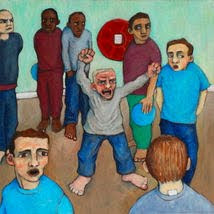
h/t Art collected by the Koestler Trust
Reblog this post [with Zemanta]

Wednesday, 5 August 2009

Humans go free: whales start family

Two and a half cheers among the locals here today. One big cheer for Bill Clinton, on the news that Laura Ling and Euna Lee are to be released by the North Korean Government, having been imprisoned since March 17, and sentenced in June to 12 years hard labour. As well as good news for the people concerned, this marks another stage in the redemption of Bill Clinton, who left office under the slimy weight of a load of Slick Willy stuff that was doing nobody any good, not him, nor the country. Former presidents married to secretaries of Statedo seem to reach the parts others can’t. I noticed some Yellow ribbons out on some streets in Chicago today.

For those requiring any other excuse to dance for joy int he streets today, cometh the news that two beluga whales at the Shedd aquarium here in Chicago are confirmed pregnant — Puiji (23) and Naya (21) are now looking forward to the joys of 14/16 months pregnant. That and no drinks or smokes...

Finally, a couple of baby boomers were telling me they were feeling slightly weirded out over the news that Squeaky Fromme will be out of jail soon. Paid up Baby Boomers will remember Squeaky as a member of the Manson Family. When I first visited the States almost 30 years ago, the local coroner had just published his memoirs of the Sharon Tate murder. It’s now 37 years since Charles Manson picked the young Lynette Fromme up on Venice Beach. After the Manson murders, she added the slightly abstruse crime of attempted presidential assassination, after taking a pop at Gerald Ford. She also jumped jail int he late eighties, and that added time to her sentence.

Have a nice day!

Saturday, 4 July 2009

Hoovering up Crime and Johnny Depp

Public Enemies, like every gangster movie, contains dirty rats, and requires us to be sufficiently open to a Robin Hood point of view to hope secretly that the dirty rats get away with it. We are fascinated by damaged people and evil, but faintly slimed for taking an interest at all. Actually we know the world would be an infinitely nicer place without Bonnie and Clyde, or whoever, but can’t help wondering why they did it. We identify with them as a means of reassuring ourselves we are really not at all like them. And people, especially sixty years ago, loved to see authority made an occasional monkey of, as long as we don’t get mugged on the way home. That’s where the fun and fascination would end.

For those who miss James Cagney Jr and wonder when comes such another, Public Enemies is a beacon of fun and hope. This movie is tough and occasionally nasty, repellent but not revolting. Some may not even notice Michael Mann’s decision to make the movie on HD Video rather than the stuff you take to the chemists, but I was fascinated by the result.

With HD-V there's more detail on the plate, and what I can only call a slight dark steel, bluish sheen around night scenes in the woods or down the dives of Chicago. Lighting the movie was a challenge — the best boy must have enjoyed the experience. I hazard a guess that low available light registers more readily and across a different part of the spectrum on HD-V. The whole effect, which ought to look more natural, actually looks more contrived, but approprate. It’s grittily detailed, ideal for old time dirty rats, and the dolls don't have the slightly airbrushed look Celluloid gives them. The result is rather documentary, an impression reinforced by the use of steadicams and low angles, putting us where the action is.

Johnny Depp does his rough diamond thing perfectly. Cap’n Jack Sparrow had a streak of Ronald MacDonald that was fun for about ten minutes but wore a bit thin over two hours with people over 12 years old. Depp’s Dillinger is an altogether deeper and more complex kind of psychopath. Marion Cotillard plays the faithful Moll faultlessly, providing excellent and absorbing chemistry between the principals.

Much as we know that the whole ruddy lot should be strung up, we are glad to come along for the ride
, even with its repellent occasional violence, and slightly sorry when it’s over. That’s the sign of a first class gangster movie.

Placing itself in historical context, the film stays clear of O level sociology, and wisely majors on characterisation. J. Edgar Hoover is, like everyone else in this film, perfectly sketched — a scientific beureaucrat struggling to organise clearing raids into a jungle where the public representatives are as dodgy as the public enemies. Christian Bale is the sharp end of the feds’ operation. He’s sincere and occasionally frustrated to find himself as one of the good guys, unable to be as nasty as the bad guys. Amidst a sea of clean-cut but essentially expendable G-men, his Agent Purvis conveys, perfectly, a sense of being a brighter man than his profession requires him to look.

None of this is revolutionary, on a narrative level, but it’s perfectly executed and it works. If your idea of summer fun is Year One or Hannah Montana this will not float your boat. For those of us who prefer Dark Chocolate to Milky Bar, Public Enemies is absorbing, well-paced and characterful. For all the film’s occasional nastiness, it’s reassuring to know the midwest is not as flat and boring as some people say it is, and Dillinger’s appearance of fortuitous invincibility was, after all, an illusion. At a visceral level it’s always fun in a depression to see big banks treated with the contempt they deserve. As you see pretentious senior bank managers haplessly fumbling in terror to open the safe for Dillinger, people this side of the pond can think Fred the Shred. I hate to admit it, but the sight is sweet. For overseas readers, Fred is the real-life character who walked into a bank and got away with several million in a way Dillinger could only dream about, and was rewarded with a knighthood and pension on a desert island. But that’s another story, too improbable for a movie.

Tuesday, 6 May 2008

Swinging Sixties bring moral meltdown

Remember the sixties, when the rot set in? The white heat of new technologies began to transform Britain, but brought its own decadence and troubling signs of a moral meltdown. With young royals misbehaving themselves in public, new fashions transformed London into a world capital of chic, but the drug scene bloomed. Dodgy detectives began to swing round the City as a law unto themselves, and the public began, for the first time, to feel real disquiet about police and other public institutions. The Church lurched from crisis to crisis. Attendance slumped, and a quarter of the bishops boycotted the Lambeth Conference. The other side of the pond, the age was defined by an assassinated president. Terrible decade, the Eighteen Sixties.

The decadence started with the Road Hill House Murder, a dark tale of family breakdown, involving a toddler with his throat cut, hidden adultery and psychotic teenagers. The new media feeding frenzy that followed gripped the nation. Tractarianism played an integral part in the person of A. D. Wagner, the priest who made Anglo-Catholicism the London, Brighton and South Coast religion.

Kate Summerscale has now brought the whole sordid affair to life, with a deft hand and clear eye. Using contemporary records and later revelations over the next eighty years, she lifts the stone on the whole frightful business. Real Life makes the Woman in White look like a Sunday School Outing. It’s a rollicking good read, though unsuitable for urchins, lunaticks and domestic servants. Fortunately most of them can’t read anyway.

Monday, 21 April 2008

Would the Birdman do his Bird in MK?

Woodhill prison, chairing a board to appoint a new second chaplain. Alan Hodgetts and multifaith colelagues are doing great work together. I was also struck by the good humoured commitment of staff to running a safe and non-abusive, occasionally high stress environment.

The staff are magnificent. What’s wrong with our prisons is the fantasy surrounding them. Woodhill is sometimes ludicrously described in the media as “Britain’s own Alcatraz.” Just in case your editor is too dim to know the difference, Alcatraz is on the Left, & Woodhill below.

Perhaps the next phase of our glorious prison building programme could involve digging a replica of San Francisco Bay around it. We could import pelicans, fogs, and greased up Clints swimming up and down dodging the sharks, etc. It would only cost 2 or 3 billion pounds. Oh and we could mount severed heads on the gate — only you'd need crowscares, or the magpies get ’em — if that happens your heads are soon rubbish, and crime soars again. Oh and we could moor rotten hulks in the bay, with broadcast groaning day and night. Then it really would be Britain’s Alcatraz. State of the art in 1934, the real Alcatraz was obsolete by the mid sixties.

Ludicrous fantasy pretty much colours what Fleet Street imagines should go on in prison. Historical experience is that once you have prisons, you fill ’em. The UK government actually plans to build more; and now recidivism is back around its historic 70% rate in the system, this can only increase the amount of crime on the streets long term.

The only silver lining I can offer is the discovery, thanks to Maggi Dawn, of a fantastic blog by Anne Droid (The Reverend), Scottish prison chaplain teasingly called Get out of Jail Free. The names have been changed to protect the innocent. It’s a kind of reality checkpoint amidst all the idiot fantasy about prison. Go read it, particularly her stuff on forgiveness...

Wednesday, 2 January 2008

Spy vs Spy?

Privacy International monitors the extent to which personal privacy is vulnerable in different countries around the world. The UK is right up there in the superleague of “endemic surveillance societies.Lagging far behind are countries like Germany, Belgium, and Italy. Greece and Romania hardly score anything. We just manage to beat the French, which will be a comfort to some. The UK has the lowest ratings in the world, alongside Singapore, Russia, China, Malaysia and the US.

Governments photograph and snoop on individual people, of course, to keep everyone safe from crime and terrorism. This is obviously sometimes necessary. But hang on; It is simply not significantly more dangerous out on the streets of Luxembourg, Greece or Portugal, than those of Russia, the US or, come to that, the UK. We experience far higher rates of crime and terrorism, along with our superleague companions. Of course there’s an element of chicken and egg about this. We experience crime that has to be fought, so we tighten up on everyone. But I wonder:
  1. Where and how does this process of progressively spying on everybody end? At what point could we break into the cycle of fear inducing more intrusive security measures that inspire more fear, and how? Or is the whole process just inexorable, until we all really end up in a kind of 1984 state?
  2. Security strategies aimed at containment can work well in short term and immediate ways. But what are the positive factors that enable many other countries to protect personal privacy better, whilst at the same time enjoying a higher underlying level of public safety?
Answers, on a postcard?

Wednesday, 17 October 2007

Children in Prison — killing Cock Robin?

England & Wales now leads Europe and is rising fast in one of the most bizarre global superleagues — the number of Children in prison, reports the Howard League.

The numbers are shameful and increasing. Despite a 44% decline in crime and no evidence of any increase in crime committed by children, we lock up far more children in England & Wales than any other country in Western Europe. In 2005 we jailed 2,274 children, compared to 1,456 in Germany, 628 in France, 73 in the Netherlands, and 9 in Norway. The latest annual England & Wales figure is 3,012.

You can blame the government, and we probably couldn't produce such depressing figures without rudderless initative-itis in our criminal justice system, along with structural anti-family bias and discrimination in all areas of social policy.

You can blame some elements in the media, before whom the government walks in fear, who weep crocodile tears about child abuse, peddle soft porn, whip up fear, and use children to make money whilst robbing them of their childhood.

But the real answer has to be... ourselves. We get the governments and media we deserve, and if we don't like the children our unrelational, often anti-relational, society is producing we need to look long and hard in the mirror first, and ask what has to be different, and where does the change have to start?

Tuesday, 11 September 2007

Child protection in the real world


Out on the road today I caught an amazing programme on Radio 4. In The Choice, Michael Buerk carefully and honestly examined child abuse within a family. Claire and Ian's was an awful story, involving a substantial prison term and sustained rehabilitative work with the Lucy Faithfull foundation. Everyone involved had been to some terrible and disturbing places. What shone through was how the family really prioritised their daughter at every point, and were trying to build an honest future together, with courage and realism.

It's an extraordinary piece of radio, cutting through the pretending and hysteria that sometimes surrounds this subject. Anyone who is serious about the realities of child protection would do well to hear it, and think through the practical and moral issues it raises. It's on the BBC Listen Again Site, here.
Related Posts Plugin for WordPress, Blogger...