
 We speak often about Pastoral Care, but what do we mean? I was struck, visiting St Francis of Assisi Terriers, by the Gospel, where we are told Jesus saw the people as “sheep without a shepherd” an image drawn from the Old Testament. Ezekiel the prophet saw the whole people
wandering aimlessly on the mountains and high hill… scattered over all the surface of the earth; with no one to search or seek for them.Jeremiah 23 34 introduces the great promise of the Messiah, a righteous branch of Jacob, thus:
I myself will gather the remnant of my flock out of all the lands where I have driven them, and I will bring them back to their fold, and they shall be fruitful and multiply. I will raise up shepherds over them who will shepherd them properly, and they shall fear no longer, or be dismayed, nor shall any go missing.
 There is a deep hinterland to Jesus’ proclamation “I am the Good Shepherd; I know my own and my own know me; the Good Sepherd lays down his life for the sheep”
The prime willingness of the shepherd is to take responsibility — to centre attention and work on the needs of the sheep,
 not the shepherd; freely to give time, loving attention and care. Clergy and other ministers do all sorts of good things and bad things, noble things and silly things, but should you observe any of these characteristics in anyone in a pastoral role, don’t ignore it:
- Be very afraid of pastors who have may faults, but being wrong is never one of them.
- Be very afraid of people in pastoral roles, for whom everything that happens in their lives is about themselves, not the other people involved.
- Be very afraid of people in pastoral roles who blame everyone else for their messes.
 I remember when I was in my late twenties having a minor scrape in the car and going to amazing lengths mentally to convince myself it was all the other person’s fault. It was a learning moment. Fault is rarely simply with one side or the other, but all of us need to learn how to accept responsibility for our feelings and acts, before we can go on to the basic willingness to accept responsibility which lies at the heart of any pastoral calling
And what of God’s shepherding for the sheep of his pasture the flock of his hand? Well, unless you have a few handy sheepdogs running round and round in circles, you can drive cattle, but you have to lead sheep. If you wave your arms about and make a noise at sheep, they become worried and run away. Drive them, their instinct is to spread out and there’s a great danger one or more will bolt.
“The Lord is my shepherd. He leads me to green pastures; he leads me by still waters.”Many things drive us and pressurize us, especially in the high tech, litigious competitive South of England. Not God. And, I hope, not Church either. It’s important to remember this because there is a human tendency to create a god in our own image.
 Round here, that false god will often take the form of a demanding angry maniac, who doesn’t tolerate mistakes and works himself into a right old lather driving people to ever greater heights, usually, especially if we are Male, new heights of pretending, fantasy and BS. The False God will also, like as not, be a religious maniac.
 There is absolutely no evidence that the God and Father of our Lord Jesus Christ is any of these things. He leads where he has been before; he does not drive us. Therefore we are invited to follow him. There is no question of driving us or bullying us, playing hardball, or sorting us out. Just love. I am the good shepherd, says the Lord. My sheep know my voice.
 Here’s a picture of a pastoral community on a journey — Rabari nomads of Gujarat. What has this model to say about how we do Church as a pilgrimage, not an institution? Pilgrimage is the classic image of the people of God in the Old Testament, desert wanderers.
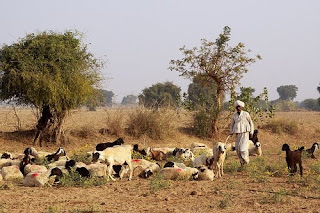 This is how these people pastor sheep. In the daytime the shepherds take their flocks out into the fields, they all come together for the night. As many as five thousand sheep from several different flocks are crowded together. The shepherds take turns keeping watch. Some sleep while others patrol the perimeter of the whole enclosure. The patrolling shepherds bang their staffs and rattle things in the dark to scare away predators or thieves and to reassure the sheep that they are being protected.
We are the sheep of his pasture, the flock of his hand. Think of the all the different voices we hear during each day, clamouring for our attention, angling for a response. Apparently we in the West are bombarded by three thousand advertising messages per day. Add to them the constant clamour of media voices, telling us what we should want, how we should live, how to measure ourselves against everybody else. . . this is the way to insanity! Our task, then, is to learn to recognise the shepherd’s voice, and thus to respond to his teaching; to model our ambitions and our lives on his care, and so to reflect it in all our methods — in other words to love our neighbour as ourselves. People look to pastors, ordained or not, for trust, compassion, stability and hope. These fruits are the measure of our work.


