Showing posts with label Vision and Values. Show all posts

Friday, 14 May 2010

Christian values in Germany

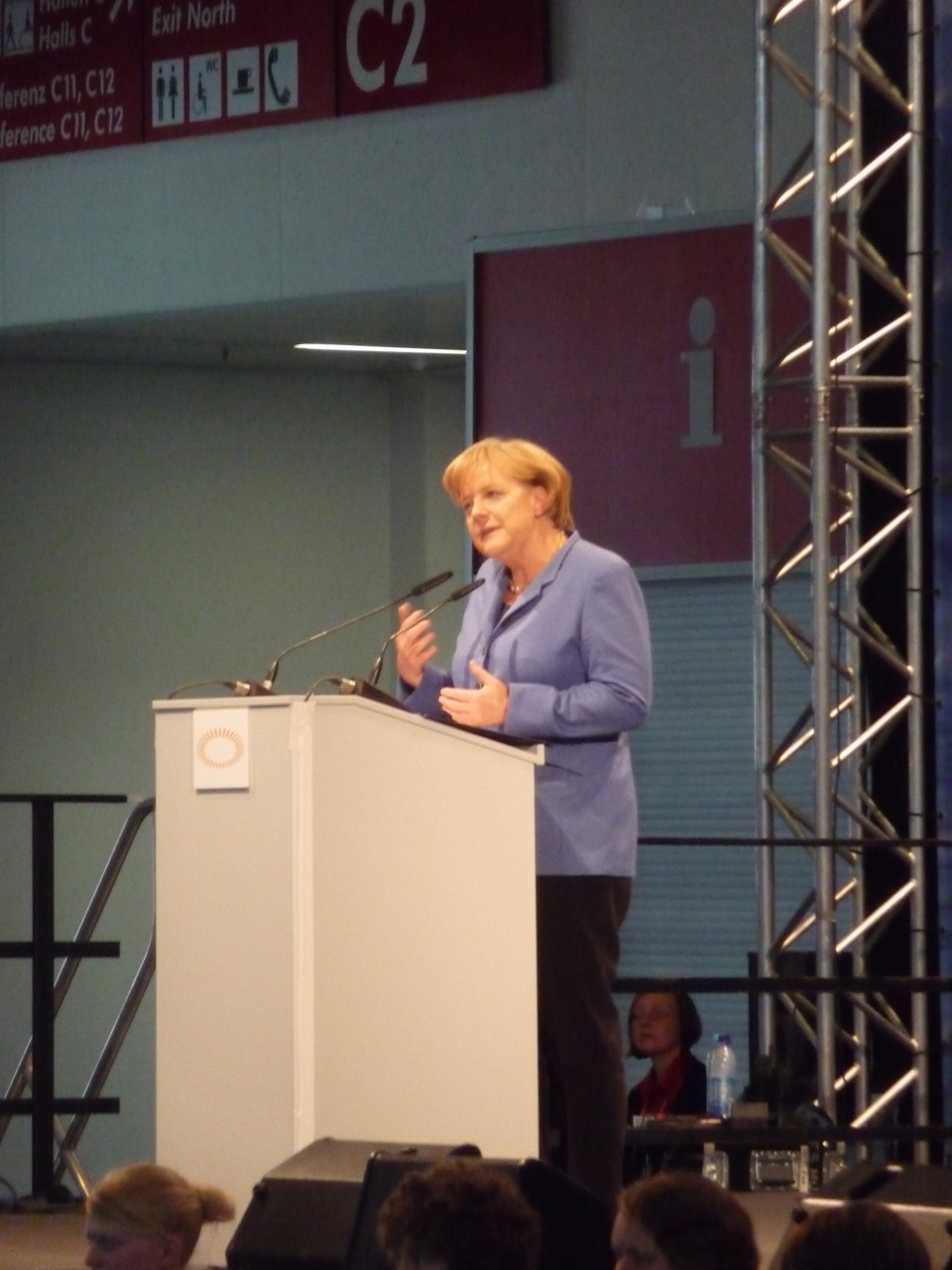
Christianity is a fundamental root of societal values in Germany. Official. I just heard it from the Bundeskanzlerin herself. Speaking in Munich to 6,000 people, the Prime Minister of the largest democracy in Europe acknowledges freely and imaginatively the significance of Christianity as one of the great root of her country’s social values. She is not saying these humanistic concepts could not have been developed in other ways, but the fact is it was from and through Christianity that they have been.

Here in Bavaria there is a refreshing absence of crude secularist rant, along with scare stories got up by the right wing press to suggest that any departure from Victorian morals and dogma means the end of Christianity and ruin of society. Those fears and fantasies are expressed on the margins of society, where they belong.

Neither do I detect the lazy old English idea you “leave morality to the bishops”. Mrs Merkel calls for a dialogue between churches and society, where both engage closely and bless each other and are willing to be changed according to their values and experience — so no crude monopolies of truth, no slippery slope panic, no fear that engagement between churches and society will corrupt the Churches or Confessionalise the State. Freedom is a Christian value, but not egoistical freedom from taking responsibility. Christian freedom is the use of possibilities to follow values as a way of supporting others — another one of Mrs Merkel’s core Christian values.

All she is saying is that there needs to be respect, realism, self-awareness and truthfulness. In this context, Mrs Merkel is just announcing €60Bn of cuts between 2011 and 2015, asking around various possibilities. She isn’t claiming a godlike command of all possible answers, but owning up to a serious problem, addressing pragmatic reality, asking for hep and obviously winning some respect for her candour. How refreshing! How grown-up!

Politicians, even controversial ones with cuts to announce, seem to be held in higher respect in Germany. Wondering why I am told they have a more realistic mandate from a more fully democratic voting system, and that there is a higher value of corporate civic life here. They are not thought to behave that much better, but they are held to account more tightly over their views as well as their expenses. They have to treat people more like grown ups, partly because there is a very direct relationship between how many votes and how much power. There is often a higher degree of historical awareness and pragmatism, with less simple sloganising. By comparison, much UK debate about Church and society, such as it is, simply bears out the old maxim that Clichéd words reveal clichéd thought. There has to be a better way!

Wednesday, 13 January 2010

Bullying, Bureaucracy, Vague Values?

Do we need a load of bureaucracy to tackle workplace injustice? At heart I am a swashbuckling Cavalier, who would like everything as easy as possible. Too much bureaucracy can actually foul up a process with excess semi-relevant information, and procedures that paralyse action. Ask any police officer. Maybe Bureaucracy is just a standard human activity, like politics, cooking, sex, or religion. If so, there’s good bureaucracy and bad bureaucracy. Small and effective beats big and cumbersone every time. At its best, like electricty in a home, you should be unaware of bureaucracy as a thing in itself. It should just be working away in the background. Ye shall know how good or bad it is by its fruits.

There’s something disturbing about playing off trust against audit trails. Up to the 1850’s you could be a doctor in England by self-definition. Today doctors have to go to medical school and pass exams. There’s far more than a bit of paper involved in the healing art, of course, but the paperwork actually increases, not reduces, my trust when I go to the surgery, as well as reminding my doctor of the story so far. Medical standardization mustn’t stifle creative research, or, even more importantly awareness of the patient as a person, but without some standardization we’d be back where we were in the 1850’s.

How vague are the positive values I suggested were the antidote to cultures of fear and intimidation — diversity, equality, respect? Call them anything you like, but
  1. the logic of the Day of Pentecost implies the Church isn’t meant to be definitively homogenized around any particular culture, but incarnate in many cultures. It takes a whole world truly to know Christ.

  2. Jesus had strong views on equality: “call no man Father, for you have one Father and you are brothers.” This was no incidental soundbite, but the cornerstone of a new philosophy of leadership that was not optional. Where the institutional Church has not been wholehearted or disciplined at implemeting that philosophy, it has suffered.

  3. Respect, or the Golden Rule, is the centrepiece of the Sermon on the Mount. Niceness and good intentnions are no kind of substitute for justice. Ask the prophet Amos. His standard is the plumb line, and applying that standard doesn’t happen by accident.
Actually, I don’t see anything vague about these values at all. Life is full of practical opportunities to apply them. What’s truly vague is assuming “anything we do is bound to be OK because we are, after all, the Church, and we’ve been doing it for years...” A Church that is always being reformed has to be healthier than one that thinks it’s arrived.

I think the best way of defending the Church is for it to be authentically and recognizably walking in the way of Jesus Christ.

That means putting in serious, intentional work to focus on and apply these simple gospel values, in ways that can be measured. This involves rejecting deceit, self-deception, corruption and manipulation in our life together, in any practical way that presents itself. And a Church which is always being reformed will, by grace, come closer to being what it was called to be. It will be more missionally attractive than one that is content simply to coast on, with occasional kicking and screaming when it’s caught out.


Reblog this post [with Zemanta]

Saturday, 2 January 2010

Accounting for Everybody

Most of us like to think we believe that people matter more than things. Archbishop Rowan’s New Year message in 2009 challenged us to be more honest and consistent about this belief. Taking as his starting point the story of Laurence the Deacon, who told Roman authorities that the poor supported by the Church were its treasures, he asks
What would our life be like if we really believed that our wealth, our treasure, was our fellow human beings? Religious faith points to a God who takes most seriously, and values most extravagantly, the people who often look the least productive and successful — as if none of us could really be said to be doing well unless these people were secure. And as we look around in our own country as well as worldwide, this should trigger some hard questions...
This year’s takes a similar theme, and raises the stakes to a global scale: —
There are fewer and fewer problems in our world that are just local. Suffering and risk spread across boundaries, even that biggest of all boundaries between the rich and the poor. Crises don’t stop at national frontiers. That’s one thing terrorism, and environmental challenge and epidemic disease have taught us. We share the risks. The big question is “Can we share the hopes and create the possibilities?” Because it’s when we do share the hopes that we really see what it is to belong together as human beings, discovering our own humanity as we honour the human dignity of others...
The challenge to discover our own humanity as we honour the human dignity of others raises its own hard questions for a society in which the gap between rich and poor has, almost unbelievably, been widening these past thirty years. It calls to mind a report produced late last year by the New Economics Foundation — A Bit Rich: calculating the real value to society of different professions. In the spirit of progressive economics, it’s available free as a .pdf.

The report examines the real value to society of six very different jobs. These professions come with big mythic perceptions and assumptions in the great game of Careers — City banker, nursery worker, advertising executive, hospital cleaner, tax accountant, waste recycling worker.
The result isn’t a simple game of goodies and baddies, but it does challenge the Great Golden Myth of eighties yuppiedom.

In its purest form, the GGM tells us that a tiny elite of pangalacticaly superior individuals create wealth for society, which largely consists of lumpen drones and wasters. Any silly nonsense that these self-designated “Wealth Creators” care to indulge is thus, ipso facto, OK. Fairness, like taxes, is strictly for the little people. And the lesson of the past year or so is that not only is life in the golden dome golden, but largely consequence-free as well. Nice work if you can get it.

NEF’s report does not call into question the right to private property, or fair reward for labours and risks, or differential remuneration. It does, however, suggest we push the envelope beyond considerations of the naked cash nexus in assessing the social and environmental costs and benefits of all jobs.

So how do we account human worth? How should we? It’s as much about what we notice and our methods as the conclusions we reach...

Wednesday, 1 October 2008

Valuable Values make Visual Visions

Working through a Vision ’n Values statement the other day a light came on about why these things are so often turgid objects of derision.

A Vision has to be visual. “A Personal Computer on every desk” is visual. “To be the best distributor of prime punnets in the UK” isn’t visual. Actually it’s just a bunch of crap — a clumsy manipulative soundbite that leaves wide open the question of what they mean by “best.”If the vision isn’t visual, it’s just a jingle. “Imagination is more powerful than knowledge” (Thanking you, Dr Einstein). Imagination is kindled by clear visual stimulation, not waffle.

Values have to be truly and recognisably valuable. “Not to impose things from above but do everything bottom up” isn’t a value. It’s prudent behaviour in many circumstances but it isn’t universalizable. Anyone can easily think of actions that should be done from the centre; like making laws or printing money. A value has to be something people click with straight away (like “humility”, “realism”or “self-respect”, for example) and recognise as something they hold dear, or it won’t inspire anyone. And if the organisation’s values are vague, the mower won’t start because the fuel’s not flammable any more. A value also has to be something to which people can hold themselves and the organisation acccountable...

Rant ends.
Related Posts Plugin for WordPress, Blogger...