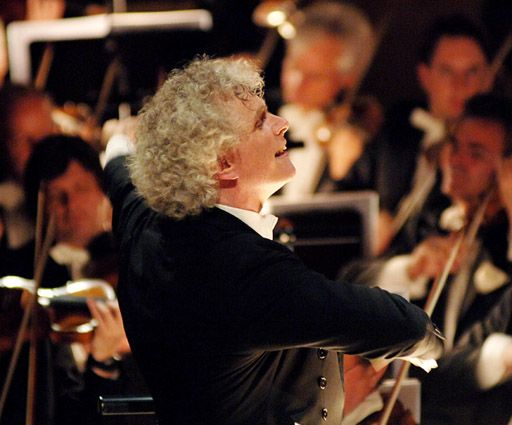
Why is it easier to conceive of people sharing their lives and aiming for excellence in a community like a symphony orchestra than in Church? Why does religion so often seem part of the problem, not the solution? I don’t know the answer, although I'm earnestly seeking it, but I want to press the question because answering better or worse it could radically change the quality, maybe even the quantity of our future.
Let’s start with Sam Norton’s very sharp diagnosis from yesterday:
“successful orchestras recruit people who can see the beauty in submitting to a larger vision, something beyond themselves, and it is the authority of that vision, rather than the authority of any individual, that binds them together to produce something marvellously beyond the sum of their parts.Many people in Church claim to have larger visions of God, but how large is our vision of human beings, supposedly made in his image?
The trouble with our church is that not enough people believe in that larger vision. Ironic really, given what it says on the tin.”
 There is a basic Darwinian model of nature as what Woody Allen called “a huge restaurant” — dog eat dog, competition, compulsion, survival.
In the human world this is reinforced by a Freud style account of what goes on in our heads. This is seen as a competitive world of basic instincts, a darkened cellar in which a gorilla and a sex maniac are locked in mortal combat every day, slugging it out over various notionally juicy bones in ways over which they have no control.
 Is this vision of humanity adequate?
How could a roiling mass of individuals like that ever produce a decent society?
Or, theologically speaking, how does it reflect the image of God?
Here’s an alternative vision of what’s going on, and the kind of community that could be built on it, from US Economist and thinker Jeremy Rifkin, delivered in visual form by the Royal Society of Arts:
So, theologians, if we want to be art of the solution, not the problem, is it time to re-visit and refresh our understanding of “the Fall of Adam?”