Showing posts with label Women. Show all posts

Friday, 5 July 2013

Genuine Unity — How to focus it

A bishop is called to be a focus of unity. But how?

Unity matters. Here’s the theory, according to St Paul. The whole created order is emerging into Unity through Christ whose death has reconciled everything and triggered a viral process of reconciliation that takes in every human dimension. the Church is a new people, the firsfruits of the whole creation. Nobody is left out. It takes a whole world to know Christ.

Disunity is all in the mind. Some Christians believe gayness is within the purpose of creation; some against it. Much of our official history has taken the anti-gay line, and much of our unoffcial practice has behaved differently. Some believe in women’s senior leadership, some not. According to the last Archbishop, bishops could only be a focus of unity by resisting change in order to reassure traditionalists, in public anyway. The price of unity was rejecting gay people, largely paid by gay people. Ditto with women. They were to calm down and accept being diminished in ministry, as the price of unity.

This policy has failed, on every level.

The dwindling number of Traditionalists were not reassured and gay people continued to be diminished, patronised, bullied, and rejected. Meanwhile the Church became the only UK public body left allowed to discriminate against women in its senior leadership. What seemed even-handed was actually taking sides and has kludged up real dialogue, parking the issues in a siding, but guaranteeing an increasingly guilty and untenable paralysis. Meanwhile society got on with sorting both issues without the Church.

Bishops sat on the fence for the sake of unity in the name of even handedness, trying to slow everything down and keep order. The result was disunity, frustration and chaos.

In reality there was no fence to sit on. In effect, doing nothing was siding with the decreasing majority who believe gay people are wicked, stunted, sick or disabled, or the one that believed women were made by God for non-leadership roles.

As the numbers who believe gay people are just people and women are equal grew and became a majority in England, even the Church of England, the game was up.

You can't build unity in a family by excluding any members of it. If your children fall out it is not even handed to ignore the one who's stepping out of line, to build fellow feeling between the others who aren't, sacrificing the black female, or gay member “for the sake of family unity.” Doing that actually destroys the family, not unites it. You can only parent a family on the supposition that all its members are equally valid. Thus Bishops, by trying to be nice to gays whilst siding with anti-gays have not been a focus of unity, but have actually stoked a bigger crisis over gay people in the church than was experienced in education, politics, the military, the law, commerce, or any other area of life.

If bishops want to be real focuses of unity they have to stop trying to be nice, in effect siding with anti-gays. Both sides act out of conviction. Good. It's time to stop trying to calm everybody down and synthesize them. A working model is actually in the New Testament, and we need to wake up and follow it.

Romans 14 deals with Meat sacrificed to idols. This mattered to early Christians not as animal lovers, but because meat came from pagan temples. Eating it was either subsidizing idolatrous cults or defying them by proving Christians were immune to their products. Eat or refuse, you couldn't do both simultaneously. The issue was black and white. If St Paul ate meat he sided with those who think their faith is strong because they eat meat. If he refuses he sides against them with those who refuse, on grounds of conscience. There is no middle ground.

At this point St Paul could come running on, saying "Calm down, dear! Nobody eat anything because that will upset the vegetarians! Let's all discuss what we all have to do before we can do anything! And then when we're ready to move, we must all move together!"

What St Paul recommends is the exact opposite. He tells every Christian
  • to be convinced in their own mind, each one personally.
  • to get on with doing whatever they do, meaty or veggie, 100%, but to do it for faith reasons, for Christ, not fear reasons. What comes from faith is faith.
  • When doing this produces passionate disagreement, to view it as an opportunity to accept the other as is and love them, not an opportunity to tribalise
  • To judge nobody else before the time
  • When people see you doing this, they will be amazed, and God will be glorified. Nobody has to pretend. Every particularity praises God's works, not its own, in its own language. Nothing is judged or synthesized before the time.
Fake Unity is basically about what's going on among the officers on the bridge. Its aim is keeping everyone as happy as possible. Driven by fear of everything falling apart, the captain becomes what Walt Disney called Mickey Mouse, "a little guy trying his best."  Its aim is a world tamed and homogenised, where everybody calms down, and each particularity curbs its enthusiasms whilst every anomaly is synthesised out.

Real unity is concerned with where the ship is going as well as how the ship is running. Its comes from the Cross, powered from within by a shedding of blood that bridges every contradiction in heaven and earth, even life and death. Its aim is a world reconciled, not homogenised, where every particularity believes and does what it does to the utmost and so becomes fully itself in a new, emergent, diverse, chorus of praise to God.

The coming days, for the General Synod, could be make up your mind time between these two visions of unity, cheesy or real. At last.

Monday, 19 November 2012

So Long, Mr Nibbles


Dr Robyn Skinner, psychotherapist, once had a patient with a most annoying habit. He always brought along a stuffed toy rabbit, a mysterious authority figure that was assiduously consulted before any critical decision. The presence of Mr Nibbles was lucrative for Dr Skynner, but seriously inhibited progress with the gentleman’s condition. Theological discussions involve sensitive personal matters, and participants often bring along their stuffed rabbits — mystery authority figures. 

Anglicans have three particular bunnies. 

There’s a Vatican Gold one — 
“we’d love to, but what would the Pope say?” Well, the real Pope has always shot straight from the hip about womens’ ordination. He abominates it lock stock and barrel. He even came up with the ordinariate, a tiny but perfectly formed exercise in what Southern Baptists call sheep stealing, that leaves no room for doubt.

There’s the Biblical Literalist one — 
Oh, we all know God didn’t do the job in seven literal days, but the nursery narrative says could have, and we want to play safe. On gender equality most people know the score. The most avid “complementarians” do allow their wives to bob and cut their hair, to speak about faith, except in Church, to lead teams containing men. They’re part of a Church whose supreme governor is a woman. The English settled the real issue about whether women could ever, as a matter of Creation ordinance, hold positions of authority over men back in 1569, and it’s generally worked out fine since.

Finally there’s the dog eared old rabbit called “nice.”
All manner of murder and mayhem, backstabbing and worse, go on at the Vicarage. Only we must be nice about it. In fact, none of us are as nice as we like to think we are, but the pretence continues in the face of considerable evidence to the contrary if only we behave well. Nice is full of “yes, buts.” I first encountered it in the form “We’d love to have a Cheshire home in the town, but we can’t let people in wheelchairs dent our property values.” yes, But... It’s anything but nice. And in present circumstances another canter round the paddock for this question is anything but nice.

This week the General Synod reaches a final vote. Stuffed rabbits sometimes help make it possible to talk together along the way, but they can't help with final decisions. Best vote according to your positive convictions, one way or the other. If you believe women cannot be bishops, you couldn’t live with yourself if you voted any way but against. Nobody would expect otherwise. But the reverse is also true for those who do believe women can be called by God to the episcopate.

It makes no sense at all to anyone to consult any stuffed rabbits any more. Everyone has compromised, including those who believe in a non discriminatory church. The idea that another trip around the gasworks on this subject will deliver traditionalists anything better in eight years’ time seems, frankly, insane. That could only happen if a new synod represents a final retreat into the ghetto, because the direction of travel on planet earth is plain as a pikestaff, and it's the other way.

After years of trying out every conceivable permutation a compromise has been reached that leaves almost everybody unsatisfied. The only process grounds left involve the notion that a statutory instrument is too far short of a statute to protect people — a somewhat top shelf legal concept that is simply untrue in any other area of life.

Time to leave Mr Nibbles out of it and vote according to conviction. Time to move on. 

Friday, 25 May 2012

Cooking the Curate’s Egg

So, where has the C of E got to this week on Ministry and gender?
Assuming Les Six have done their stuff, an amended scheme will go before the General Synod in a few days time.

Down the road leading here two mantras have pullulated behind the discussion:

(1) “This isn't, of course, about gender. Perish the Thought.”
This assertion is a lie. It is, and it always was. Discriminatory is as discriminatory does. It is not for the discriminator to judge the matter, based on their intentions, but those discriminated against, based on what actually happens. All else is illusion.

(2) “This is about theology not discrimination.”
This assertion is a lie. However you tart it up, Trevor Huddleston showed us years ago, discriminating is actually a theological assertion. Imagine, as I have attempted sincerely to do, that there is a theology that justifies treating women, against their will and calling, as inferior. I can't conceive of such a thing, but let's suspend disbelief for a moment. What is the difference between that noble theology and cultural prejudice dressed in voodoo? At no time in the past five years has anyone showed me. All that unites reactionaries in this matter seems to be a cultural prejudice against seeing women in positions of authority, reinforced by a reactionary subculture. It is every bit as much drawn from the contemporary world’s values as progressive aspiration. It’s just drawn from the reactionary quarter of them.

So, for synod members, it’s what one game show used to call make-up-your-mind-time, for the next five years anyway.

If the Church needs a gender-neutral ministry, something the vast majority of people believe to be right, this scheme does not deliver that. It is fundamentally inequitable and discriminatory. The best condoms do not have holes in them, however small. There is no telling what monstrous births may take place in the various caves of Adullam this measure potentially creates. It could be a step in the right direction, but it will retain the Church’s institutional sexism in a way most people outside the bubble find puzzling and, ultimately, morally disgusting.

If what matters most is the lesser matter of allowing women to be bishops, this scheme does finagle that. In itself the eventual presence of women in the house of bishops might be able to achieve what the present set-up couldn’t for the institution, and plug the hole in the bucket. In a down and dirty world this won't be the first time in human affairs tulips were grown on dung.

As to the leadership of the Church in synod, a lifetime of pretending, whilst trying to set their course on dead reckoning and politics with only an occasional star sight, scarcely prepares them to exercise moral leadership at a critical moment. Most episcopal palaces are emitting a loud and eloquent silence now. Many of our senior men probably thought on Monday that all they were doing was giving the women what they wanted whilst being as nice as possible to the other lot. That's why you can't see them for dust now.

It’s Touch and Go, I’d say.

Tuesday, 22 May 2012

Swimmin with the Wimmin part 94

So what was the women bishops result? I don’t really know, of course, not being part of the house of bishops, but preliminary indications are pretty much that things can roll forward. Bishop Pete Broadbent, who sits in the House, has provided a good thumbnail summary.

The result, in true C of E fashion, is a curate’s egg, but probably not such a rotten one as to send the whole process around again in five years time. The Bishops said “yes,” mainly because anything else would be ludicrous now. The number of people requiring alternative episcopal oversight has dipped in most of the country, very likely, below 2-3% of electoral roll members — something like 0·06% of the population. Another circuit to land in 5 years time would not yield a different result, and certainly not one more congenial to those who believe women do not belong in positions of episcopal authority.

But, some inquire, what exactly does the press release Ruth Gledhill called “the worst written since the Reformation” actually mean?

The project basically moves forward with two amendments. I will now attempt to pick through the entrails. If I am wrong, please correct me. But this is what I think it means...

(1) The first amendment expresses the slightly donnish theological distinction Rowan pushed at the last general synod between “delegated” power, a legal thing, and what could be called ordinary episcopal authority. Thus when I ordain people I am understood to derive my authority to do so from my ordination as a bishop, not from the Bishop of Oxford let alone his gene pool. This has the benefit of expressing traditional ecclesiology in the way that the flying bishops project never did.

The distinction is supposed to help on two fronts. Those who believe higher clergy need male gonads can comfort themselves in the knowledge that their guy got all of his regular authority to function from the admittedly nebulous entity called “the whole church of God,” not the XX bishop up the road. On the other front the Chromosomally Simplistic One can reassure herself that she got her authority from the same place and did not lose any of her episcopal Mojo in order to placate the XY-only people. Their arrangements were a merely legal fandango.

In itself this amendment was probably necessary to move forward at all, given the situation created by the Act of Synod from 1993. Unlike the nineties flying bishops arrangement, at least this amendment is ecclesiologically coherent, and it could help normalise perceptions from a theological point of view. The extent to which ordinary people (in the non-ecclesiastical sense of that term) know or care about it may well be limited.

(2) A second amendment requires bishops to have serious regard, when allocating clergy, to the reasons parishes require bishops or priests with gonads.

On the face of it this is common sense. If people want a male because the Eucharist must be celebrated by someone who shares Jesus’ biological gender (if not his Jewishness or Beard), they get a Real Man of the Eucharist. If on the other hand they believe that God Made Woman not to hold any authority over men in Church (unless an Archdeacon or Supreme Governor), then what matters isn’t the Eucharist, but that women don’t preach to other men. In effect these latter want a proper male preacher, having often in past times had an Oxbridge blue in some Manly Pastime. Just remember this is nothing to do with gender, and that this second amendment, kindly and sensibly, requires a proper match in this matter.

Is the Church going to remain a discriminatory organisation, with a thinning theological figleaf to cover its vulnerability? Truth compels me to say, probably yes. In Brer Rabbit terms the old deal was that the buses were not segregated, and as long as the whites who believed in segregation on biblical grounds sat at the front, they could kid themselves that there weren't blacks at the back of the bus. This has now been modified. The driver can soon be black, and those who believe in Biblically based separate development can either stare out the window sideways or comfort themselves that they only have to look on the back of the driver's head. This scheme could well be a way to bring women bishops onshore from places like Oz, New Zealand, Canada, and the US. That's progress, I suppose. Intellectually, it’s not quite desegregation. But do not underestimate the power of evolution. We wouldn't be having this discussion if Evolution didn’t work.

In the meanwhile my picking over the entrails mattereth not a pig’s burp. There is a special Group of Six Wise Ones (including one woman) who will now pick over the entrails to decide whether this is too radical a change to go forward. I wouldn’t think that's too risky a bet, but the C of E is a place loaded with surprising possibilities. If Les Six do decide this amended scheme won’t blow all the fuses on the Enterprise, everything rolls onward to York in June. Get that old ecclesiastical anorak out of the cupboard and tighten your underwear. The Monstrous Regiment is at the gates.

Friday, 3 February 2012

Looks Like a Duck, Stings like a Bee,


A course in Dignity at Work yesterday reinforces what every employer knows. In law and in fact, Discriminatory is as Discriminatory does. If a behaviour is experienced as belittling (and it is for the person who feels it to decide this, not the perpetrator), and it actually expresses itself in measurable behaviour, that's it. Discrimination has occurred whatever the motives or intentions of the perpetrator.

Imagine I open a Hungarian restaurant and refuse to serve anyone but Hungarians. I am discriminating against non-Hungarians. I may point out that I never served non-Hungarians before, or there are parts of the world where racial discrimination is legal, or my head office in Budapest likes me to do it, or any other excuse that comes to mind. I may even say Jesus is telling me to do it, but that is evidence I am crazy, not Jesus. None of it is strictly relevant. 

Discriminatory is as discriminatory does, even if I have no conscious intention to discriminate, even if I cannot believe I am the kind of person who would do such a thing. Thirty five years ago I was once quartered with a Christian lady, call her Doris, who explained to a colleague and me that "darkies deteriate (sic) the area.” My more courageous colleague tactfully said he found this sentiment racist. Doris was horrified. Of course not. “If it were,” she said, “that would make me a racist, and I'm not.” Doris was wrong. Hers was a racist sentiment, and, thank God, less likely to be heard from a good Christian lady now, I imagine, than it was thirty five years ago. 

In that spirit, it is more than high time for the Church of England to stop discriminating against women in its senior staffing. It really is as simple as that. Whenever this obvious point is made, howls go up from various Dorises that they have no intention to discriminate. We are not as other men are. When we discriminate it is not discrimination. Increasingly, this assertion seems merely ridiculous.

I was glad to read John Sentamu’s recent Telegraph interview on marriage equality, because the full transcript reveals just how little of it was actually about marriage equality. As sometimes happens, the newspaper concerned span the controversial bit largely out of a couple of stray comments at the tail end.

Most of it was moving testimony to how it has felt to be on the wrong end of one of the Church of England’s dirtiest little secrets — genteel and not-so-genteel Racism. When, back in the Halcyon days of the fifities the Windrush generation arrived, 90% of whom were weekly churchgoing Anglicans, we froze, humiliated and drove them out from our churches, often in a few weeks. John Sentamu has himself played a noble part in changing the Church the way it had to go, in the face of howls of protest from Doris and her compadres. It is a positive story looking a happy ending. That will come when the racial balance among clergy in parishes corresponds to the makeup of the communities we serve, and not before.

Now all that is necessary is for Sentamu’s colleagues in purple to join up the dots and get on with ending discrimination against women in bishop appointments. Whether they have the guts to do it now will say much about whether they have anything else of value to offer a society crying out for alternatives to materialism, prejudice, selfishness and apathy. Martin Luther said “The time is always right to do what is right.” After twenty years of ludicrous faffing and wiggling, the time to sort things out is now.

Sunday, 15 May 2011

Airbrushing out Women

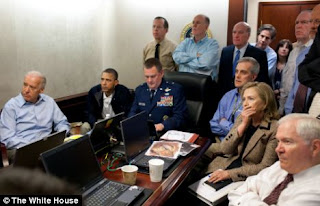
The US Secretary of State sat in the war room as her troops closed in on Osama, monitoring developments carefully with senior operational chiefs including the Director of Counterterrorism. The manner of Osama's taking off has raised moral concerns, but the fact that the US secretary of state, being female, “doesn't have a wee tail like little boys do,” (as a recently seen Edwardian manual of nursery management says) is a matter of fact that would, you’d think, raise no religious or moral concerns.

But you'd be wrong. The sight of Hillary Clinton in role as Secretary of state and Audrey Tomason as Director of Counterterrorism so offended Der Zeitung, a Brooklyn based hasidic newspaper, that it airbrushed them out — a time-consuming operation, but necessary to protect their readers from the dreadful sight of women in positions of authority.

I am sure the newspaper notionally admits these woman exist. Some animals have to cover their eyes so they can't be seen. In that spirit, the paper airbrushed the women out of what soon became one of the most famous images in the world. This was a crass and obvious thing to do, presumably because the satisfaction of the few in their silo outweighed for them the millions beyond their silo who would find their behaviour reprehensible.

Der Zeitung’s reaction was a real give away:
Because of laws of modesty, we are not allowed to publish pictures of women, and we regret if this gives an impression of disparaging women, which is certainly never our intention. We apologize if this was seen as offensive.
In other words, if we don’t consider it disparaging, it isn’t, because we say so. What tosh! The newspaper went on to say its photo editor did not realize he was violating White House copyright conditions.
“We should not have published the altered picture, and we have conveyed our regrets and apologies to the White House and to the State Department,”
So hang 0n, DZ still does not acknowledge its journalistic sin of manipulating the truth, let alone its somewhat medieval attitude to half the human race. As one is usually told by Unreconstructed Discriminators in every sphere of life, this had, of course, nothing to do with women being women — a piece of self-deception that always gives the game away from the start. The reality is that discriminatory is as discriminatory does. All else is self-deception.

Instead Der Zeitung took refuge behind a screen of faux-religiousity. I say “faux” because I take it from the fact that back in the Iron Age there was no need to airbrush the judge Deborah out of the Book of Judges, that the Eternal himself does not feel the same collywobbles about this as his more zealous minders.

So we see the capacity of Religion to become part of the problem, a smokescreen to cover unreality rather than a means of engaging with Eternal reality, including that of the present. Soon those who take this path are safely tucked up in their own religious disneyland in which the thing they most fear is kept out of sight. Their religion thus becomes a cover for fantasy, an alternative world, ultimately an insanity licence.

And just as all of us this side of the pond smirk away at the gormless folly of Die Zeitung, perhaps we need to reflect on our own more ingrained cultural sticking points about women. 30 years after equal pay legislation came in, womens’ earnings still lag significantly behind those of little boys with wee tails, the British Boardroom is still largely a male preserve, and, dash it all, we have all just enjoyed a lovely wedding in which the only female voice in an hour of liturgy was that of the Bride, as though that were normal. We all still have some way to travel ourselves before we arrive at the world of Ephesians 2.

Tuesday, 8 February 2011

Discriminatory Louse on Lady’s Bonnet

As Buckinghamshire experiences its annual Burns Night Kilt Hire peaktime, recitations will roll of Robbie Burns’ poem To a Louse, on seeing one on a Lady’s Bonnet at Church, 1786:
O wad some Power the giftie gie us
To see oursels as ithers see us!

It w
ad frae mony a blunder free us,
An' foolish notion:

At a recent confirmation, I saw a louse in Church... It was a bonny evening with many candidates of all ages and a congregation of several hundred, and great joy and celebration. As I sat in the hall afterwards signing gifts and cards, a candidate in his late 20’s came up to me and, as often happens, we began talking about about his coming to Christ.

Formerly an atheist, he had found faith in a flourishing Evangelical church, but the biggest obstacle in his way had been what he called the Church of England’s sexist senior leadership structure and poor record on human rights. If his workplace behaved like that they'd be closed down. Here was a national institution claiming some kind of moral authority, but behaving in a way which he, and everyone in his office, found morally disgusting.

Steady on, I thought, and trotted out a line about tradition and variety. How could I say that? he asked. Everybody knows that in the workplace discriminatory is as discriminatory does. It’s no defence in an Equalities case to say you didn’t consider your discriminatory behaviour to be so, far less that the Pope told you to do it, or that you’d always done it, or that God does it. Anyway there was a happy ending, he said, because after four years’ delay, he had eventually found in his local Church a genuinely open and apostolic community. But when was the institutional national Church going to catch up?

As legislation for female bishops goes out for consultation, everything will be framed in terms of the problems experienced by a tiny minority of churchy dissidents. I don’t suppose anyone will speak up for those who don’t yet go to Church, like my confirmation candidate and his work colleagues. They don’t show up on our radar. Maybe that’s why there aren’t more of them being confirmed.

Great Soapy debates will be held in the next day or so, with much lather produced in good faith and many croc tears about mission and why congregations fail, and how sad it is that the average English Anglican is 61. It’s not going to change, though, is it, until we accept the hard truth that some of our cherished behaviour and attitudes can be a real stumbling block to those on the threshold of faith. The problem is with us and either we don’t really care that we are blocking the gospel, or we have to do something, perhaps the obvious, about it.

Monday, 12 July 2010

Off for a few Monastic days

Abandoning what some speak of as the smoking ruins of the General Synod, I’m off for a week in a monastery. Reports and notes will follow, but I do turn off the Internet at St Wandrille, and won't be blogging again until next weekend.

I’m not sure the ruins of the General Synod are smoking, even if the next steps remain to be discerned on ordaining women to the episcopate. The Archbishops had a right to do as they did and suggest another way forward, although I can understand some synod members feeling the procedure gazumped due process. The synod had the right to decide it didn't quite buy the deal. C’est la vie. The Holy Spirit is able to work through the human processes of the General Synod...

Howbeit, one doughty layman of a traditionally Conservative outlook suggested to me at a recent do, you can't really have a situation where the blacks are allowed on the bus but only because there's a whites only section at the front where, as long as the passengers don't look round, they can feel as though nothing’s changed. It’s for everyone to decide what their consciences will and won't wear, but we each and all have more or less tuned consciences, and therein lies the complexity. He thinks they all need a bit of moral courage, now. Further paralysis and funk is the worst option of all, surely, for everyone. Time for a bit of faith.

Thursday, 24 December 2009

The Work of Incarnation Close up

In Church on Sunday, Rosie the Vicar walked us through the Magnificat as a woman’s voice amidst the overwhelmingly male sounds of Hebrew and Christian Scriptures. At Christmas, I was moved and delighted with a greeting better than any card from Katherine Kaye in Oxford. She wrote:
This is a poem called "Not Art", by Kate Clanchy, an Oxford poet. It is one version of female experience which, as a man, you can only look in on, what it means to visit the place where women show one another wares, their handicrafts, and what is gain: so unspectacular, so unshowy, so not what the dominant ones notice, let alone "count" - and yet what makes us what we are. Our true home is in our childhood. That, and a recommendation that you listen to the three ages of women in Durufle's "Tota pulchra es" make up my Christmas gift to you: more perspectives still.
The image of Our Lady is from the Church at Saint-Wandrille — a final picture I took during this year’s stay. It is actually a nineteenth century iron casting (I kid you not) taken of an original in the Louvre.
Not Art


This is close work, this baby-stuff,
the intricate wiping and wrapping,
the slow
unpicking of miniature fists;
village-work, a hand-craft, all bodges
and spit, the gains inchingly small

as the knotting of carpets, raw wool

rasping in the teeth of the comb.

The strewing and stooping, the prising

of muck from the grain of the floor -

I think of gleaners, ash-sifters, of tents

sewn with shoe soles, wedding veils, plaits,

how patchwork is stitched-up detritus,

how it circles on quilts like a house split

to bits when the typhoon has passed.

And the ache in the neck, in the back,

in the foot, are the knocks of wood looms,

narrow as cradles, borne from pasture

to valley to camp. I am learning
the art of mistakes, to accept

that the marks of each day are woven in

by evening too far back to pick out.

This is the work women draw from the river,

wet to the waist, singing in time,

the work we swing from our shoulders,

lay on the ground and let the crowd

hold and finger and value - the young girls
wondering, the laughing old women,

the bent, the milk-eyed, the blind.
Reblog this post [with Zemanta]

Saturday, 14 November 2009

Revision Committee: Tough Salami

The latest from the rather dry and technical sounding Revision Committee on women in the Episcopate which met yesterday contains one ecclesiologically significant discovery:

After much discussion, the members of the Committee were unable to identify a basis for specifying particular functions for vesting which commanded sufficient support both from those in favour of the ordination of women as bishops and those unable to support that development. As a result all of the proposals for vesting particular functions by statute were defeated.

The effect of the Committee’s decision is therefore that such arrangements as are made for those unable to receive the episcopal ministry of women will need to be by way of delegation from the diocesan bishop rather than vesting.

It seems that the 19 members of the committee spent long hard hours trying to see if there was some way of producing some kind of new model episcopacy that simultaneously was and wasn’t complete in the ministry of every bishop. What they seem to have discovered by painful endeavour is that it just isn’t possible to salami slice what bishops’ ministry is within an autocephalous Church. St Cyrprian’s principle (“Episcopatus unus est cuius a singulis in solidum pars tenetur”) has, since the time of Archbishop Benson (1882-18891), been the keystone of Anglican theology of Episcopacy. Thus, ecclesiological first principles prove themselves.

So what? The choice now before Synod is for provision outside the legislation itself, or a statutory code of practice. The full synod will doutbless discuss these options and decide what they want to do between these options. There is, of course, always a third option of dong nothing (letting the measure fail). This is the kind of discussion and decision making the General Synod is for, really. February’s debates could well make interesting reading...

Monday, 14 September 2009

Binary Follies and missional drift

There are two kinds of people: people who divide others into two kinds of people, and people who don’t. Sometimes it’s wise to distinguish between others, but often not. Usually it’s helpful to remember that any one of us has it in us to be several things at once.

Which brings me to Bishop Stephen Cottrell’s great sermon at yesterday’s Racial Justice Sunday celebration in Oxford. St James tells us about pure wisdom, and that the harvest of true righteousness is sown in peace, for/by those who make peace. So he roots our divisions in our pride, frustrations and faithlessness, and calls on us, double-minded people, to wash our hands and cleanse our hearts.

Jesus told the story of two boys, one of whom refused to do as his father asked, but ended up doing it anyway, as against his brother, who said he would obey but never did, nor even really intended to. We will be surprised in heaven by all sorts of people getting there ahead of us.

Classic bourgeois hypocrisy is all about striving officiously to appear respectable, but another, possibly more pernicious form of double-mindedness is dividing up and compartmentalising the whole world, in ways that tend put ourselves perpetually in the right.

Looking at our grasp of St Paul’s great revelation of unity in Christ in Galatians 3 — all One in Christ, neither Greek nor Jew, slave nor free, male nor female — is not entirely encouraging. It took the best part of 100 years of bitter disputes to bring words and public deeds into alignment over Greeks and Jews, 1800 over slaves and free, and among Anglicans, we still seem to be a tad confused over male and female...

I notice, myself, another intrguing way of indulging this ugly side of human nature; making up novel denominational, racial or religious reasons not to engage with others, producing a technical but narrow conformity to our own particular interpretion of Galatians 3, or whatever.
Who’s driving the narrowness? God, or the limited way we see ourselves and others, and our reluctance to engage?


This all leads me to surmise that if ever we do decide to give practical Christanity a go, there are all sorts of people out there who would love to see it put into practice, much more than they can bear all the fear, excuses, bickering and other symptoms of doublemindedness they are picking up now.

Saturday, 9 August 2008

Women Leaders stand up and out

Willow Creek has long sought to recognise leaders regardless of gender. If God has plainly gifted someone for leadership, why pretend he hasn’t on grounds of mere gender? In practice, however, the vast majority of faculty members at previous summits have been men.
This year’s event has included in its lineup two particularly inspiring women, Wendy Kopp of Teach for America and Catherine Rohr of the Prison Entrepreneurship Program.

Both, shortly after leaving College, resolved to change the world, by taking wasteful injustices head on . TfA uses a Peace Corps model, with its strengths and weaknesses, to deploy good young graduates in inner city schools with a transformative brief. PEP, based in Texas, seeks to turn around prisoners’ lives in the largest state penal system in the world, by giving them self-awareness and self-respect, growing character, and developing the will to use skills which have been misapplied in constructive ways.

Both Catherine and Wendy came over as sharp, perceptive, high capacity, and practical. These qualities came with low tolerance of being assumed to be their own PA’s, or otherwise patronised. How many times in the past 30 years, asked Catherine, with laserbeam piquancy, had Bill Hybels been asked what it felt like to be a male leader?

The Church of England has some honest, passionate, realistic and focussed leadership like this at senior levels, but desperately needs more. I think back to the stifling, idiotic boys club culture of deanery chapters I belonged to in the 1980’s, and rejoice to think it has largely been subverted. As this process marches on, even towards the House of Bishops, it’s good to know the talent is out there, if only we find the grace and wisdom to acknowledge and deploy it.

Wednesday, 30 July 2008

Bruised hands rock the cradle

Rape and violence against women are not topics for polite conversation, but they are realisites of life all over the world. It’s especially shameful if the Church becomes part of the problem rather than the solution. Yesterday saw a challenging morning in the big top, sharing with spouses a Bible Study on II Samuel 13, the story of Tamar. Introducing the session, Jane Williams reminded us of the basic principle that “Violence done within the Body of Christ is violence done to the Body of Christ.” A performance by Riding Lights about Jesus’ dealings with women had two bishops near me blinking back tears. This was a straightforward, African Bible Study, lasting most of the morning, with men and women studying separately to provide safe space in which both could discern meaning from their gendered experience.

Leading an open Bible Study for 1200 people from 130 nations is not easy. There were inevitable clunkinesses about flow and content. Some points of view, especially from Portugueses speakers, were trenchant. It wasn’t to the taste of all bishops. Stewards reported that over 100 had slid off within an hour — all men! So this was raw, challenging stuff, but all the more worthwhile for that.

Only a dozen or so of the 1200 people there had ever heard II Samuel 13 read on a Sunday. It’s a powerful warning about the way a family can be ruined by civil war arising from politicking behind the scenes à la Jonadab. It tells of a brave and resourceful victim of rape, who refuses to stay silent. The passage unlocked fierce responses to issues of gender and power in the world church. We were reminded of violence by some women against men, too, but the heart of the problem was the other way round. One passionate North Indian contributor told of human trafficking and the abuse of women.
“There are serious issues we are not talking about that matter far more than homosexuality.”
This comment was followed by a spontaneous ovation from the floor, lasting almost half a minute. Another male contributor suggested
“talking about homosexuality may be a way of avoiding the greater problem of heterosexual males behaving badly.”
It was instructive to explore this Scripture, and various responses and to do some rigorous self-examination of the way the Church can become abusive in its handling of institutional and personal power. The voice of Tamar stands witness within our Scriptures of a need for self scrutiny. These things were written for our learning.

I also want to record that the blunt African way of prising open texts directly and drawing them alongside personal stories, which some English colleagues seem to find so basic and uncongenial, has actually been one of the great spiritual discoveries of this Lambeth for me.

Wednesday, 9 July 2008

Church of Navel-Gazers?

I am not a natural Daily Mail reader, and I struggle with some of its historic points of view, from its enthusiastic endorsement for Hitler back in the 1930’s to its more recent tendency to whining Xenophobia. The fact is, however, that it is one of the few newspapers to build its circulation in the past twenty years. It has done this, it is said, by having a sure finger on the pulse of middle England.

Seeking the gift the giftie gie us, to see ourselves as others see us, I noticed a different persective on this week’s General Synod by Stephen Glover. Does this voice of Middle England deserve more serious consideration than comes naturally to Church political insiders?
Most people do not know the Church of England very well, and few of us regularly worship in its pews. But it is, for all that, our national Church, and most of us write 'C of E' when asked our religion. Millions of us are still married in its often glorious churches, and millions of us will have the words of its prayer book - transcendent ones, if they come from the 1662 version - spoken over our coffins when we are dead. So, however remote we may appear from the Church of England, it remains part of many of our lives, if less so than for most of our forefathers.

Strange and unfamiliar it may sometimes seem, but it is not some private sect whose deliberations are purely its own concern. And yet that is exactly what it has appeared to be these past few weeks, months and, I fear, years, as it has torn itself apart over issues that do not seem central to this nation's needs and concerns...

Our national Church is preoccupied - no, obsessed - with two issues: whether its priests should be allowed to be practising homosexuals, and whether women should be allowed to become bishops. I don't say such matters should be of no importance to members of the Church. But to concentrate on them so long to the virtual exclusion of more important things - well, that seems a form almost of madness, and certainly evidence of grotesque introspection.

One does not have to be apocalyptic to believe that we live, as David Cameron says, in 'a broken society' in which Christian values, as they would have been recognised by our fathers and grandfathers, and as they have been preached by the Church for nearly 2,000 years, are scarcely observed, or even understood, by many people.

Nearly half of marriages, which institution the Church has celebrated as the rock on which society is built, end in divorce. A growing number of people no longer bother to get married at all. The family, whose most perfect inspiration was the Holy Family, is no longer a paradigm for many people, and the Church of England only intermittently and half-heartedly promotes it. The Church is silent on many pressing social problems which seem to portend the slow disintegration of society, and often arise from the family breakdown about which it is comparatively relaxed. While it has been agonising about homosexual priests, ever younger children have been stabbed to death on our streets, and the level of mindless violence seems inexorably to grow. Yet our national Church has little to say about the brutalisation of our country...

The debate on the consecration of women bishops has been bewildering to many people, including some Anglicans. The Church of England decided 15 years ago, rightly I think, that there is no theological objection to the ordination of women as priests. Now half those accepted for ordination are female, and there are women canons, archdeacons and even a dean. Why not bishops?

One can understand that Anglo-Catholics should feel qualms about women bishops, as they did about women priests, and it seems reasonable that they should have their own male 'super bishops', as was proposed at the Synod yesterday. But the country looks on in amazement as Anglo-Catholics threaten to resign en masse, and to rip apart a Church that is, frankly, already tottering. Their arguments seem arcane, particularly in view of the earlier acceptance of women priests, and almost insanely inwardlooking.

Similar objections should be made to the Church of England's obsession with homosexual priests. Here, the factions are different, with the Anglo-Catholics being for the most part relaxed about homosexuality, while many Evangelicals, comfortable with the idea of women bishops, are distinctly queasy about homosexual priests. Many Third World Anglicans, especially in Africa, share their reservations.

But why in God's name does it matter so much? Both sides should be castigated for upping the ante. There are people such as the publicity-seeking American gay bishop, Gene Robinson, for whom homosexuality appears to be the most important issue in the world, and there are fundamentalists on the other side, the degree of whose intolerance seems almost un-Christian.

Everyone knows there have always been gay priests, and no one minded very much as long as they didn't demand instant and complete equality with heterosexuals within the Church. With good sense on both sides, there could have been a quiet evolution, which has been the Anglican way in past centuries, or at any rate since 1660 and the restoration of the monarchy and the Church of England.

As it is, with grandstanding crusaders opposed by intolerant fundamentalists, there has been an unedifying struggle about something not very important, while the rest of the country looks on in amazement at an increasingly monomaniacal national Church. Think what both Anglo-Catholics and Evangelicals in the Church of England did for society in the 19th and early 20th century - building churches and opening missions in working-class areas, ministering to the poor, encouraging education, and inculcating Christian values.

And now, when our own century throws up its different but perhaps no less appalling social problems, our national Church, far from trying to fill this frightening moral vacuum, is too busy talking to itself.
I have certainly met good ordinary people, many of them lifelong core members of the Church of England, traditionally minded rather than traditionalist politicians, who think exactly along Stephen’s lines. They often feel that nobody in Synod speaks for them, and the whole focus of the present debate excludes their point of view. Discuss?

Monday, 7 July 2008

Reactionary Mount Improbable?

Presiding at the Eucharist this morming for a religious community, the Gospel from St Matthew told of Jesus and the woman with Haemorrhages and Jairus' daughter. These gave some hope of healing and resurrection. The verses just before, I notice with great disquiet, had Jesus laying down the very un-English principle that new wine requires new wineskins — not great politics, but the sober truth. I can say, with some relief, I'm not a part of this afternoon’s discussion. We’ll see how and where the Spirit leads, and try and make it work, whatever.

Driving back, it struck me that the Bible contains all kinds of praxis, including women judges in the OT and a gender balanced leadership in early Churches. The NT tells women to wear hats and ask their husbands when they get home, as it tells slaves to obey their masters cheerfully. It's a command to live incarnationally within the real world. Following that command today would take you to a missional place where female subordination wins no respect, and slavery is gone in spite, you may feel, of the clear teaching of the Scriptures, if you take their advice to slaves as absolute rather than circumstantial.

From a Catholic viewpoint whom you ordain is a matter of canon not dogma. I respect and very much like the tiny number of petitioning clergy we have. I hate the idea of the church causing them distress. I wish they had been able to come up with some way of locating their convctions aganst female bishops in some bigger moral framework, in which there was some positive candle, apart from inertia, reactionary fear and hurt feelings. I would love to have this explained to me, but nobody has so far come out with anything remotely convincing on this level to any except their own.

Talking to non-ecclesastical-anoraks, Discriminatory is as discriminatory does. For them, rejecting gender inequalty isn’t a fashion statement. They believe, deeply, that discriminatory attitudes and behaviour are disgusting and immoral. The Church preaches hope and new life, but seemingly behaves less ethically within itself, as they see it, than Woolworths. To reply that ’tis all, in truth, some kind of Father Ted voodoo mystery thing means nothing at all to anyone who thinks this way. This is as big a missional no-brainer as disobedient wives and truculent slaves would have been in the early church. No system of pockets within which gender based discrimination is OK can cut any ice missionally. Pragmatically, perhaps you can abolish racial discrimination in Alabama whilst keeping a few all white buses, or all-white drivers’ rotas. On every other level, it just don’t make sense.

That’s the mountain our so-called traditionalist friends have to climb, and sincerely I wish them good luck with it. I can’t join them on the climb, because I believe passionately in the Church’s mission, and at the heart of that is the building of a kingdom in which there is neither male nor female, slave nor free, but all are called to be one in Christ Jesus. Period.
Related Posts Plugin for WordPress, Blogger...