Showing posts with label Music. Show all posts

Friday, 29 March 2013

Good Friday Music: Sung Text in Context


One Big Plug from a serendipitous holy week: John Butt’s Dunedin Consort Bach St John Passion, just published, represents a significant trend in the presentation of passion music.

This recording recreates the Passion as liturgy, not concert performance. It draws together organ pieces, supplemental congregational singing, collects and responses, and even a sermon from 1720 downloadable from the publisher's website. Recordings on original instruments have a potential for their own silly fundamentalism. If anyone wants to give me a concert Steinway for Easter I won't be putting it on the fire. Great music works in all kinds of media. There is a whole voodoo of pitch and temperament that is best avoided by all except professors of the subject.

A whole liturgical approach does, however, invite anyone with a heart to feel afresh the impact of the whole text in context. I was stunned to hear the dark and stormy opening chorus (Herr, unser Herrscher, dessen Ruhm in allen Landen herrlich ist!) framed, astonishingly, by Buxtehude’s F Sharp Minor prelude (BuxWV 146). It works.

This approach requires small consorts and choirs on something like an eighteenth century scale. Doing this not only makes runs more nimble and passionate, but sings on various levels. Soloists’ recitative tells the tale. Arias provide relief, interpreting and inviting possible responses. Choruses play group roles and provide reaction shots. Single line chorales represent the congregations at Leipzig in the 1720’s, marking major points of transition and a frame on which to hang the whole and tie it together.

The point of listening to a Passion is to be drawn, mentally and spiritually, to the different roles in the drama, entering each to some extent. We are fleeing confused disciples, we are Peter the Impulsive,  Judas the Betrayer, Caiaphas the professional holy Joe, Pilate, the overpromoted Coward. We play all these parts at different times in different contexts. All call for Grace. Each, in the course of the drama, meet Christ's searching understanding compassion. The possibility of that meeting is also potential for healing and hope.

Why not this year? Why not me? Why not you?

Saturday, 26 February 2011

Mahler Nights: Excellence and Equality

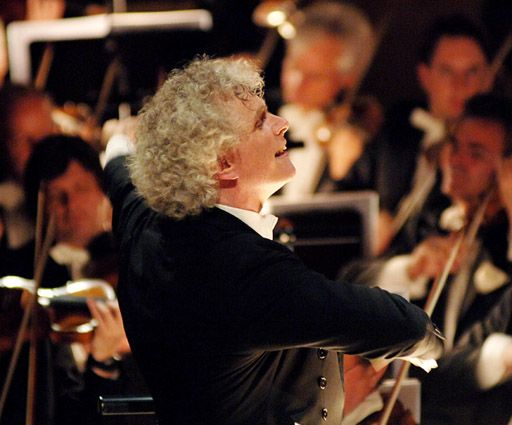
The almost transcendent experience of this week’s Berliner Philharmoniker concerts in London has got me thinking. Yesterday I wondered how Church could be as engaging, spiritually alive and focussed a community, producing hope as well as music.

Among other really helpful comments, Ray Barnes was back with a searching and pertinent question:
Since at least 80% of the success of the very best performances owe their high standard to the conductor, and since Simon Rattle is arguably one of the very best, the question is perhaps - where is the Simon Rattle of the Church?

The orchestra is ready and waiting!
I am happy to use the word leadership in Church, but rather suspect outside Leadership models, some of which we haven’t caught up with yet in practice, don’t really capture the beadth and depth of what is required. I want to be as accountable as any leader has to be in an excellent outfit today, but know there are other people involved as well.

Enter Fergus McWilliam, since 1985 a horn player for the Berliner Philharmoniker. He gave an excellent and thought provoking talk at the Festival Hall before Wednesday’s concert on how the sound of the orchestra relates to its members.

Afterwards he answered questions with some ideas that relate directly to Ray’s crucial line of questioning.

The band begins with a profound value of equality founded on mutual respect. It is a working democracy, in that it elects its musical director, and auditions are carried out principally by prospective colleagues. In other words it rejects artifical hierarchy and embraces personal fit — auditions, said Fergus, could assume technical competence and were thus not beauty contests, but more like marriage partner decisions.

In such a society there is little or no place for deference, often the English default position. As brilliant as Simon Rattle’s tenure has been, extended by request of the players, it has not been uncontroversial, nor would he or the band expect it to be. The idea of a hierarch high and lifted up sneering at people with whom he disagrees rather than listening to them would be absolute anathema, and kill the sound.

Fergus also called into serious question the idea of the Titanic Conductor, which he had encountered the other side of the Atlantic a few years ago — players produce the dots and the conductor will produce the music. As someone who works daily with the best conductors in the world he wasn’t rubbishing their work, but suggesting it ran on creative tension and relationships. Both band members and conductor mattered as much as each other. Mutual respect and understanding produced the best performances.

He also suggested that decisions to hire people for the orchestra were invitations to join a shared adventure. Risks are involved. There has to be a shared maturity and radical equality,continuous openness to what might be, and willingness to pursue it in a focussed way; a passionate focus around the music itself, andradiucal mutuality.

Levels of virtuousity are climbing all the time, but could, unbridled, lead to a band of soloists playing ego games. People have to want to join the band enough to transcend pure ego, for which you need a capacity that has to be acquired, without losing their personalities. But the real distinctives he looks for in new colleagues, he said, were
  • Passion (a capacity to feel in the present moment)

  • Sensuality (sensual awareness, not necessarily in a narrow sexual sense the term is often used in English)

  • Viscerality (Connectedness between head, heart and guts — radical groundedness)
That’s how Fergus’ orchestra, that many hold to be the best in the world, produces music. His experience is lived, not an abstract ideal. How arrogant would it be for to we think we can aspire to excellence and produce hope without prizing and expressing some at least of those values and attitudes?

Friday, 25 February 2011

Mahler Nights: Cool Live Music

Very absorbed, me, in two amazing evenings with the Berliner Philharmoniker, currently visiting London, with its musical director Sir Simon Rattle. This meant Maher 4 on Monday and Mahler 3 on Wednesday, some 35 years since I last went to a Mahler symphony concert, at the Proms.

There is a fatal facility about recordings, fine as they are. The illusion, reinforced by the quality of the digital equipment on which we play them, is that they capture the music. Of course they don’t. They capture a sound impression of the music, but there’s so much more life and vibrancy in a live performance.

It is extrordinary to be in the same room as over a hundred of the finest musicians in the world, listening to each other, creating a joint pulse of something bigger than any of us or all of us, and feeling their way together through a shared adventure. I have no caustic critical words, not because evryting went perfectly, but because I was too absorbed to stand back and pass comment for fear of missing something. You can’t simultaneously swim a river and stand out on the bank commenting on the splashes and bumps.

And, frankly, there were no egregious splashes and bumps. Every voice in this orchestra has a wholeness and versatility to throw itself into different modes freely. Every voice that was a voice seemed like a musical instrument, free of intrusive ego, whether cool or soaring or cool supremely lyrical. Such mutual respect and understanding resolves the intensely activties of 120 soloists into more than the sum of its parts — a blended, poised, unity that is not uniformity, and brings out of each performer the best that they can be. The band is engaging not competitive, compelling but not coercive, and what it does feeds the soul.

Now how can our lives be made such music? When are we going to see a Church that does half those those things, half as well? And how?

Friday, 9 April 2010

Soul Food in Chelsea

Feeding the soul is not just for Lent. The highlight of this post-Easter break has been a visit with an old friend and Stephanie to the 606, one of my loved and inceasingly loved sources of soul food.

You can’t just wander in off the street. There’s an entryphone, grille and long staircase to negotiate, a fact that in itself makes the whole place seem deliciously contraband, like a speak easy.

Inside you find a small basement and bar, some tropical fish and a kitchen. I once asked one of the staff when it closed and was told “how would I know that? I’ve only been working here four years.” The 606 is the ultimate musician’s jazz club. — evenings up close with some of the finest musicians in the world, even on a Wednesday night.

This is not ego food, but soul food — graceful, passionate stuff. This Wedenesday saw two trios — John Critchinson (Ronnie Scott’s old pianist, looking increasingly like David Attenborough in Jurassic Park), Alec Dankworth (who has played with Dave Brubeck, giving a mellow impression that the double bass was playing him not the other way round, and laying down a powerful, gentle, playful beat), and Dave Cliff, a straight ahead guitarist who somehow eliminated all traces of pickiness or twiddle and fitted everything together like an old glove. Sound was subtle, creamy goodness. We had no idea of the time. The stuff you eat at the 606 is getting good, too.

Second set was something completely different, Bryan Spring the drummer, who played Stan Tracey’s second take of Under Milk Wood, with Andy Cleyndert (unusual to see a bow occasionally used in such a context) and Mark Edwards who managed to hold his own against some (occasionall) ferocious intense drumming, all the time placing notes with Wolfgang Amadeus precision.

Bryan Spring coaxed a glistening web of surround sound out of four cymbals, and did strange and beautiful things with a snare. His solos are passionate and gloriously precarious — like seeing someone skipping along the edge of a cliff, dancing off the edge, a cartoon character who hangs in the air for what seems like minutes, then bounces triumphantly back onto the edge, absolutely on cue. The whole evening was a startling fusion of musical passion, grace and mutual humility, and almost a give away.

Shades of the old joke about the difference between rock and jazz guitarists — elite rock guitarsts play three chords to thousands or people, and elite jazz guitarists play thousands of chords to... bit like religion?

Sunday, 10 January 2010

Punky Business with Ian Dury

Musical biopics are a funny old genre. Song of Norway is a nice film. People who hate that one, however, may enjoy Mat Whitecross’ Sex and Drugs and Rock and Roll. This chaotic picaresque romp contains lashings of all three — exactly what it says on the tin. It’s a 1980’s Hogarth — like Gin Lane 250 years ago, a riot of grotesque caricatures, much exaggerated swearing and snarling rending the air, sordid and messed up relationships.
Very Punk.

If you hate Punk music (and be honest, that’s what you’re meant to do) you will probably think this film is no more than a filthy old mess. The script is a coarse riot. Crude rumbustuous jumble is relieved by curiously clinical flashbacks to a nasty 1950’s Spastics School. This stands for a succession of Establishments against which Dury rebelled in his youth, including Wycombe Royal Grammar School, briefly attended in the fifties. Various iconic moments, such as Dury’s punchup with Omar Sharif, are alluded to but not portrayed.

So what of Ian Dury? He caught polio at age seven, he believed from a swimming pool. His schooldays were nasty, brutish and degrading, kindling lifelong rage and a rejection of all adult authority. His grown days were one perpetual run-in with the bottle. Especially after he’d had a few, he saw himself as a kind of Spartacus figure for disabled people. He pioneered wearing of razor blades as ear rings. While his band was based in Aylesbury he drove a maroon van bearing the words “Danger — Inflammable.” Bus full of nutters.

Dury was capable of moments of great affection, but fundamentally incapable of sustaining a grown-up relationship. He was an atrocious husband and father, but one who raised atrociousness to an art form. One sub-theme of this film parallells his parenting performance with that of his own old dad. Dury was very clever with words, and his furiously alienated stance made him a kind of mirror for the rest of us from somewhere way beyond decent society.

The film’s highlights are its occasional set piece numbers, includng such unexpected surrealistic pleasures as Hit Me with your Rhythm Stick performed underwater in a swimming pool, delivered with blazing energy and freewheeling anarchy. The film’s climax, though, is a riproaring Cover of Ian Dury’s contribution to the International Year of Disabled people (1981, you remember) — tastefully entitled Spasticus Autisticus:
I'm spasticus, I'm spasticus
I'm spasticus autisticus
I wibble when I piddle
Cos my middle is a riddle...
Hello to you out there in Normal Land
You may not comprehend my tale or understand
As I crawl past your window give me lucky looks
You can be my body but you'll never read my books...
I'm knobbled on the cobbles
Cos I hobble when I wobble
Swim!
So place your hard-earned peanuts in my tin
And thank the Creator you're not in the state I'm in
So long have I been languished on the shelf
I must give all proceedings to myself...
54 appliances in leather and elastic
100 000 thank yous from 27 spastics...
Ian Dury himself would have loved the look and feel of this film, probably as much as, if not more than, Grieg would have enjoyed Song of Norway. Andy Serkis does an energetic, more than capable job of impersonating the Diamond Geezer, assisted by authentic Blockheads. This is quality casting and acting, ladies and gentlemen. If you’ve given up reading this in disgust, Mr Dury would be tickled pink. If you haven’t, you probably should try and catch this film while it’s going by. I suspect, however, that its blend of blazing anger, pungent irony, verbal tiddlywinks, and angry toilet humour will not easily travel far beyond these shores.

Dury’s basic questions about how exceptional people are seen in society, their room for freedom not to be helped by well-meaning people, a notional right for anyone to define themselves however they damn well want, disability and autonomy, could still do with answering, thirty years on. And punk? Like most fashions it probably wasn’t all it was cracked up to be. It seems little more than a rabid “Mr Angry” protest against the stifling conventionality of Britain in the fifties and sixties. Its incoherence makes it more like a burp in the face of the Establishment than an alternative way of life. Take away the object of its loathing, and all that is left is sound and fury, signifying, er, not a lot. But Dury’s fury was profoundly authentic, and this film is worth a look, especially if you are intrigued by the raw energy of Punk. I wouldn’t, however, take my mother in law. Seven out of Ten stars.
Reblog this post [with Zemanta]

Friday, 24 July 2009

Guitar shopping for beginners

School holidays, and first family project was getting Nick a proper guitar. He's had an OK but not great MFI Plywood special for a while now, but not full size, and now friends were bugging him at parties and putting it on YouTube, and he’s spending hours with his guitar, he really does need a half decent one. So, armed with wee pot of dosh from an amazing and beloved aunt who died in 1999, we headed for Britain’s own Tin Pan Alley.

Contrary to expectation this is not a fantasy location off Harry Potter. Guitar shops proliferated, more than wot we’d had hot dinners, so we nuzzled round with the whole family (minus Catherine) in tow, sizing up possibilities, then zeroed in on Wunjo Guitars in Denmark Street to see what they could do for us. Brian was amazing — no silly sales pitch; just sized up the job, sat Nick down, tried a few possibles, narrowed it down to two, then one ideal guitar — an entirely Nick led process. He than did us a doable deal and banged a bit of dosh off. This was helpful, as when you go to a world class place to buy anything you get an amazing selection of good stuff, but you can end up paying through ye nose. Not here.

So, for the family record, here’s the dream Machine — a Cort MS710 — Flamed Maple, rich tone, and a bit of welly especially with pick-up. It will only get better with age and constant playing. A thing of beauty is a joy for ever! Topped off with a celebration meal at the Rainforest café and, don’t laugh, a Snog in Brewer Street this has to be one of the more amazing family days out for a while...

Friday, 26 June 2009

Michael Jackson Dead

The Death of Michael Jackson is a significant milestone, if not quite a Kennedy moment. Thriller remains the highest selling album and video ever, and cutural historians may well see him as the Elvis of his generation.

However repellent and bizarre the Sun’s “Wacko Jacko” had come to look and sound, with his strange colour, weird childish ego and nose jobs, Jackson was an astonishingly able entertainer. For all his undoubted personal and musical eclipse, he still managed to sell out a run of 50 O2 concerts next month.

Jackson’s stage act defined a central strand of a whole generation’s culture. His seamless song and dance fusion and OTT stage effects had astonishing visual impact, delivered to audiences at one fell swoop and largely without computer graphics, fusing talent, hard work and meticulous craftsmanship. Fred Astaire once phoned him to compliment him on his dancing. Along with Freddie Mercury’s performances, Jackson’s were the popular entertainment phenomenon of their age, and his videos defined the field for a new art form.

Parents may well wag their fingers and draw attention to the ludicrous aspects of Jackson’s strangely blessed and stangely cursed fifty years — they certainly give pause for thought to any pushy mummy tempted to shove her little darling onto the stage at age 6. Good news — you become an icon. Bad news — your whole life is messed up. Just say no.

Driven by a desperate need to be loved, combined with an inability to grow up, Garland’s Law still applies, in good ways and bad: “Be a first rate version of yourself, not a second rate version of someone else” Jackson’s ability and inability to do that, musically and personally, were the rub. It’ll make a hell of a movie, someday.

Monday, 15 June 2009

Just what was Handel on?

Out in the car yesterday, I managed to catch, by pure fluke, a repeat of the best radio programme of the year so far — a quirky Radio 4 piece by the composer Jocelyn Pook, who compoased creepy atmospheric music for Kubrick’s Eyes Wide Shut, on the word Hallelujah. She considered its origins and inherent properties as a singing word, visited Jeremy Schonfeld, a Jewish Cantor and teacher from Cambridge, who sang a beautiful inpromptu Hebrew Psalm 117, before heading out through Leonard Coehn, to the Hallelujah Chorus, both in its original form and jazzed up excellently by a Gospel Choir from Tottenham.

“It means more than what you’re trying to say,” said one enthusiastic Gospel choir member. Leonard Cohen himself put in an appearance to talk about an 80’s working lunch in Paris with Bob Dylan, at which he told Dylan it had taken him two years to write ‘Hallelujah,’ although in fact, he confided to us, it had actually taken rather longer. Cohen then asked about his favourite spiritually loaded Dylan song, “I and I,” and Dylan revealed writing that had taken him... er, fifteen minutes. Don’t you just love it when that kind of thing happens to you?

She also discussed Handel’s alleged religious experience whilst composing the Hallelujah Chorus, where he was found by a servant in tears, having “seen the face of God.” Anyone who can copose two and a half hours of oratorio in three weeks must be on something interesting.

Whilst this was going on Pook composed for the programme a stunning atmospheric short piece of her own around the word “Hallelujah”, with strings and a female singer weaving music around the Cantor’s recitation of Psalm 117. The result, now available on iTunes, was rather magical — the kind of radio they only really do in the UK, as it is of zero commercial interest, but 100% soul food. God bless the BBC!

iPlayer users can catch the programme for a week here.

Sunday, 1 March 2009

Land of Song: The Redwood Version

Dydd Gwyl Dewi Hapus! And nothing makes for a fun Saint David’s Day like the sight of an English politician making a complete ass of himself.

So here is the highest expression of this art form, the defining moment. Here is the one and only John Redwood, gamely attempting the Welsh National Anthem, in his early days as Secretary of State for Wales. I bet his civil servants enjoyed the show. Alpha effort, Gamma performance. Dydd Gwyl Dewi Hapus I bawb!

Thursday, 26 February 2009

Magical Music in a Digital Age

Yo’ music listening pleasure need never be the same again, thanks to Shazam and Spotify. WARNING: Running mystifactious software on your computer will probably destroy your brain, but, once it’s gone you won’t care ayway...

You are listening to Radio 1 whilst preparing your sermon. No, your kids have Radio 1 on loud whilst you are trying to prepare your sermon. Anyway, a half decent track accidentally makes it onto the airwaves and you think “Wossat?” Wonder no more. What you do is launch Shazam on your iPhone or computer, and tag it. The machine listens to a brief snatch from anywhere in the track, sends it away for analysis, and comes back with its identity, along with any iTunes or Youtube references, and further information about the artists. Shazam is probably powered out of a basement somewhere by a couple of ageing “High Fidelity” hippies on weed. Alternately, it’s Magic. Anyway it’s fun and it works.

But why listen to Radio 1 anyway when you could order up what you want to listen to and have your own bespoke music show? Spotify is a narrowcast station which enables you to listen for free to music on demand, using your computer. Read that sentence again and think about it. Several million tracks are up there, including more classical music than I expected. You sign up for a free account; ask for the music, listen and enjoy for free. The only cost is a single advert at the end of the track. For a modest subscription you can bypass that and listen for nothing. Becauze you don't download the track it's legal, and it's free. Think of it as a music radio station where you control and mix your own personal broadcast. It's also superb for tracing recordings — enter a song title and get a comprehensive list of covers — and then, best of all, you can listen to any or all of them to your heart's content gratis, feee and for nothing. Perfick.

Sunday, 21 December 2008

Crash bang wallop: real joy!

Lost and Found Orchestra at the Royal Festival Hall. I hadn’t been there for about twenty years, then Herbie Hancock last month, and now a friend kindly gave Lucy and me tickets for this Son-of-Stomp! spectacular. It’s music, Jim, but not as we know it. No conventional instruments are involved. An orchestra of 50 (plus choir of 40) produce a riot of co-ordinated, elaboate, messy joy. The instruments are made from a variety of items off a skip (US - Dumpster), including parking cones, saws, crutches, shopping trolleys, rubber hosing and IV Drip stands. There’s dance involved, and presentation is as important as the sound. It’s a whole composite deal, where everyone is someone. It alll sounds a bit like Adiemus, but crazier. To get the best of it, you do have to be there — no mere film can do it justice.


I think we learned something last night —
It’s amazing what you can find in the things people trash — there is music hidden away in everything, waiting for people with the imagination and commitment to release it together.
Is this what Saint Paul meant when he described the Church as the “dregs of everything”?

Tuesday, 18 November 2008

Leadership Secrets of Herbie Hancock

Saturday night was the hottest jazz ticket of the year, Herbie Hancock’s Sextet at the London jazz Festival. This man played with Miles Davis. Herbie rides again! This man is legend: and he packed the stage with some of the greatest musicians in the world. If you were dong a fantasy football best sextet ever, these guys would be in it — Terence Blanchard, James Genus, Lionel Loueke, and Kendrick Scott. No Sax, but a Swiss Harmonica man called Gregoire Maret. And this was not fantasy, but happening feet away from us, with an ease and grace that blew me away.

The programme was a cool mix of barnstorming stuff from the Head Hunters era and cool exploratory playing — HH’s freshness, vitality and skill just seems to grow all the time. At the end people went wild, and we got an encore which consisted of HH, playing one of those keyboard guitar things straight off the set of a 70’s cop show, going round the band, dialoguing with each of them, showin’ em up, in all humility, as five of the greatst musicians in the world.

I’m greatly struck by the parallels between jazz, ministry and creative leadership. This is how you integrate humility and passion. I was helping last night on a residential with our diocesan Developing Servant Leaders Programme, workshopping with some of our curates where our docesan strategy is and could be going (another really motivational evening with some great colleagues). One thing we did together was just observe a clip from the final encore, how each voice was different, how the structure and discipline of being together set people free to be themselves, how Herbie led never dominated, and, above all, the grace and ease of the handovers, the little gestures of affirmation that say so much about what’s really going on.

I do believe that if we could do Church Leadership this way, the Lord himself would be laughing and swaying with the rest of us and the joy would be infectious, and the singing would never be done.

Saturday, 1 November 2008

Ministry as Jazz...

Great joy, today, to admit 5 Licensed Lay Ministers (Lay Readers) at the Cathedral. Trying to think through what Ministry processes are about, and how they relate to the Kingdom, I quoted yesterday's poem by Nicola Slee, and compared the way we fulfil our shared calling to jazz:
I spent some time a few years ago ago in the Diocese of Durham, where problems over the parish share and clergy supply make the Oxford diocese look like a Sunday School outing. They have parishes where they could no longer afford to pay a vicar even if they could find one, so the congregation has just had to raise its game, painfully, and find other ways of being church. After three days working on the nature of priesthood with a group of clergy from Durham, tough, resilient and enterprising people, they decided that the best way to describe what they are being called to as ministers in our age is Jazz.

Jazz is characteristically produced by small groups jamming together personally, not by large formal ensembles like the old fashioned pit bands and choirs, most of them dead now in the North East. Making Jazz is based on listening to other people, valuing individual contributions, holding fast to a tightly disciplined structure, but in order to facilitate great freedom in what you improvise around it. It involves deep feelings shared in public. It can’t be done without passion and commitment to a fragile group of fellow musicians. It is an inherently precarious way of making music.

The helpfulness of this jazz image to a group of colleagues for whom I have such a great respect inspired me to find out more about jazz. The more I’ve learnt, the more I see what they meant. Why was Miles Davis able to reinvent jazz in the 1950’s? The trumpeter Winton Marsalis, says this; “The big band era was over. Once a man was able to let vulnerability into his sound it became irresistible. Soft but intense. Sustained intensity = ecstasy” If the big band era is over for the Church of England, what’s for us to learn here?

What enabled Miles Davis to let vulnerability into his sound, was a reaction to his bad experiences as a black man in a colour bar society. When he visited Europe in 1949, he stepped out of colour bar USA, and experienced different attitueds, and respect for his humanity. In Paris, said Davis, he learnt that all white people weren’t the same. He fell in love with the singer Juliet Greco. Miles Davis: ‘I never felt like that in my life. It was the freedom of being treated like a human being.’

Do you think, we could try a bit of that? In our ministry teams and parishes and various ecclesiastical gardens, this all saints tide, could we, together, show people what it’s like to be treated like a human being, with deep love and respect? Can we model what real community could be, so that the Kingdom values of the Sermon on the Mount begin to seem accessible, doable even? Can we, in our ministry, increasingly know, and introduce others to, the true freedom of being treated like a human being, a precious child of God?

Blessed is your community when it knows its need of God; when it hungers and thirsts for justice; when refuses to give up on what people could be, merely at the behest of what they are. How blessed are you when you sit with those who mourn; when you make peace; when you suffer for the truth.

Even the most established Christian community is fragile, and every Christian minstry carries its own vulnerability. But our greatest peril comes when we lose sight of our whole context, a kingdom of saints, and purpose, Love founded on respect. Accepting the deep longing in our confused and unhappy society, how can we be part of the movement to raise it up, personally, to God? If the big band era is over, what kind of a kingdom community can we create as jazz?

Seeing, says St Peter, that everything around you is breaking up, dissolving, what sort of people should you be? What sort of people could you be? We are called to be saints as much as our forebears and heroes in faith. In our answer to that basic challenge lies not only our own happiness, but the key to the peace and salvation of all the world, in us, but through him and by him to whom be ascribed as is most justly due all honour might, majesty and power, today and for ever…
Related Posts Plugin for WordPress, Blogger...