Showing posts with label Andhra Pradesh. Show all posts

Sunday, 6 May 2012

Christian Aid: A Bigger Splash

Everything in India is bigger. Driving through Hyderabad assaults the senses with its seemingly endless miles of heaving humanity in all its expressions, diversity and colour. How small it makes the field on which I play out most regular work seem. In 42 degree heat a small group of us hone a development plan for a school based on Jesus’ principle that the child is greatest in the Kingdom and only the best is good enough for the poor. 

This is no time for half measures or empty gestures. World citizens clever enough for the social and technical way we’re evolving but morally grounded enough to make it worth living in do not grow in trees. Each child gets one opportunity to grow and learn, and there are no dress rehearsals. Here, beyond gestures, for some of the poorest people int he world, We are trying to capture Jesus’ vision of life in all its fulness. Nothing less is worthy of our highest endeavours, even if it means being real but also radical about everything, including ourselves. 

But how?

The question brings me back a particular conversation with a City trader. He’s a good and decent man, who well understands the virtues of capitalism and has pursued them. He is no fool. He knows that our present system, worked by autopilot, has no long-term future. It has produced wealth, but also tremendous debt. It relies on half a billion partying in first class whilst everybody else lives a less enriched life. The arrival at the ball of another two billion aspirant middle class partygoers from Brazil, India, Russia, and China (to name but a few)has to change everything radically. It calls for a new kind of ingenuity. Finally the rape of the pant has consequences.

So what we need, he says, is beyond economics. 

Economics is often treated as a science but in fact it is no such thing. It manages inequalities according to a set of assumptions about worth that go beyond its own capacity to examine them. 

Economics draws its basic premises from choices we make about what we see as a good life. Questions about those bring the doctor and the priest in their long coats, running over the fields. 


What we need, my trader friend and I say, is beyond the secular principle — life pursued pragmatically, free from the imposition of particular religious dogma in its narrowest sense. It’s a precious hygiene factor in any free society, but does not exhaust the possibilities of being alive. Without is we cannot run a decent and humane society, and it has serious comment to offer on how the ship is running, but can have no idea of where the ship is going.

I wonder about a slogan I saw a few years ago, painted on the side of the South Karnataka State Legislature in Bangalore — “Government business is God’s business.” They don’t mean any particular god among the thousands India holds. But they do means what they say. Not only is the ultimate subject matter the stuff people engage with in community by faith, but these things that really count can only be pursued radically with courage and confidence. Pure pragmatists are only tinkering, and more is being demanded of us all than mere tinkering.

How is God calling us to do this? By grace through faith that is committed enough to
  • be Real and open to what is — not to tart things up, because faith is beyond pretending
  • be Positive about what might be — because what proceeds from faith is faith, and Anglicans above all should know that all you get from fear is paltry squabbling, however worthy and genteel
  • Get Engaged — to get right out of its comfy seat and engage, remembering that because of the incarnation the only bass for true and fruitful engagement is equality
  • be Honest — taking every thought captive to Christ because otherwise we are stuck in no more than a religious hall of mirrors
That’s enough down and dirty agenda for a lifetime, is it?

We have work to do. Over the next three days the newly honed school development plan needs to go back to its originators in the school, and we work with them to make it happen. 

The jeep calls at 11.00. 

Friday, 12 February 2010

The Sweet Taste of India

India for a few days, with all its beauty, colour, warmth (31 degrees!), need and vibrancy. I’m travelling with friends and colleagues from Chalfont St Peter, Charles the local Vicar, John the Head of our School, and Chris the school secretary. Chalfont has responded in a really exciting way to the schools development and networking project we went to Andhra Pradesh to inaugurate in 2007.

This isn’t just a money thing — although when floods struck Kurnool last winter I was thrilled by the almost instantaneous way our network was able to get thousands of pounds of aid straight out and onto the streets where it was needed. It reminded me of the way I was told many in Milton Keynes were able to throw themselves into support for Haiti with the help of RC nuns at Thornton College, who have working sisters there.

That kind of direct two-way relationship is really important. Of course we need big NGO’s and government agencies, but the guts of giving isn’t money, but a giving attitude, a focussed will, the good samaritan thing. The local Church is the hope of the world, in various ways, including the fact we have people on the ground. It’s a real joy to be hands-on in this work with Chalfont St Peter taking the lead.

There are four purposes in this very brief visit
  1. to meet some of the people caught up in the floods, encourage them in the work of reconstructon and, if we can, to see if we can design a scheme for small school to school basic infrastructural support packages for which we hope to drum up support among our own 288 schools in the Thames Valley.

  2. to scope the future of our Oxford/ Nandyal relationship, and see how it can be developed in the fields of sharing technology, passion and vision together with Bishop Lawrence and his colleagues.

  3. to share an assembly, if we can manage it, between two schools, one in Nandyal and one in Chalfont — Chris has a bag of gubbins! It’s not only a dry run for the kinds of linkages we think could open up all sorts of possibilities for students in the UK and India, but it will bring the whole relationship to life,w e hope, on both ends.

  4. to spend a very short, but I hope quality time praying and studying with clergy in Nandyal.

  5. I hope we can really grow in ways that are mutually beneficial, and am much looking forward to renewing friendships and sharing visions with sisters and brothers in India.
As a colleague was asking me tentatively whether he could be excused from his parish to minster abroad as part of a parish link, I want to reiterate that I believe it’s a really good thing for clergy to commit a few days ministry regularly to the majority word Church. I know Bucks colleagues who are ministering in Nigeria, South Africa, Sweden, India, China, the Middle East, Germany, Sudan, Uganda, Pakistan and South America. If 150 Bucks clergy want do this kind of thing, I’m delighted. The growth of such activity among my colleagues really excites me. There are various ways of wiring up this kind of service, and for any PCC’s wondering what they will lose if their vicar commits to a regular element of this kind of ministry, I want to say there is no down side. It refreshes and renews people as well as giving tangible expression to the Catholicity of the Church. It takes a whole world to know Christ!

Reblog this post [with Zemanta]

Saturday, 3 October 2009

Andhra Pradesh Flood Emergency

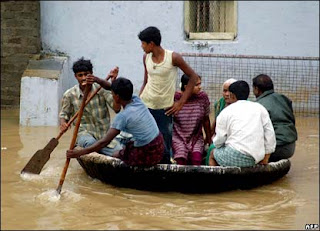
Lucy and I have been very sorry to hear from our friend P. J. Lawrence, Bishop of Nandyal, of serious flooding in Kurnool. About 25,000 people are said to be trapped in the city, amidst 10 foot floodwaters. Basic relief plans are starting up, It was delightful and moving and to visit the city in 2008.

We were bowled over by the love and generosity of so many people we met, and very impressed by the vigorous work going on to build the Church, both people and buildings. There had been serious foods in 2007, but this seems even worse.
These are enterprising, courageous and creative sisters and brothers, confronted now with a particular challenge
. Bishop Lawrence writes:
In Nandyal Diocese several areas are drowned in floods by the inflow of the rivers Thungabadra and Krishna. Mostly the Kurnool town is almost all drowned and other villiages in Kurnool District also submerged in water. Particularly our great church in Kurnool town also been surrounded by flood waters more than ten feet. Our clergy and the congregation members living in the surrounding area of the church are taking shelter in the balcony of the Church. And the news is that the situation may worsen further. People are running to higher grounds, and are trying for help. There is a sense of helplessness and uncertanity of life with the sense of drowning.

We have just concluded the meeting of all the leaders of the diocese to prepare for relief work with supply of food, water and shelter in our schools hostels and church buildings. We also conducting prayers of intercession and help for the gratest distaster. The situation is grave with raising level of water of rivers canals and tanks. This is the first of its kind we are appealing for your prayers. On the part of the Diocese priests, church workers, volunnteers and the whole diocese on the war footing for conducting relief and counselling and spiritual services.
So, please, pray, and when the time comes for help with reconstruction, please be generous. This isn’t a well-known part of the world, and I hope people in our diocese, especially those involved in our schools link, will be characteristically imaginative and generous in the face of this need.

Tuesday, 15 January 2008

Poop Poop Poop

How people drive is a mirror into the soul. The English can be genteel about it, but the theory is pretty much the Mr Toad One. I want to get there soonest. I must defend myself at all times (as Mike Tyson used to say), and the horn is a rude emergency device. Only rigid lane discipline, traffic lights and roundabouts can defend me from the aggression of strangers, and prevent accidents. Road Rage is just below the surface.

Indian driving is different. Roads teem with life, ox carts, herds of goats, motorbikes going the wrong way, toddlers. Horns sound every few seconds, with no offence given or received. Seatbelts are ornamental, but not Mobile phones. 4 lane highways have speed bumps, herds of cows & pushbikes crossing:

The crowning glory of our Indian Driving Experience, was probably the gentleman in the Northern suburbs of Bangalore, riding to work on the back of a motorbike with an office chair on his head instead of a helmet. Like you do. But we also saw families of five on motorbikes, with one helmet between them and a baby lying across the back seat. An Indian road is a total transport system for anything. You wouldn't think anyone would survive ten minutes, but they do. How? Here are some tell-tale signs about the human logic of Indian driving:

Indian Driving is a Social Dance. Indians drive with elaborate, sensitive social antennae, tuned to everyone else. Everyone keeps going at their own pace, simultaneously. The root concepts are radical pragmatism and social sensitivity. The Horn is a greeting, and drivers expect you to use it generously. Red Traffic lights (very rare) have a word painted on them — not “Stop” but “Relax.” By and large everyone’s journey is held to be as important as anyone else’s. You don’t need roundabouts because the whole road is a roundabout if you need it to be. Everything has its own order, but here’s the interesting bit — priority goes to the smallest, the weakest, and the least able to look after themselves, including animals. If there's an accident rigid hierarchy indicates automatically whose fault it was — the biggest/ fastest/ most able. Whatever happened it was their duty to protect the weak!

Here’s an everyday example of the whole dance, from our front windscreen traveling through Anantapur, Andhra Pradesh, possibly Gooty. They drive on the Left in India but actually our excellent driver happened to be driving on the right as the clip begins. I particularly liked the guy in the white van driving round and round in circles, and the motorbikes going the wrong way up the pavement on the left at the end. What does the way we drive in England say about our real social values?

Saturday, 8 December 2007

People, people everywhere...

Help! All the clichés are true, if only pale shadows of the vibrant realities that inspire them! Nothing could have prepared us for South India, either hi-tech Bangalore, or the remote rice bowl of the Deccan Plain. I'll limit myself to four blog entries over the next few days, because I'm fighting hard not to become an India Bore. Any voracious information gatherer loose in India feels like a hungry shark in an ocean of bright coloured tropical fish at dinnertime. Everything means something, and nothing is quite what it seems. You do get hooked. We did.
So, here are four immediate ways in that struck me — Mass humanity & inhumanity, Indian Driving, God overload, and something about Graciousness, Gracefulness and Grace. The other thing I must log sometime is the practical education/ development job Lucy and I went out to do, in which we was most triumphant, but mightily challenged.
Thanks to Lucy's conscientious following of our friend and Education Director Leslie Stephen's travel tips, we both came back with minds reeling but tummies untroubled by the legendary Delhi Belly. We got a diary, not diarrhoea. Not only is there a God — India has 8 Crores, 84 Lakh of gods (That’s 80,840,000 in the old money). Phew!
Related Posts Plugin for WordPress, Blogger...