Showing posts with label Retreat. Show all posts

Monday, 19 July 2010

Equity and Faith belong together

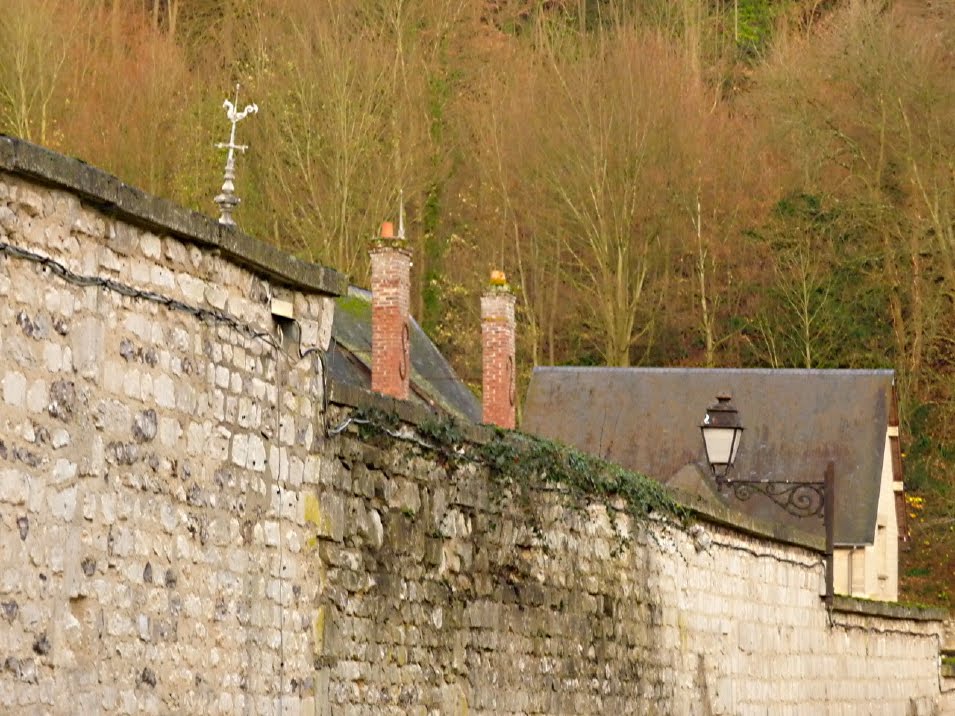
St Wandrille in July is almost unnaturally lush, green and leafy. It seems a completely different place to the austerity of November. I greatly value these weeks away from the internet, emails, etc. — indeed I have now spent 3 months of my life here, spread over the past few years. On my first visits I used to take a pile of books, but these days everything centres naturally on the office and the Church.

One theme that has been jumping out of the psalter for me this week is “equity.” Some people talk as though justice and equality issues facing the Church were some kind of imposition from secular culture, to be treated with suspicion as a post-enlightenment racket.

The insistence of the psalter that God is a God of equity and justice, whose people should strive to reflect these qualities gazumps this whole illusion. If, quoting Michael Ramsey, “The Church exists that Christ may reign,” our life should be characterised not by weird exceptionalism, but intentional striving for equity and justice. What equity means pragmatically differs from age to age. However the challenge remains constant. God’s justice may transcend that of the world, but it has to be at east as just. And after a week praying the collect, much more elegant in Latin than Engilsh, that Christians may reject those things that do not fit with the name we claim and choose those that do, it just doesn’t make any sense to suggest that basic issues of justice and equity are marginal or secondary, or merely secular impositions. They spring, in fact, from the core of our faith, as reflected in the psalms.

Thursday, 4 February 2010

Riddles of the Soul

Reflecting on the shared experience of six friends’ ministries this past year, I marvel how the balance works between belief (that is rational) and living experience of God (that often just grabs people unexpectedly from behind). Perhaps the best ways of relating both these dimensions of faith to each other and us are paradox and image. Offering a poem a day from this retreat/review at Alton, I suggest the paradoxes of a fascinating poem by New Zealand poet M. K. Joseph (1914-1981), and the great icon of SS Mary, John and Benedict in the Church here, which looked especially loaded and extraordinary surrounded by leftover candles from Candlemas on Tuesday.

A Riddle of the Soul

I cannot give
Unless I have
I cannot have
Unless I save
Unless I have
I cannot save
Unless I give
I cannot have.

Unless I live
I cannot be
Unless I am
I cannot seem
I cannot be
Unless I seem
I cannot live
Unless I am.

I cannot be
Unless I give
I cannot have
Unless I die
Unless I grieve
I cannot love
Unless I die
I cannot live

Wednesday, 3 February 2010

The necessity of Incarnation

Reflecting with the usual five friends on the last year’s joys, follies, grunts and frustrations, ecstatic and ordinary, long term trends emerge. We’ve been doing this together in this monastery at this time of year for almost thirty years, and someone noticed the way in which our conversation is less entirely than it was driven by ideals and the impossibility of bringing them to pass. We seem to have developed far greater acceptance of human realities over the past ten years or so. Rationalising this indicates that ideals, even good ones, need to take flesh or they don’t mean a thing. Cue D. H. Lawrence:
Demiurge

They say that reality exists only in the spirit
that corporeal existence is a kind of death
that pure being is bodiless
that the idea of the form precedes the idea substantial.

But what nonsense it is!
as if any Mind could have imagined a lobster
dozing in the under-deeps, then reaching out a savage and iron claw!

Even the mind of God can only imagine
those things that have become themselves:
bodies and presences, here and now, creatures with a foothold in creation
even if it is only a lobster on tiptoe.

Religion knows better than philosophy.
Religion knows that Jesus was never Jesus
till he was born from a womb, and ate soup and bread
and grew up, and became, in the wonder of creation, Jesus,
with a body and with needs, and a lovely spirit.

Monday, 30 November 2009

Winter refreshment in Advent colours

Over 10 years, I've never stayed at Saint-Wandrille this late in the year. Winter is a wonderful time for de-fragging. This year I decided to take a complete break from the Internet and all its works. In comes all the stuff and information from the year, and, as you enter a world of marked time measured by the psalter, everything begins to float towards its own level. Monastic life is paced by Scripture, not phone and screen. The psalter, as ever, articulated and absorbs an incredible range of feelings in an immensely varied range of emotional tones. So, over a week, everything begins to decompress, anxieties are acknowledged but not absolute, and a sense of God begins to emerge from the ordering of time.

The liturgy is absolutely plain in the last week of the year — a flatland before Advent. Benedict’s line about Monastic life being a continuous Lent, something about simplicity and refreshment, comes very much into its own. That meant a week of the traditional “stir up” collect, that feels gloriously straightforward in the Latin (Excita, quaesimus, Domine tuorum fidelium voluntates, ut divine operis fructum propensius exsequentes, pietatis tua remedia maiora percipiant...). This meant an easy ride through the psalter — especially to be appreciated in the early mornings!

The Monastery itself is approaching the barest it can be in the year. I was especially struck by the stick-like desolation of a glorious avenue of limes. If you»ve seen them in July they freshen the whole Courtyard with their soft verdant leaves and goo. Now they were so many sticks, with strangely bright spiky red tips. The hillside is equally plain, relieved only by occasional confiers (I could only count two or three) and, more sinister ivy strangling one or two tree trunks up the slope. The Vine is doing well in its own house, though. There are occasional green survivals on some trees, which makes me wonder whether the house is ever entirely leafless.


As to content, even though Advent felt further away than it was, you can’t ever get away from the Incarnation in an Abbey. The purpose of Christ being formed in me, however resistant material, is foremost. I spent some extended study time in the forites of the Rule, which I haven’t done before. As a new model Terms and Conditions of Service Tsar (!), I thought it might be good to work through Benedict on competencies and accountability, around RB46. It’s a part of the rule where Benedict innovates and simplifies considerably over and above the Rule of the Master, and I came back with a pile of fresh ideas, some of which may turn out not to be silly...

Sunday, 15 March 2009

Working in the Thirteenth Century

One of the things that’s helped me heavily into the notion of revolution by tradition is working in some fabulous medieval locations — like Charney Manor. Bishop’s Staff stayed there for a really productive overnight residential last week, where, as well as usual business, we spent some time exploring with Professor Martyn Percy what ministry education really has meant for us, and could mean in tomorrow’s church.
The house is owned by the Religious Society of Friends. It’s lovingly made available for groups with a basic commitment to peace, which I hope our Bishop’s staff is. Food is home-cooked and extraordinary. The house has a lived-in feel, not like a museum at all. Facilities are excellent — indeed they’re infinitely more homely but also stimulating than an average hotel-for-business-meetings site.

It’s good to work in a place where the Quaker tradition, that has played such a key role in British Christianity, is honoured and lived out. I was reminded of what it stands for by some words by her children about Joan Vokins, wife of Richard Vokins of West Challow, died 1690, after whom the annex in which I stayed is named:
She was one that did truly fear the Lord, and sought the prosperity of his precious Truth [“and” — surely a mistake] above all the glory and honour of this world. Whensoever the Lord was pleased to send her forth in his service, she went without murmuring, believing the Lord would carry her through it, though weak in body; who did enable her to bear a fathful living testimony to his Name, in this her native land, and in places remote beyond seas as in Barbados, and in other parts of America and in Ireland, through great exercises, in patience and cheerfulness, it being as meat and drink to her to do his will.

Tuesday, 3 February 2009

Alton Abbey in the Snow

The community here carries on in its own unpretentious way, with hope of some potential vocations. The pub landlords know us as old friends. Having been a regular at Alton with the same group regularly for 28 years, I thought I’d pretty much taken all the obvious pictures.

Add a burst of Snow, and everything changes. I keep expecting to bump into Mr Tumnus:
Snow does change everything — The shapes you thought you knew well blown up, soft and puffy, morphed, but with their inner secret better hidden, carpeted in a particular still silence.

In his wonderful book Finding Sanctuary, Abbot Christopher Jamison quotes a haiku blinked out by Abigail Witchalls, a young Catholic mother who was stabbed as she was out walking with her child and is now paralysed:
Still silent body
But within my spirit sings
Dancing in love-light.

Related Posts Plugin for WordPress, Blogger...