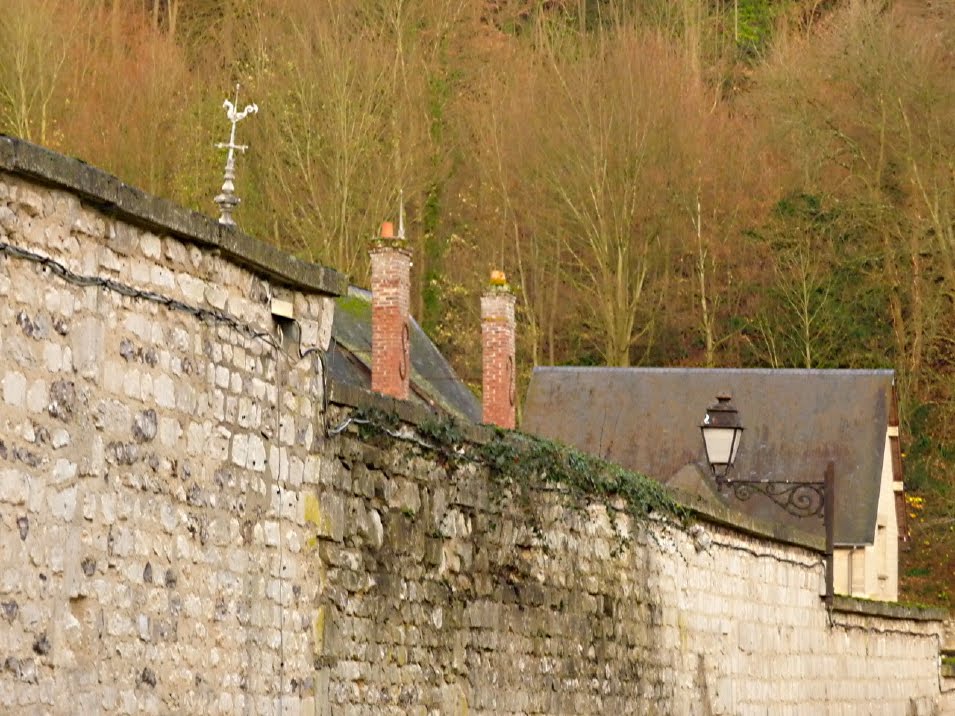
Showing posts with label Saint Wandrille. Show all posts

Monday, 19 July 2010

Equity and Faith belong together

St Wandrille in July is almost unnaturally lush, green and leafy. It seems a completely different place to the austerity of November. I greatly value these weeks away from the internet, emails, etc. — indeed I have now spent 3 months of my life here, spread over the past few years. On my first visits I used to take a pile of books, but these days everything centres naturally on the office and the Church.

One theme that has been jumping out of the psalter for me this week is “equity.” Some people talk as though justice and equality issues facing the Church were some kind of imposition from secular culture, to be treated with suspicion as a post-enlightenment racket.

The insistence of the psalter that God is a God of equity and justice, whose people should strive to reflect these qualities gazumps this whole illusion. If, quoting Michael Ramsey, “The Church exists that Christ may reign,” our life should be characterised not by weird exceptionalism, but intentional striving for equity and justice. What equity means pragmatically differs from age to age. However the challenge remains constant. God’s justice may transcend that of the world, but it has to be at east as just. And after a week praying the collect, much more elegant in Latin than Engilsh, that Christians may reject those things that do not fit with the name we claim and choose those that do, it just doesn’t make any sense to suggest that basic issues of justice and equity are marginal or secondary, or merely secular impositions. They spring, in fact, from the core of our faith, as reflected in the psalms.

Thursday, 24 December 2009

The Work of Incarnation Close up

In Church on Sunday, Rosie the Vicar walked us through the Magnificat as a woman’s voice amidst the overwhelmingly male sounds of Hebrew and Christian Scriptures. At Christmas, I was moved and delighted with a greeting better than any card from Katherine Kaye in Oxford. She wrote:
This is a poem called "Not Art", by Kate Clanchy, an Oxford poet. It is one version of female experience which, as a man, you can only look in on, what it means to visit the place where women show one another wares, their handicrafts, and what is gain: so unspectacular, so unshowy, so not what the dominant ones notice, let alone "count" - and yet what makes us what we are. Our true home is in our childhood. That, and a recommendation that you listen to the three ages of women in Durufle's "Tota pulchra es" make up my Christmas gift to you: more perspectives still.
The image of Our Lady is from the Church at Saint-Wandrille — a final picture I took during this year’s stay. It is actually a nineteenth century iron casting (I kid you not) taken of an original in the Louvre.
Not Art


This is close work, this baby-stuff,
the intricate wiping and wrapping,
the slow
unpicking of miniature fists;
village-work, a hand-craft, all bodges
and spit, the gains inchingly small

as the knotting of carpets, raw wool

rasping in the teeth of the comb.

The strewing and stooping, the prising

of muck from the grain of the floor -

I think of gleaners, ash-sifters, of tents

sewn with shoe soles, wedding veils, plaits,

how patchwork is stitched-up detritus,

how it circles on quilts like a house split

to bits when the typhoon has passed.

And the ache in the neck, in the back,

in the foot, are the knocks of wood looms,

narrow as cradles, borne from pasture

to valley to camp. I am learning
the art of mistakes, to accept

that the marks of each day are woven in

by evening too far back to pick out.

This is the work women draw from the river,

wet to the waist, singing in time,

the work we swing from our shoulders,

lay on the ground and let the crowd

hold and finger and value - the young girls
wondering, the laughing old women,

the bent, the milk-eyed, the blind.
Reblog this post [with Zemanta]

Monday, 30 November 2009

Winter refreshment in Advent colours

Over 10 years, I've never stayed at Saint-Wandrille this late in the year. Winter is a wonderful time for de-fragging. This year I decided to take a complete break from the Internet and all its works. In comes all the stuff and information from the year, and, as you enter a world of marked time measured by the psalter, everything begins to float towards its own level. Monastic life is paced by Scripture, not phone and screen. The psalter, as ever, articulated and absorbs an incredible range of feelings in an immensely varied range of emotional tones. So, over a week, everything begins to decompress, anxieties are acknowledged but not absolute, and a sense of God begins to emerge from the ordering of time.

The liturgy is absolutely plain in the last week of the year — a flatland before Advent. Benedict’s line about Monastic life being a continuous Lent, something about simplicity and refreshment, comes very much into its own. That meant a week of the traditional “stir up” collect, that feels gloriously straightforward in the Latin (Excita, quaesimus, Domine tuorum fidelium voluntates, ut divine operis fructum propensius exsequentes, pietatis tua remedia maiora percipiant...). This meant an easy ride through the psalter — especially to be appreciated in the early mornings!

The Monastery itself is approaching the barest it can be in the year. I was especially struck by the stick-like desolation of a glorious avenue of limes. If you»ve seen them in July they freshen the whole Courtyard with their soft verdant leaves and goo. Now they were so many sticks, with strangely bright spiky red tips. The hillside is equally plain, relieved only by occasional confiers (I could only count two or three) and, more sinister ivy strangling one or two tree trunks up the slope. The Vine is doing well in its own house, though. There are occasional green survivals on some trees, which makes me wonder whether the house is ever entirely leafless.


As to content, even though Advent felt further away than it was, you can’t ever get away from the Incarnation in an Abbey. The purpose of Christ being formed in me, however resistant material, is foremost. I spent some extended study time in the forites of the Rule, which I haven’t done before. As a new model Terms and Conditions of Service Tsar (!), I thought it might be good to work through Benedict on competencies and accountability, around RB46. It’s a part of the rule where Benedict innovates and simplifies considerably over and above the Rule of the Master, and I came back with a pile of fresh ideas, some of which may turn out not to be silly...

Monday, 23 November 2009

I may be gone for some time

...said Captain Oates.
But only, in fact, DV until Saturday.


As announced at Oriel College when preaching at Evensong, I’m off for the inside of a week’s retreat at the Benedictine house of Saint-Wandrille near Rouen. This is a wonderful place to reset the clocks and meditate. You can find out all about the monastery here. I will take the camera.

To blog or not to blog? Actually, am giving the internet a rest for a few days. I will post some reflections next weekend.
Reblog this post [with Zemanta]

Wednesday, 26 November 2008

Retreat Notes 2: Tradition and “Traditionalism”

Tradition is lived reality — in the New Testament “I received of the Lord what I passed on to you;” I received it as I received it, and you received it as the person you were, lived it fallibly, but authentically enough to pass it on. Thus tradition renews itself in each generation, out of circumstances, by Grace and the Holy Spirit.

Therefore Tradition is always touched by human hands, never pure and unsullied, always subject to seasons and sin. Pure objective points exist, but they are beyond me. If, driven by fear and insecurity, I extract some element from my life in Christ and try to erect it into an objective norm to bypass the messy process, I am basically making an idol. The tradition I pass on wouldn’t need pickling if it were actually alive.

That is why we need faith
; and that is why splinter movements, even Lefèvrist ones with traditionalist good intentions and bright beginnings, always end up petering out inconsequentially, unless they find a way to reintegrate. Separated from the vine they wither and die.
Good religious communities are laboratories within which we can see the dynamics of tradition properly working. The life to which Benedict calls Christians renews itself generation by generation, as it is lived. Here is Dom Antoine Levasseur writing about Saint Wandrille:
His biography is far more than an informative record about a character from the dark ages. It must live in us. That is difficult for our modern minds to grasp, given our habit of considering ancient writings as mere records, or souvenirs of a past age. This is that, but it seeds itself afresh in each successive present, in order to engage us and train us for the future, to live the life for real.
Lived tradition challenges tendencies, understandable in times of fast change, to romanticize, confabulate, fantasize or panic. It is those tendencies which invite us to fix on some Big Thing, hang desperately onto it, then make it the Grand Shibboleth.
Here’s a recipe for “traditionalism.” Half digest some of key ingredients from a living tradition in a rather modernist way, pickle them up, then pack them up in the old kitbag as weapons. You half digest because the days are evil and you are in a hurry. If you really digested the tradition you would be aware of its subtleties, vulnerability and ultimate mystery.

The Religion may be laid on with a trowel, but there is little faith involved. There used to be a thing in England called the “society for the maintenance of the faith”; a rather extraordinary object for a society, the more you think about it. Or at least so it seems in a place where the week’s ferial collect contained a daily reminder it is God alone de cuius munere venit, ut tibi a fidelibus tuis digne et laudabiliter serviatur (“of whose resource alone it comes, that your faithful may do you appropriate and praiseworthy service”). This monastery wears its religion sincerely, but lightly and realistically. After 1359 years of the process Dom Antoine describes, there’s nothing left to prove. Amen!
Related Posts Plugin for WordPress, Blogger...