
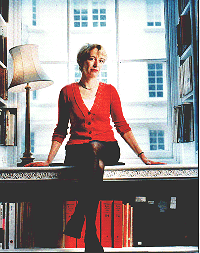
 Is Facebook doing all our brains in? Susan Greenfield is the country’s most distinguished popular brain scientist, and has asked hard questions in the house of Lords about the harmful effects that hours spent on Facebook may be having on our childrens’ attention spans and social development.
The whole experience social media offer is
devoid of cohesive narrative and long-term significance. As a consequence, the mid-21st century mind might almost be infantilised, characterised by short attention spans, sensationalism, inability to empathise and a shaky sense of identityWoody Allen once said his Brain was his second favourite organ, so this is an urgent question. And, typical Anglican, my instant superficial response is to say I believe that, as reported, her words are both entirely correct and entirely wrong-headed.
 Her concern is fundamentally right, because everything we experience has some impact on the brain as a complex self-organizing system. We learn by adaptation, and it is impossible to think that, however we fill our hours, this will have no impact on our personalities, expectations, skills and aptitudes.
That said, I believe her particular concern is probably entirely misplaced, in the grand Scientific tradition of Dr Dionysius Lardner’s dire predictions that trains would kill people if they went over 40 mph.
I have learnt from Professor Greenfield, and others, that the brain is not a single entity. It's more accurate to think of it as a bundle of specialised centres, each developing its own competence by adapting to experience. This makes personality, the vital precondition of rich social interaction, an emergent reality. We have an amazing ability, especially during teenage neurological growth spurts, to develop superabundant multiple interrelated abilities, rather than simply manage static or limited capacity. The whole brain is fantastically adaptive and compensating.
Therefore experience of hours on facebook is unlikely to skew the whole personality in the way suggested. Walking three miles to school every day for eight years doubtless strengthened my legs and their neurological controllers, and scored pathways at various loci in my brain. It certainly absorbed many hours of time I could have otherwise been reading. But to go from that self-evident truth to an assertion that adapting my neurophysiology to largely autonomic control processes could only be done by stunting my capacity to develop centres for higher non autonomic functions like reading, is nonsense. Those tradeoffs are neither necessary, nor desirable. I walked to school, and got into Cambridge. So did thousands of others.Screentime may be damaging eyesight, obesity levels, the ways people connect stories and spirituality; or not. Research is always welcome. But the autism thing is surely nonsense. How can babies, for example, have been corrupted by hours on Facebook, of all things? Autism seems to be a parking lot for anything we don't like and don’t get — it fulfils the social function witchcraft did in Salem, MA. Witness recent hysteria over MMR jabs.
Finally, and this is the thing people my age never get at first, the whole point of social media is not the screen, but the human beings with whom you communicate using the screen. My kids don’t MSN because they love MSN technology. They do it to be with their mates. Offering a rich palette of ways of interacting, mediated by screen, actually enriches their interactions. All I could do at their age was talk for hours on the phone with my girlfriends. They can share videos, etc.
The effect of the whole is not to make them want to stay at home, but to develop an even more voracious appetite for social interaction, including face-to-face. Having more material from which to construct narratives doesn’t prevent you doing so, any more than living in a forest would prevent you having log fires. Au Contraire.
 Therefore, above all, I beg to differ because the vast majority of young people I meet are intensely socialised and socialisable, very aware of others, and far less geeky and withdrawn than many of my compadres were thirty years ago. My generation’s geekiness resulted from hours reading books on our own, when we should have been socialising with small talk down the pub.
If you really push me to source attitudes that are “infantilised, characterised by short attention spans, sensationalism, inability to empathise and a shaky sense of identity,” I’d head right for Fleet Street. Since nobody much under 30 reads a newspaper any more, I’d say the human race’s social future is pretty secure...


