Showing posts with label Maggi dawn. Show all posts

Thursday, 1 July 2010

Bible and Culture 101

Back in the 1960’s school RE was boring and worthy but predictable, and largely based on the Bible. You might decide it was a load of old tosh, but at least you ended up able to understand Shakespeare’s Hamlet or Milton’s Paradise Lost. The past becomes a completely foreign country, however, when a society obsessed with the latest of everything loses touch with its own roots, and compromises its own corporate memory.

Let me illustrate. As a sixth former I learnt that after the death of Palmerston, in 1866, a group of anti-Reformists called the “Adullamites” forced the resignation of Lord John Russell as Prime Minister. This interesting bit of Lib/Con coalition building has much contemporary resonance. John Bright, leading political commentator of the day, coined the term to draw attention to Lowe and Elcho’s unwillingness to be led by either Gladstone, whose reformism they had consistently opposed, or Disraeli. The meaning was plain to anyone who knew I Kings 22. Trouble is, not many of today’s students know I Samuel 22. We even have students who have never read Genesis 1 or Matthew 5, let alone I Samuel 22.

Enter Maggi Dawn, and her new book The Writing on the Wall. It’s a trip through the Bible for the biblically ignorant but otherwise educated reader, giving some basic info and background on the stories that have shaped our literature and history. She doesn’t just tell the story, but gives enough background to it to help you understand its meaning, and why it may have been used as it has been. So she turns on a light bulb to illuminate a range of cultural basics — Shakespeare, Rembrandt, Milton, Senser, Jacob Epstein, Wilfred Owen, William Blake, Tennyson, Oscar Wilde, yea even Monty Python... and hundreds of others.

So, here is an ideal present for the sixth former in your life who seeks some background to our culture. Its clarity and sense of perspective may also help the busy preacher. No cave of Adullam, though. Now someone’s done Literature, could it be History next for this treatment?

Monday, 21 June 2010

If you want to get ahead get a hat

I return from a very busy week hosting Indian visitors, among other wonderful experiences too absorbing to allow time for blogging, to find great convulvulus in the Blogosphere over what some are already calling Mitregate.

Now that the Murdoch paywall has, tragically, cut Ruth Gledhill out of the conversation, the best source of information is Maggi Dawn.

This bizarre story indicates, as has been told, that unlike previous visiting female bishops from the US, the Presiding Bishop of the Episcopal Church was banned from wearing a Mitre in Southwark Cathedral. Forrest Gump’s mum used to say, stoopid is as stoopid does, and the whole mentality of such a request, if it was ever made, is profoundly stoopid. The whole thing smacks of hypocrisy. It bears the fingerprints of blind officialdom rather than the Archbishop himself.

I’m an optimist, however, and can see positive learning from such loonery:

  1. The C of E has a lot of getting real and growing up to do. Seeing the problem presented in a stark form presents a good opportunity to recognise it and resolve to do better in future.

  2. All God’s promises are “yes” and “amen” in Jesus Christ, who taught his disciples to say yes or no. Anything else comes from the evil one. The Spirit has always called the church to a form of ministry that was real within the sociology of the world we serve. Therefore we respond to the Spirit’s call obediently, not half-heartedly. The Puritans used to talk about the “Devil’s Martyrs” — people who lost out all round, because they messed with Mr In-Between, depriving themselves of the advantages of being Puritans, or Libertines. Simply framing the Spirit’s call to ordain women in terms of the problems it raises is boring, weedy and faithless, as well as hypocritical.

  3. We’ve been reading recently in Church about Jesus in the house of Simon the Pharisee. We all have an inner self-important Scribe or Pharisee, and by his fruits ye will know him. Some exceptional people, however, manage on occasion to walk through the inner ring of Scribes and Pharisees with deftness and charity. It’s by doing this, ex opere operato, that such people demonstrate an important theological truth. Although the Church’s outer (institutional) form is rotting away, says St Paul, its inner being is constantly renewed by the spirit. The grace of God makes such things possible, and thus gives hope. What we have to ask ourselves is who, in this admittedly trivial but symbolically loaded tale, has acted in a Christlike way, and how? What do we learn from it?

  4. As a bishop I learn that, loaded with creative potential and myth as my job can be, when all is said and done I am just a driver of the Lord’s Number 49 bus, and the more I can rememeber it’s his bus not mine, saints preserve me, the less likely I am to get too far up myself. This makes me easier to live with, and learning it daily is worth a day of anybody’s wages…

Thursday, 18 February 2010

True Fasting: fruit and effects

If all we think and do for God is provisional, how can we discern the spirits? A theologically based poiont of view cannot be validated merely because it uses God-talk and Scripture, appeals to conventional understanding from former ages, or is passionately and sincerely held. Apartheid endorsements from the eighties were all those things, but still wrong, indeed evil.

The mistake the wrong sort of Pharisee made, and St Paul’s opponents in Galatia, was to suppose Faith is some checklist thing that could be read off in advance. All we can ultimately test a proposition by are its fruit and its effects. The real tests of our most insistent Scripturally founded theological convictions are
  1. Fruit — what fruit does a proposition bear in the lives of those who espouse it, and how is it good news for everyone concerned, and how does it fit into God’s purposes for the peace and salvation of all?

  2. Effects — does it confront injustice, enrich the poor, set the prisoners free, minister healing, and turn the world upside down?
Activity that is literally fruitless, or even worse, bears bad fruit — anger, clamour, wrath, rivalry, emulations, factions — will probably serve nothing but itself.

So, contemplating the future of the Anglican communion with someone who wrote to me about it from overseas, I can see a positive future, if we have the courage to go for it. It came to me this morning, like a slap across the face, in the passage Maggi Dawn’s Lent book gives for today from Isaiah 58:
Is not this the fast that I choose:
to loose the bonds of wickedness,

to undo the straps of the yoke,

to let the oppressed go free,

and to break every yoke?

Is it not to share your bread with the hungry
and bring the homeless poor into your house;

when you see the naked, to cover him,

and not to hide yourself from your own flesh?


Then shall your light break forth like the dawn,

and your healing shall spring up speedily;

your righteousness shall go before you;

the glory of the LORD shall be your rear guard.


Then you shall call, and the LORD will answer;

you shall cry, and he will say, “Here I am.”

If you take away the yoke from your midst,

the pointing of the finger, and speaking wickedness,

if you pour yourself out for the hungry
and satisfy the desire of the afflicted,

then shall your light rise in the darkness

and your gloom be as the noonday.


And the LORD will guide you continually

and satisfy your desire in scorched places

and make your bones strong;

and you shall be like a watered garden,

like a spring of water, whose waters do not fail.

And your ancient ruins shall be rebuilt;
you shall raise up the foundations of many generations;
you shall be called the repairer of the breach,
the restorer of streets to dwell in.

Wednesday, 17 February 2010

Lent, Faith and Clarity

Our capacity to build conclusions on what we think we see is the most useful but also the most dangerous trick in the bag. We catch a perception of something that matters,then crystalise it mentally into something we think we know. All well and good, often. But when mental ruts grind deep, what we think we see becomes more real than what’s there. Mark Twain pointed out that what makes us dumb isn’t what we don’t know — It’s what we think we know, but it’s wrong.

Faith is the capacity to hold something that could be true at arms length, accepting its apparent reality but not at face vaue. Faith is looking deeper, and lookign around. Faith is comparing our experience to other people’s within the Catholicity of a whole company of people and the Scriptures. Then faith is acting, but fully aware of the provisionality of anything we can think we know, compared to the blazing reality of God.

So this Lent I’m using Maggi Dawn’s Lent guide, Giving it Up, as a daily read. She starts with some classic meanings and disciplines of the season, but then invites us to bring our various cheished notions about God, the world and everything back to some significant Biblical passages and characters for checking, cleansing and re-envisioning. Having used Maggi’s materials for Advent before, I am very much looking forward to the journey...

Friday, 19 December 2008

Happy families? all a bit weird...

Do nothing — Christmas is Coming! Last year I followed Maggi Dawn’s excellent Biblical advent course. This year Lucy and I have been taking Stephen Cottrell’s advice as we prepare for the Big Day. Stephen tracks through most of the weary things we’ve all felt, and some of us have said, about Christmas on its way, then takes the whole thing to the cleaners, by suggesting some down-to-earth ways of Thinking Different, that could really make a difference.

On Page 1 (as far as the busy journalist can be expected to read in any book) Stephen quotes one weary grinch:
Groan. It’s the first day of December, I’ve got about a hundred Christmas cards to write...”
Sadly our journalists were so busy that they didn’t get far enough to realise that this wasn’t an ex Cathedra statement from Stephen but an opening quote about feeling harrassed round Christmas. This mistake gave birth to a “Father Ted has got it in for the Chinese” story about Stephen and Christmas Cards. This straddled the world, from GetReading:
The self-styled “crazy bishop” has made the news again urging us all to forgo sending Christmas cards.
to the sunburned splendour of the (Murdoch) Brisbane Courier Mail

Church of England Bishop Stephen Cottrell says we should chill out this December and forget about sending Christmas cards.

Even Kiddiwinks got misled, as the fountain of niceness, CBBC Newsround reported:
Stephen Cottrell says we should stop sending Christmas cards to absolutely everyone we know, because it's a waste of time.
This is the time of year when most journalists go out, leaving machines to write ritual formulaic stories instead. There is a Holy Trinity of seasonal RF Stories:
  1. Sales exceeding all records (possibly not this year, but they might run it anyway)
  2. A council somewhere cancelling Christmas so as not to offend other faiths
  3. Some vicar somewhere who doesn’t believe in Santa Claus.
These stories are not produced by human beings. There is no point treating them as though they were. The tale of a bishop banning Christmas cards is a variant of (3).

Having read as far as page 46 of Stephen’s book, I can testify that it’s worth it:
To one degree or another, we all find our families embarrassing. It’s something we all have in common. And the other sobering fact that we seem hell-bent on avoiding is that we are all members of our family. What really irritates us about them is that they are so like us! And here’s another uncomfortable truth: we are part of a common humanity. We all have the same frailties, insecurities, anxieties and heartfelt longings. We are all a bit weird. We are all flawed. We are all less than the people we want to be. We all get embarrassed by ourselves and by those around us. We all cause embarrassment to others.

Christmas can be a time when we let this get on top of us. Wouldn’t it be better to take the medicine on offer? To accept these frailties, and then do two other things: first, accept yourself as the flawed and beautiful person that you are; and second, have a very good laugh at your own foolishness and enjoy the foolishness of others, especially those you’re going to be spending the next week with. After all, this is supposed to be the season of goodwill.
I defy the risk that the world’s press will now report that the self-confessed weird bishop has murdered all his family. I like his advice today:
  • The best comedies will not be on TV this Christmas. They will be around your own table, if you can but see them.
  • Re-imagine the peoples of the world as a hugely complex, extremely muddled, wonderfully odd and riotously funny family. Enjoy the differences. Take proper account of the deep-seated similarities.

Tuesday, 25 November 2008

iSpy Advent coming up...

The publishing trade seems to have spotted a new market developing in Advent resources. Maggi Dawn got in first last year with Beginnings and Endings, a thoughtful daily Bible based resource that takes you right up to Twelfth Night. This year I want to try m’colleague and friend Bishop Stephen Cottrell’s down-to-earth Do Nothing: Christmas is Coming. Watch this space.

If that’s not enough to get you there, perhaps you need an Advent iPhone application. I’m trying Advent08 from iHabitus.com. This is a Scripturally based image enhanced supplementary office you run on your iPhone, that may well do nicely in the evening, complete with Celtic artwork that counts down from Advent Sunday, tying everything together. It can be used with personal or group meditation around an Advent wreath. For Liturgical anoraks, the scheme follows colour coded classic Advent themes up to and including the O Antiphons, and lands you up on Christmas Eve all dressed up and ready to go. All this for only 59p from the iTunes store!
...

Wednesday, 20 August 2008

1904/2008 — Just Men?

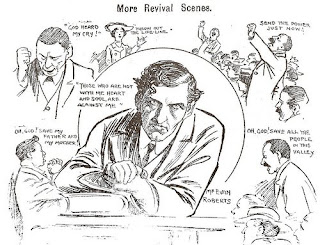
Basil Hall, my Director of Studies when I was an undergraduate, taught in a Presbyterian seminary in Wales, I believe, just after the Second World War. There, in a mental hospital garden, he encountered a quiet elderly man, rather broken in manner, whom they said was in fact Evan Roberts, leader of the great Welsh Revival of 1904-6. He suffered a massive breakdown in 1906 and withdrew from public ministry. The Western Mail said of him, on his death in 1951,
He was a man who had experienced strange things. In his youth, he had seemed to hold the nation in the palms of his hands. He endured strains and underwent great changes of opinion and outlook, but his religious convictions remained firm to the end

As a young man in his twenties, Roberts, a former miner, ignited a chain of dramatic Evangelical conversions that swept 100,000 people into the chapels of the Principality. Before that time Wales wasn’t known for male voice choirs and teetotalism — it was the Welsh revival, they say, moved the goalposts.

Real life is strangely mixed — Swift satirised fair tulips sprung from dung. Among my favourite movies is Steve Martin’s Leap of Faith, which affectionately parodies an Elmer Gantry shyster revivalist. Jonas Nightingale pulls all the tricks in the book but finally a little girl is genuinely healed, rain really does come to the dustbowl, and the joke’s on us all, as well as him.

Cue a couple of posts from Maggi Dawn, here and here, about the breakdown of Todd Bentley’s marriage (details from Brother Maynard here). Earlier this summer a friend who’s a nearby Baptist minister was kindly critiquing the Lakeland revival on the basis of some UK follow-on stuff he’d attended. Amidst much extreme stuff (people being knocked over in a supercharged atmosphere some outsiders would associate with stage hypnotism rather than religion), I would lay serious money some people have actually been helped to genuinely good places they otherwise wouldn’t have reached.

If it’s a spiritual virtue to value the person more than the sins they commit, perhaps it’s also prioritising mercy before sacrifice to look to the human being amidst religious hype, to remember them personally and charitably in our prayers, and to recall that in the end we’re all in the same boat.

Sunday, 6 January 2008

On the twelfth day of Christmas

A wonderful confirmation service on a glorious sunny morning at Hambleden for Epiphany — and the end of Maggi Dawn’s Beginnings and Endings (and what happens in between) which I've reading almost daily since 1 December. It’s been a very engaging way to stay focussed at a time of year I usually rather lose the script. This book gives a short scripturally based reflection for every day from the beginning of Advent to twelfth night. I have missed two or three days, but it’s easy to catch-up, and I've very much valued the overview, and some of the particular ideas. There’s a very strong biblical base, including the big picture alongside some analysis of particular parts of the story and context. This book puts you back in the place people were in before they did Christmas in an over-familiar way. Tracking through the tale from the very beginning stage by stage has been very enriching.
As Matthew tells the story it’s not a neatly wrapped-up ending, but a scene of urgent and slightly panicky journey making. Both the magi and the holy family are warned not to go back the way they came, and they depart from Bethlehem in different directions.... the end of the nativity story, then, marks the beginning of two new journeys into the unknown — two journeys in which the plans are changed at the last minute and departure is suddenly made more urgent.
The idea that we cannot go back the way we have come is an important spiritual metaphor: having encountered the Christ-child, we can never just go back. Even if we return to the same life we find that it has somehow changed...
For those who like the idea that the gospel gives us certainty — clear and applicable truths that we can solidly depend upon — this ending of the birth narratives is an uncomfortable disruption. The only certainty here is the promise of uncertainty. But it is an uncertainty that is full of hope, for it is also the promise of new beginnings.
My only qualification to this enthusiastic endorsement is to point out that you can’t exactly read it in the way it’s designed to be used for another 11 months — but Advent and Christmas will, almost certainly, be back next year...

Monday, 26 November 2007

as long as a piece of string

Looking ahead to Advent, which I’m going through this year with Maggi Dawn’s reflections Beginnings and Endings, the cover and blurb drew me into thinking about time; time (chronos — how long), and time (kairos — opportunity). And what about the context of both: beyond time what? — eternity? Infinity? world without end?

We can use a bit of Maths here. How long is the coastline of Britain? There’s an AA Road Atlas answer, which is good enough for most purposes, but there’s also a completely different Mathematical answer, which you could express by breaking down every line and mapping it as a set of points in a complex plane to form a fractal. Here’s a Mandelbrot set (not the coast of Britain). If the final frame were the width of your screen, the whole fractal would be larger than the known universe — it’s an interesting image to pray with... world without end?

Sunday, 23 September 2007

Ever-rolling Stream...

Just Time, today, to tear the wrappings off an interesting looking new book, Endings and Beginnings, by Maggi Dawn, priest, poet, musician and theologian. That kind of Time is “Kairos.” But it isn't the only kind of time.

There's another word also for ‘Time’ in NT Greek. It’s Chronos — the stuff by which you set your watch. The second word in my first sentence, Kairos is “time in its human context,” opportunity. Chronos runs smooth and regular, like a vibrating quartz crystal. Kairos is far more subtle and complex. Can you say how long, strictly speaking, was your first Kiss? Labour? Driving Test? wait for a scan result? You can give a figure, without beginning to explain what it really meant or why.

Advent is the time when everything comes full circle — The old year dies, and the whole story begins again. As we follow it through, we are put back in the position of people who had never heard of Christ, so that we can live the whole story from scratch, and capture something of its freshness and vitality, as well as opening up new possibilities we didn't see last time round. Thus we journey onward towards the city of infinite day, one step, one cycle at a time, refreshed and renewed on our way.

Maggi's book takes us through some Bible passages that may help unlock this process. She tracks the story through Christmas itself and right up to twelfth Night; giving a focus for eleven days that often disappear from my life into a kind of Blue Haze. Not this year. I don't want to give this book a flat review as though it were an academic treatise, because that's not the way it was designed to be used. What I will try and do is use it myself through Advent, reporting back occasionally how I'm getting on. I'm looking forward to a good poke around the roots of our faith, and a chance to turn some attention to some of the last things I usually want to think about, all anchored into some classical texts of exile, restoration and hope.
The biblical accounts of beginnings and endings tell us that the Christian faith is a journey that starts somewhere and goes somewhere. It's a journey that develops through time, rather than simply going round and round in an endlessly repeating cycle. the season of Advent, too, reminds us that we come from somewhere and we are going somewhere, and thinking about beginnings and endings helps us to rediscover meaning and purpose as we live in these times that are ‘in between’.

Related Posts Plugin for WordPress, Blogger...