Showing posts with label Worship. Show all posts

Tuesday, 20 April 2010

Weaving the Rainbow in Wycombe

Rainbow Worship is a regular outfit based at St Birinus and St John High Wycombe, which started four years ago and increasingly draws in several dozen people with learning difficulties from all around, to network, celebrate, and worship. It’s a congregation that’s started from the other end, not so much trying to jam people into conventional observance as to allow simple and engaging expressions of love and prayer to emerge from a very diverse crowd.

RW is rumbustous and celebratory some of the time, but hushed and awed at others. Comments are chipped in from all around as things happen, like an ol’ time revival meeting. Craft actvities are built in, and the management has radically tried to break down the distinction between client and helper. On one occasion, as Noah’s Ark was revealed in all its glory, a loud voice cried from the back, “This is one I made earlier.”

Last night I confirmed six members of this community. It’s extraordinary how live it feels praying with people who have no “side” or pretensions, but simply respond instintively in the moment. Highlights included a Creed delivered to thunderous band in clubbing style, melding into a sea of friendly, open faces, dancing and banners, and losing myself in the joys of dance with a marimba. One of the first things I believe we will lose in heaven is self consciousness, which will be subsumed in self-awareness, and the tingling joy of being alive, as death is swallowed up in victory. That’s what we did last night anyway. A lot of us came away feeling we had had a trip to the cleaners — and that doesn’t always happen when we worship, does it?

I found it the experience of a lifetime to bless, anoint and confirm in such a place. There had been modest anxiety in the setting up about how some would cope with the touching and liturgics.
Actually, it was a liturgical stroll along a moving walkway, to call people by name into the kingdom, to anoint them as a sign that they are royalty with the King of Kings, to bless on the basis that “God has called you by name and made you his own...”

Although the language of inclusiveness is politically usable, I don’t actually think it quite covers such experiences. “Inclusiveness” assumes there is a some thing that really belongs to “us” (whoever we are) into which “they” (whoever they are) need to be “included” preferably by the things “we” do for “them.” This did not feel like that at all.

The truth is that we are all exceptional people, all fearfully and wonderfully made, with varying awareness and ownership of what makes us exceptional. Some people with learning difficulties have far more of this than the well-heeled. The real emergence of something heavenly occurs naturally when we all embrace our exceptionalities — why should we wish to be deceived? — and lose ourselves in the emergent transcendence.

One interesting little piece of inclusiveness though, was the inclusion of Morag who founded and leads the group. She was stuck in Switzerland waiting for a plane, so was skyped into the event on one of the worship leaders’ laptops.

It was the first tme I had seen that done in a confirmation, and it somehow affirmed the irrelvance of geography, as well as “disability” to the proceedings.
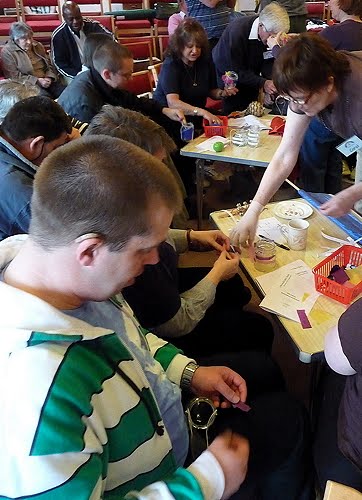
Many thanks to Steve the Vicar, Morag, Roger who led the talk, craft leaders, and Jay who led much of what geeks would call the Synaxis, and friends, including Scratch the Preacherman Dog.

When you get to heaven it will seem a more natural carry-on to you than it wll people who have been further up themselves on earth, because you will have been practising first.

Saturday, 24 January 2009

Church Building and Building Church?

Outsiders often love Church buildings, where insiders often feel more of a love/hate thing about them. Insiders know all the pitfalls and challenges, as well as appreciating their place in the local skyline. It's been fascinating to spend two days with the Ecclesiastical Law Society, contemplating buildings as mission opportunities.

Sir Roy Strong sees no future for parish churches as mere museums or clubhouses, bottled up in formaldehyde. They have to engage everyone who relates to them to have a future; and if this means toilets, then so be it. He is interested in the long-term history of Churches before our eighteenth and nineteenth century forbears turned them into one day a week places. We need to recover a longer perspective; and be slightly careful about amenity societies and others, if they ever exercise power to comment without responsibility.

Charles Mynors and Richard Giles led us through legal and structural possibilities for buildings. I came away from Richard’s talk in particular feeling that where things sometimes go wrong is when congregations themselves lose the script about their worship. It’s a trap to engage architects before you know what you’re trying to achieve and why — results can be disappointingly muddled and incoherent.

Andrew Mottram and Paul Bayes then led us through the concept of buildings for mission. It’s mad to start with design, before you know what you’re trying to design. This comes back to the need for clear thinking from the outset. All sorts of people way beyond our conventional constituency are seeking out special, holy places in their lives. Look at those shrines you increasingly see lovingly kept see by the roadside, where people have died. When people oppose change, it’s easy to grumble about them — but what is God saying to us through them about where we need to be? People can be very positive about their parish churches, but not if they are only fitted for gathered communities with high exclusion thresholds various. he gave various examples of different groups relating to buildings in surprising ways, sometimes very positively and creatively.

Tonight? John Mummery, Justice of Appeal and Chairman of Tribunals under the Clergy Discipline Measure. Stern and thrilling stuff awaits, perhaps...

Sunday, 12 October 2008

Who’s wrecking Britain, and how?

Quentin Letts of the Daily Mail includes Graham Kendrick in his list of 5o people who have wrecked Britain (h/t Dave Walker and David Keen). GK has wrecked Britain, apparently, by writing 400 popular Evangelical hymns. I can’t say I’m a particular afficionado of them, but somebody must find joy singing them. If people’s hearts are stirred to worship God this way, why be snooty and sarcastic about it? Unaccountably, QL’s piece also takes a mean sideswipe at Mrs Alexander’s All things Bright & Beautiful, which I would have thought was right up his street. Beating up old ladies in public is ugly, but it’s a free country, I suppose.

Somebody told me today that what’s really wrecking Britain for them is the angry cynicism, celebrity fixation, base xenophobia, mean spiritedness, superstition and crass materialism they find in the Daily Mail. I don’t often read the Mail, so I couldn’t possibly comment. But a marvellous contraption called the Vodex Mailmaker will help you explore for yourself how the Mail’s worldview saves (or wrecks) your Britain. In seconds I produced my own work of art.

Most of the work we do is by definition less than our very best. Every age’s hymns contain much that is ephemeral, and it’s only as they are sung over many years that the real long-term winners emerge. So it was pure joy to be in a large congregation in Winslow this morning, on the 50th anniversary of Ralph Vaughan Williams’ death, a day designated as the International Day of Vaughan Williams, singing For all the Saints to his wonderful and uplifting tune.

I think we can all agree that RVW’s contribution to Britain’s worshipping life was sublime and enduring. How come some of our greatest hymn tunes were penned by an agnostic? Music is self-expression, but done with humility, the best music transcends its composers and artists. Great music is great music, and stirs the soul, full stop. God uses it as much as works by pious composers. Oh, and our packed congregation in Winslow also sang a Graham Kendrick hymn (Make Way with its curious evocation of Rule Britannia in the first line).
Nobody walked out, and I'm sure the Lord enjoyed the joke.

Wednesday, 24 September 2008

Love and Death — and coming alive

Bishop Stephen brought a fabulous love poem to today’s senior staff Eucharist. Reflecting on the physicality of Anglo-Catholic worship, and the propensity to kiss altars, books, even human beings sometimes, this poem somehow made sense of breaking bread — a kind of St John of the Cross thing. The poem is from Carol Ann Duffy’s extended exploration of love’s moods and realities, Rapture.

If I was Dead

If I was dead,
and my bones adrift
like dropped oars
in the deep, turning earth;

or drowned,
and my skull
a listening shell
on the dark ocean bed;

if I was dead,
and my heart
soft mulch
for a red, red rose;

or burned,
and my body
a fistful of grit, thrown
in the face of the wind;

if I was dead,
and my eyes,
blind at the roots of flowers,
wept into nothing,

I swear your love
would raise me
out of my grave,
in my flesh and blood,

like Lazarus;
hungry for this,
and this, and this,
your living kiss.

Carol Ann Duffy, 1955-
And then, precisely timed in the great scheme of things, I noticed a quote from Howard Thurman on Maggi Dawn’s blog:
Don’t ask yourself what the world needs; ask yourself what makes you come alive. And then go and do that. Because what the world needs is people who are alive.
Yes!

Thursday, 18 September 2008

Baby’s connected to the Microphone...

...now hear the word of the Lord! All behaviour is learnt behaviour. Many thanks to the wonderful Raspberry Rabbit for drawing my attention to the Revd Kanon Tipton, aged 18 months, for it is he:

Talk about Fresh Expressions. It all ends with a lovely hug, and the reverend obviously loves his Church, who love him lots.

RR wonders what Anglican babies would do — he suggests invite unconfirmed babies up for a rusk. It’s not quite the same thing, but it picks up a recent theme here: One of my predecessor’s children in Reading used to come out to the altar at the Agnus Dei, stare in to the Chalice and say “Eurggh! Blood!” He was then dragged away tastefully by old ladies in white coats, protesting “It is blood! Daddy says it is!” and similar Anglican devotional comments.

What do the mouths of babes and sucklings say to those of us who lead worship?
  • Some people worry obsessionally about what is preached. Its effectiveness is largely, perhaps, about how it is preached. Psychologists tell us that (rough figures) 7% of communication is “the script,” 38% “the Music” and “52% “the Dance.” Forty years long were we grieved as a Church over prayer book revision, paying close attention to the script. I wonder what would happen if we paid closer attention to the other 93% of what is communicated in Church.
  • I am also reminded of a comment I heard from a wonderfully experienced and effective housemistress at what is in fact often the highest performing school in the country, who told me what she always remembers about teenagers is
    “I remember almost nothing you say,
    I forget much of what you do;
    but I will remember for the rest of my life
    how you made me feel.”

Thursday, 14 August 2008

Pope drops Yahweh from the Team

As the rest of life goes to hell in a handcart, the Catholic News Service reports that the Vatican is fighting back:
In the not-too-distant future, songs such as "You Are Near," "I Will Bless Yahweh" and "Rise, O Yahweh" will no longer be part of the Catholic worship experience in the United States.
At the very least, the songs will be edited to remove the word "Yahweh" -- a name of God that the Vatican has ruled must not "be used or pronounced" in songs and prayers during Catholic Masses.
Back in Hebrew class, alongside rabbis-to-be, I imbibed traditions of reverence surrounding the Tetragrammaton in the Hebrew Scriptures. In an old git moment I have to admit this gave me an abiding and instinctive personal dislike of 80’s songs with jingle tunes and words like “Yahweh, we love you.”

The ban will, however, have to be properly policed:

Saturday, 24 May 2008

Worship for the Me Generation

Do you wish worship at your church was more relevant and personal? As we all become more obsessed with ourselves, churches become self-selecting voluntary organisations for people who like all-day clubbing, or share particular views. Salvation becomes self-fulfillment, & Ego judges everything. Here’s the ultimate hi-relevance lo-tradition praise resource for the me generation... hi-impact worship that will always cheer you up.

Friday, 18 April 2008

Round Tabling

I preached last night for the inauguration of Camilla Walton’s ministry as Team Vicar of St Michael’s Beaconsfield. Dom Gregory Dix’s monumental work, The Shape of the Liturgy, continuously in print since 1944, and profoundly influential in the remodeling of Roman Catholic, Anglican and Free Church liturgies in the 60’s and 70’s, was actually written not in Oxford, nor even a monastery, but the vicarage of Saint Michael’s which he had been sent to serve by his community early in the World War II. It was a joy and honour to meet someone who had served mass for Dom Gregory.

Camilla had chosen the Hymn to Love from I Corinthians 13 for her induction, along with Jesus washing his disciples feet in John 13. It reminded me of this poem, that various people last night asked me to put on the blog. I first encountered it from my friend and close colleague Sheila Nunn when she used it as the basis for the design of our Diocesan Convention Eucharist in 2002. I saw Sheila a lot as she was dying of cancer in 2003, and we talked through this poem together, and its implications for the kind of church we have to be, and the kind of bishop I was supposed to be — that had just been announced. I think of it often...
In search of a round table

Concerning the why and how and what and who of ministry,
One image keeps surfacing: A table that is round.
It will take some sawing
To be roundtabled.
Some redefining
And redesigning,
Some redoing and rebirthing
Of narrow long Churching
Can painful be
For people and tables.
It would mean no daising
And throning,
For but one king is there
And he is a foot washer,
At table no less.
And what of narrow long ministers
When they confront
A round table people,
After years of working up the table
To finally sit at its head,
Only to discover
That the table has been turned round?
They must be loved into roundness,
For God has called a People
Not "them and us".
"them and us" are unable
to gather round; for at a round table
there are no sides
and ALL are invited
to wholeness and to food.
At one time
Our narrowing churches
Were built to resemble the Cross
But it does no good
For building to do so,
If lives do not.
Round tabling means
No preferred seating,
No first and last,
No better, and no corners
For the "least of these".
Roundtabling means
Being with,
A part of,
Together and one.
It means room for the Spirit
And gifts
And disturbing profound peace for all.
We can no longer prepare for the past.
To be Church,
And if He calls for other than a round table
We are bound to follow.
Leaving the sawdust
And chips, designs and redesigns
Behind, in search of and in presence of
The Kingdom
That is His and not ours.
Chuck Lathrop

Thursday, 21 February 2008

L4/15-18 Bearing up, pressing on...

15. Pray for local health and social services
was a doddle, but I don't do as much of it as would be good. I've been to services in my life where pretty much all the prayers are about Us in Church, and Us in Church being better disciples; and I tend to think one way of Us in Church being better disciples would be to shut up about ourselves and our feelings and our progress, and pray about someone else for a change.

16. Arrange to visit someone else’s Church
One of the strange things about being a bishop is that I'm always in someone else’s Church (or chapel or even, sometimes synagogue or mosque). I have a formal role in the C of E churches I visit in Bucks, but in practice I find it’s far more fruitful practically to think of myself as a guest, not the boss. I also find I get more opportunities to worship with different faith groups of all kinds than was the case before. It means experiencing all conceivable types of worship, from radically unstructured to Vatican 1 high mass, from six people at 8 o’clock to a loud and lively thousand. Every expression, of course, has its highlights and lowlights, but I can honestly say I haven’t ever been anywhere without sensing spiritual value in what was going on. I realise what freshness and vitality there is around the place, and looking back I have to confess my own narrowness and parochialism down the years, and a kind of “here we go again” thing in my own mind. One of the perks of this job is to be a guest in churches where other people, operationally, call the shots. One of the great perks of baptism is to be able to go anywhere within one holy Catholic and apostolic Church. I wish I'd explored this dimension of discipleship more years ago.

17. Walk or cycle a route you would normally drive
Done a few walks up to Church and round the village, and we walked to get a new bulb for the reptiles the other day, but the fact is most of my driving is over many miles without a proper public transport equivalent.

18. Water some plants or a green space using the washing-up water
Job Done. Hope the little darlins like (trace elemnt) Spag Bol. Shows how much I know about plants, but Lucy (who knows a lot more) assures me they’ll be OK... Done the Pampas Grass out the back, which seems to like trace element Spag Bol, because it did a cute little rustle in the wind afterwards. Ahh. Bless.

Tuesday, 5 February 2008

Warmth, love and depth — and fun

I was moved by Ruth Gledhill’s background blog piece about Archbishop Drexel Gomez, with whom she’s published a London Times headline interview about the future, the Covenant and the Lambeth Conference.

I’ve only been to church four times in my life in Barbados, but I remember an overpowering sense of warmth, love and depth — real spiritual and personal encounter, and a genuine welcome. I feel echoes of it sometimes here with Vincentians in High Wycombe. It cured me (Seventies ordinand) of any false notions about the necessity for modern liturgical language for live encounter with God, and showed me how much liturgy is about the whole music, the whole dance, whole lives, not just words.

The Crown Jewels of the piece, however, is this piece of Fry and Laurie from the eighties. It came from Sam Norton last Friday —the whole low down about GAFCON:

Tuesday, 27 November 2007

Look out, there’s a monster coming

According to a report earlier this year in the Daily Mail

Health chiefs are spending thousands of pounds ordering churches to put up signs banning smoking. The decision has left religious leaders bemused because, they say, no one smokes in places of worship anyway.

The Botafumeiro of Santiago de Compostela shows there are Churches in the world that appreciate smoke, and flash photography. Just don’t try this with your house group at home...


Even if every Church can't have one of these (why not?), surely it could recruit a Quasimodo/ Oompa Loompa crew to get the things that really matter done around the place. That would bring men back to the Church.
So what’s the most distracting piece of kit you've ever seen in Church?

Monday, 5 November 2007

Pray together, stay together

Final notes from this year’s retreat — about worship. There's a natural tendency to think of worship as a programme based activity, like vacuum cleaning, or watching telly. Everything is projected on a screen before me, as entertainment or edification. Good worship requires Gear, either Muppett show electronic gizmos (Big Mixing Desk and Jumbo Projector), or a shedload of Twee Gear from the Mowbrays Catalogue (“randy for antique”).

If you stopped Joseph in the carpenter's shop and asked him about worship, life was worship, family meals were worship, the table he'd made yesterday was worship. Synagogue was part of it, and so was the temple occasionally. The roped off God zone was really rather minimal, and when Jesus died, the veil was torn and the ropes snapped. How silly to try and recreate it now , and call it a missional tool.

Furthermore 7% of communication is the script. That means 93% isn’t! Forty years long of faffing around with the words of worship in the C of E, and I reckon we've pretty much determined empirically what a place like Saint Wandrille, which has only changed the script once in the past 1300 years, knew all along — that the attitude with which we pray is infinitely more important than the words we use.

The Rule is a whole of life policy, that starts at the God end. What goes on in Church is an integral part of life and work, not a bolt on extra. You just do it and see what happens. The point is not to entertain yourselves, but to focus everything else, using the psalms in particular. All human life is there, all emotion, including nasty, tentative, lary, hopeful and thankful (sounds like the basis for seven brand new dwarfs). What goes on in the church is as integral to life as breathing. Sometimes air tastes good, and sometimes it's just air. By and large there's no point worrying about breathing, unless you're underwater. You just get on with it. In a very undecorated place like Saint Wandrille (where the church is, literally, an old barn) the community itself is the icon, and everything is radically simple and unselfconscious.

So where does this leave the whole language of “doing Church?” Worship as Muppett/ Antiques Road Show easily becomes rather stilted and artificial. Emergent churches are starting at the other end, creating community first. Worship ends up much less cheesy and artificial — an expression of who the community is before God and part of what they do, rather than an aspirational exercise. The measure of worship is not the words or gear we use, but how Pelagian or self-conscious we are in Church.

Wednesday, 5 September 2007

Design 101: The power of simplicity

A bit of fun, with a message. Big institutions fug things up when they bolt things on to try and help. We fug up our buildings and worship almost by accident as various things grow like Topsy, then wonder why people can't make head nor tail of them. Bishop Colin and I held a clergy day at Gerrard's Cross with Richard Giles earlier this year (following an earlier initiative by Bishop Stephen) about this issue.

Before you ask "What do our buildings and worship say to people?" ask "How would Microsoft package an iPod?"

Monday, 3 September 2007

Free your soul — journey together and break bread

A wonderful and thought provoking description on Mike Croghan's Rude Armchair Theology about worship with his community yesterday, with a Labyrinth, Mass and (I kid you not) Hasidic Reggae.

It's not a "how-to" for techies but a simple and deeply personal account of an encounter with God in community. If you're planning worship in new ways, and even if you're not, it's worth a careful read.

As we all go back to work, it's a challenge to think through creative and personal ways for any/ all of us to access grace in new ways which are also profoundly grounded in reality and tradition. Alleluia! Amen!
Related Posts Plugin for WordPress, Blogger...