Showing posts with label marriage. Show all posts

Saturday, 15 February 2014

We come in Peace — Shoot to Kill?

SLIDING ON THIN ICE
John Tenniel, Punch 1869
It is understandable that the anonymous author of the latest letter from House of Bishops (of which I am not a member), must, like Agag, “walk delicately.” Perhaps the best they could produce is what one early tweeter, retweeted by John Bingham of the Daily Telegraph, called “a masterclass in doublespeak, obfuscation and internal contradiction.”

The real issue was articulated by a member of the General Synod,  Simon Butler, who asked the following question at its recent session:
My question requires a little context and a large amount of honesty. I’m gay; I don't have a vocation to celibacy and at the same time I've always taken my baptismal and ordination vows with serious intent and with a sincere desire to model my life on the example of Christ simul justus et peccator. Those who have selected me, ordained me and licensed me know all this. My parish know this too.

My question is this: at the end of the process of facilitated conversations will the College of Bishops tell me whether there is a place for people like me as licensed priests, deacons and bishops in the Church rather than persisting in the existing policy that encourages a massive dishonesty so corrosive to the gospel? For my personal spiritual health, for the flourishing of people like me as ministers of the gospel and for the health of the wider church I think we will all need to have a clear answer to that question..

Clarity will need to emerge, then. We haven't got it yet. Is the answer to Simon’s question, “yes”? Well, apparently so. Recommendation One of the Pilling report states “We warmly welcome and affirm the presence and ministry within the Church of gay and lesbian people, both lay and ordained.” Surely the existing policy, with all of the moral drawbacks Simon enumerates won't continue, then? Well, apparently it will. Abiding by traditional teaching is the watchword. The massive dishonesty of which Simon speaks was not intentional. It was the only way kind hearted people could maintain what they understood to be traditional teaching in the real world.

As it was in the disputes of the 1860’s the way things pan out will largely be settled by what people do, not  policy statements or sabre rattling. Whilst a great fan of facilitated discussions I am still fuzzy about exactly who will talk to whom about what and why. Also, if it is axiomatic that nothing will change, what exactly will the point be? We may be far gone in the hypocrisies of past years, but why add to them? Jesus had far more to say about hand wringing Pharisees than he did about gays.

If facilitated conversations are to mean anything, it's important not to derail them by what bishops do to the people with whom they are supposed to be talking in a safe space. Whoever wrote the new document is plainly out of their depth. Even after twenty years of listening, nothing much has been heard and the watchword remains “Life, Jim, but not as we know it.” Captain Kirk’s next line was “We come in peace, Shoot to Kill.” Adopting that now will not facilitate honest or productive conversation.

But where do I want it to end, I am asked, and where are the Bishops really coming from if the chips are down? two quotations came across my desk, by sheer chance, this morning:

One is from Sister Simone Campbell, a Roman Catholic Nun.
The Catholic hierarchy has done very poorly at engaging the issues of sexuality, period—their own, or anybody else’s... what we need is a real spiritual renewal among our leadership because for me, following the gospel means be not afraid—welcome everyone, hug them, welcome them close, and live and love.

 The other is the gospel for the Third Sunday before Lent, year A, on which I am preparing a homily for tomorrow morning. St Matthew 5, and verse 37:
Let your word be ‘Yes, Yes’ or ‘No, No’; anything more than this comes from the evil one.

Thursday, 28 November 2013

Resources for your very own Pilling Report Party

This week brought a public meeting with m’learned friend Malcolm Duncan from Gold Hill Baptist Church for a public conversation with 280 people listening in. I welcome same-sex marriage in a way he can't, but we both enjoyed talking and agreed it was a helpful thing to do. We hoped that people might value listening in to a conversation that didn't pretend, piddle about or otherwise minimise the sharpness of our differences, but which also, people told us, conveyed our respect for each other as fellow ministers, with the Kingdom high on our hearts.

Then, out of the blue, came the Pilling Report — a discussion document. Recent speculative flurries about what might be in it shows how profoundly wise it was simply to publish it. That way everyone, including the bishops, can have better information to go on when they discuss it.

I have been asked by various people, however, for some resources to inform, enrich and enlarge intelligent conversations on this subject. Such conversations carry their own risks. It can exacerbate the problem when straight twosomes talk, even well-meaningly, about gay people rather than with them. I also realise how weird it seems to the majority of people younger than me who have sorted this subject and moved on that we are still talking about it at all. They feel as though they had strayed into a Saudi discussion of whether women should be allowed to drive.

That said, I am trying to help us do what Pilling bids us do. With my two health warnings, out of several thousand possibilities, I commend a few books that provide intelligent ways into various aspects of the matter — I don't agree 100% with all or any of them, but they have worthwhile information about different dimensions of discussions based...

Science


Law


Bible


Theology

Denominational Stories


Dialoguing in Church ...


Monday, 3 June 2013

Perils of the Aristocracy: A Political Scientist Writes...

Where does the Lords debate on equal marriage leave Lord bishops? The Telegraph reckons that “top officials” have told them to stay away on Tuesday, to avoid a constitutional showdown on the subject:
Officials in Church House are said to have urged bishops to limit their numbers to around six at the most for the controversial debate. It is thought that up to 10 of them could defy the advice and vote against the bill.
This may well be sage advice. An interesting analysis of the constitutional implications came my way recently from an impeccable source, Dr Iain McLean, Professor of Politics at Oxford University, Fellow of Nuffield College, and Vice President for Public Policy of the British Academy
There are reports that the Lords Spiritual, or some of them, will support Lord Dear’s “fatal motion” to deny the Bill a second reading. This would be disastrous to the mission of the Church of England. The Bishop of Leicester, as Convener of the Lords Spiritual, should do all in his power to ensure that at least a majority of the bishops present do not support the fatal motion. 
The Bishop of Leicester, the Rt Revd Tim Stevens, who has led the bishops in the House of Lords on the issue, said: "We clearly cannot support the Bill because it is contrary to the Church's historic teaching on the nature of marriage." He said, however, that he would want to recognise "that the Government has done a great deal to accommodate some of the Church's concerns, and to make it clear that individual clergy cannot be proceeded against by anybody". "Hard work" had been done "to ensure that the Canons of the Church of England will not contravene the civil law of England"…. Bishop Stevens said that the House did not traditionally take a vote at this stage, but that this might happen. Individual bishops would then have to decide how to vote (Church Times 24.05.13) 
The Bishops of Leicester and Chester have put their names down to speak in the debate, as have Lord Carey of Clifton and Lord Harries of Pentregarth. 
Six reasons why supporting the fatal motion would be disastrous for the C of E’s mission.

  1. The core proposal is to allow same-sex civil marriage. The elected house of Parliament supports this by a majority of 2 to 1. The people support it by a stable majority. Although religious people are less supportive than non-religious people, Anglicans are close to evenly divided. The unelected house needs to move very cautiously in the face of these figures. The statutory regime for civil marriage in England & Wales was created in 1753 and has been changed numerous times, with civil divorce being permitted since 1857. The civil marriage regime is not a creature of canon law, despite a recent mistaken claim by the Archbishop of York.
  2. Success of the fatal motion would violate the religious freedom of those who in conscience wish to solemnize same-sex weddings: currently the Religious Society of Friends (Quakers), Unitarians, Liberal Judaism and Reform Judaism. All of these have suffered from religious discrimination in the past. British Quakers came to unity in 2009 in support of same-sex marriage in Meetings according to the usage of Friends. The Quaker method relies on discernment of the inner Light, not on majority rule. If there is not unity as to the leadings of the Light, Quakers do not take a position. Their position on this matter should therefore be given considerable deference. An explanation of the Quaker theology behind it is here.
  3. As the bishop of Leicester’s reported remarks acknowledge, the Government has put very substantial protections in place for the religious freedom of those whose conscience does not permit them to approve of or take part in same-sex religious weddings. If the fatal motion succeeds, the Lords Spiritual will have no further opportunity to improve the protection of conscientious objectors because the bill will be enacted under the Parliament Act without Lords’ consent (see below).
  4. The Church of England often states that the role of the Lords Spiritual is to provide a religious perspective on current moral issues. But on this subject religious opinion is divided. See above; also the recent letter from the Bishop of Salisbury to Lord Alli. When religious opinion is divided, the only proper course for a religious representative in the legislature is to plead for freedom of conscience. That must mean, equally, the freedom of Quakers to conduct same-sex marriages, and the freedom of Anglicans to refuse to conduct them.
  5. Opposition to the will of the Commons (on this matter, and on the matter of women bishops) imperils the future right of bishops to sit in the legislature. If the bishops, or their convener, support the Dear motion, it is extremely likely that a proposal to remove them from the legislature will be in both the Labour and the Liberal Democrat General Election manifestos for 2015.
  6. If carried, the Dear motion will lead only to the Commons’ use of the Parliament Act 1949 to pass the Bill without Lords’ consent. Even if the Prime Minister does not want to invoke the Parliament Act, there is a sufficient majority in the Commons to ensure that it will be invoked if needed. The Lords Spiritual should consider what happened in 1832 and in 1911.
Heeding Professor McLean’s advice, however sensible, will annoy irreconcilables who want the Bishops to be the last ditch against the destruction of civilisation. It will at least prevent a situation where the bishops run the whole establishment onto the rocks in the name of a policy many of them didn't really believe in anyway, but were too afraid to say. It's a historic dilemma. 

Premium Members of the English aristocracy have faced Gay Juggernauts with equanimity in the past, and lived to tell the tale:

Saturday, 25 May 2013

Letter to a Saloon Bar Moralist

Thank you for your letter. The more people apply their first principles to this question, the closer we will come to a way forward so thank you for trying. I am sure many people, especially those of a certain age will share it instinctively, driven by a primal feeling of disgust about gay sex.

What I am finding also, however, is that your views appear anything but natural to vast numbers of people who simply see gay people as people, not defined by their sexual practices. The opposite answer is as clear to them, as yours is to you and the minority of my correspondents your letter represents.

So what are we to do?

1. Please note that I have said absolutely nothing about sexual practice. The honourable expression of the sexual dimension of our lives is a challenge to everyone, gay or straight, I would add, regardless of where we find ourselves on the various scales that define what we call orientation, with their various fluidities and rigidities. It is a fact that every population ever has contained, among others, a small minority whose orientation is irreducibly homosexual. We have tried criminalising them, especially since the 1880's, treating them as mad, or bad, or deformed, or inverted, or, stunted. We have chemically castrated them, locked them up, exiled them, even, in some Muslim countries stoned them. None of this makes ay difference to the basic biological fact of the matter which is a given, and a part of the way God made us. Full stop. The question is how would a holy relationship be between members of this tiny minority?

2. Please notice that "Love your neighbour as yourself" is not the same thing as "go and sin freely." It is, however, the cornerstone of both Jesus' and St Paul's teaching and neither you nor I are free to cast it aside because of our feelings of sexual disgust.

3. Jesus also taught us to beware the leaven of the Pharisees within and among ourselves. Indeed, whilst he said absolutely nothing about what we call homosexuality (hardly surprising, since the concept was not defined until 1892) he said an enormous amount about using the law to lay burdens on others harder than they could bear, not treating others as you would have them treat you, failing to see the human being in need for the child of God they are, erecting the small matters of the law into crucial shibboleths that confound the purpose of the law, thinking that searching the scriptures in itself will bring life, supposing that people were made for the sabbath not the sabbath for people, and so I could go on. St John tells us that it is futile to think that we are loving the God we have never seen, if we do not love towards the person we have seen.

4. Jesus also taught that by its fruits you know the good of anything. Our commission is to be good news to the whole creation, not Pharisees. Our conventional silence and implicit condemnation based on disgust has borne fruits of depression, hypocrisy, self-loathing and even suicide. It cannot be good enough, against the basic duty of love to which Jesus calls his disciples.

5. There is no single biblical concept of marriage. There are seven in the Hebrew Scriptures alone, including some that are far from ours (like 1 man and 700 women). Indeed there actually is no root in Hebrew that expresses the concept of "marriage" as we know it. People "take" or "procure" their women according to the custom and definition of the context. Similarly there is no link between marriage and procreation which, in the Hebrew Scriptures, as in the rest of life, can happen entirely separately. What is judged is not the definitions of their marriages but people's behaviour within them. We have to work with the Bible we've got, not the one we would have written, given our own prejudices.

What I do find is that many people who begin with a saloon bar approach find that when they try to apply it to real people they love in their own circle of friends and families, its inadequacies soon reveal themselves for Pharisaic cant. An ethic that cannot be applied to people you actually love is sub-Christian by the standards of the Good Samaritan. The sermon on the mount is not a discussion starter, but a way of life. We all have to try and engage with it, as Nelson said in another context, more closely!

With every good wish and blessing,

+Alan

The Rt Revd Dr Alan Wilson
Bishop of Buckingham

01494 862173
http://www.bishopalan.com

"People need to be reminded more often than they need to be instructed" — Samuel Johnson

Wednesday, 10 April 2013

Gay Marriage: Must Try Harder

The Lion has Roared. The faith and order commission of the General Synod, no less, has uttered its mind on marriage equality.
Marriage is the faithful committed permanent and legally sanctioned relationship between a man and a woman central to the stability and health of human society
What would happen if we simply substituted "between two people"?

Well, very little has happened, actually, in jurisdictions that have done that.

Belgium remains, after ten years, a drably conventional place, where people are married and given in marriage.

In Belgium, Gay people are not forced to marry people of the opposite sex and pretend to be what they are not. A small number of them choose a life of marital commitment together. Er, that’s it.

But apparently this is what will happen in the UK:
When marriage is spoken of unclearly or misleadingly it distorts the way couples try to conduct their relationships and makes for frustration and disappointment. The reality of marriage between one man and one woman will not disappear as a result of any legislative change, for God has given us this gift and it will remain part of our  created human endowment. The disciplines of living in it may become more difficult to acquire and the path to fulfillment in marriage and in other relationships more difficult to find.
Really? How would that be? Has anyone ever met any couple to whom this happened?

I agree that broadening access to marriage to include gay people and abolishing the unclarity inherent in forcing them to pretend to be heterosexual in order to get married can only reduce confusion, frustration and disappointment all round.

Nobody is proposing gay relationships should be substituted for straight ones, merely treated equally.

Paragraph 8 is pure waffle:
The marvelous ordering of the created world has not lost its force for a generation made more aware than before by discoveries in physics and biology of the dynamic unfolding of the universe, the interplay between innovation and constancy, variation and intelligibility.
If the author of paragraph 26 which states “persons are not asexual” were to explore discoveries in biology they would learn that a tiny proportion, up to 1% of the population are, actually, asexual.

Paragraph 29 makes a clear and helpful claim that
In God's image we bring spiritual creativity to our natural endowment without denying or overthrowing it.
One would expect the author to recognise that for some people their natural endowment is gay. Someone in favour of equal marriage would agree. But hang on, the report goes on to imply that only heterosexuality is, actually, natural.

This is the crux of the argument and exposes its genteel homophobic assumptions. If gayness may be regarded, as a matter of fact, as part of the natural order, the whole argument of this paper works in the opposite direction to what it intended. It does not speak for all Christians, as it claims to, because many Christians do not regard gay people as in any way inferior.
The conviction they are equal arises from primary gospel values.

Whilst agreeing with 95% of what is said in this report about marriage, the whole thing unravels as an argument against marriage equality the moment one accepts that gay people are not freaks, crooks, or straight people being naughty. If you believe they are any or all of these things, most of its arguments stack up against equal marriage. If you don’t, they actually stack up in favour.

I recently met a Lesbian in church who was telling me that her worst experience of Church had been when it posed as the source of some cheesy form of pastoral care whilst continuing its essentially homophobic stance towards her personally.

Thus I quake in my boots when I read in the accompanying press release
this report also underlines the role of the Church in seeking to provide care, prayer, and compassion for those who, for whatever reason, are unable to receive the gift of marriage in the form that the Church has understood it and continues to uphold.
Many of my gay friends will find this tendentious statement wildly patronising and offensive. Offers of comfort from the very people whose homophobia caused the pain in the first place will not be received easily. If the Church wants to provide compassion, it can stop talking about gay people and start talking with them. It can demonstrate the genuinness of its care by ceasing to belittle and patronise them and start taking them seriously. If it wants to pray with them, this institution which cheerfully blesses nuclear submarines, hamsters and buckets of cement can start blessing their often stunning relationships.

Friday, 15 February 2013

My Marriage Equality Postbag


Since coming out on this subject I have received many messages of all kinds — not mainly about marriage but about church people's attitudes to homosexuality. What’s the score?
  • just over 500 messages of one sort or another, pretty much all so far as I can tell from Christians of one sort or another. This implies that most others in society have moved on from fretting about this subject, if not to full  acceptance, to an acknowledgment that gay people are just people like them, and what people get up to in bed is their own business.
  • about 80% have been supportive. These include some 20-30 deeply personal testimonies from gay couples, telling of love and faithfulness, sometimes against terrible odds over many years. Legal recognition will not make these relationships stronger, but it will de-stigmatise them. Among practising Christians, I have received “Don’t tell my vicar, but...” and “not in my name” messages that imply a need for more openness, confidence and honesty, especially where clergy have attempted to whip others into shape behind a conventional party line. It is inaccurate to characterize all Evangelical Christians as anti. Many of them are far more thoughtful, nuanced and conflicted, with a strong Evangelical instinct that is not about last ditching a particular interpretation of the Bible but striving to be good news to real people. The vast majority of local Churches are personally welcoming to all.
  • Of the 20% agin, about 90% can only be seen as expressions of crude prejudice and bigotry. The phrase “I am not  homophobic, but...” sees to mean “soft or hard homophobic statement ahoy! But don't pick me up on it.” Some of these comments are more genteel than others. I have been told that gay people are lice, animals, insects, should be aborted before birth, disgusting, perverted, sexually voracious, mass murderers and sub-human — all these for just being gay. So whether you like your prejudice genteel, hypocritical, or crude, there’s a carousel of possibilities out there... It is simply false to claim there is no homophobia in the Church. There is plenty of it, apparently, and if Church leaders do not wake up and act to tackle it, the Church will become, even more than it already is, a last ditch for soft or hard prejudice that has now faded elsewhere in society. 
  • Another anti trope has been “Bishop you are trying to be kind, but you are encouraging BUGGERY!!!” (the last word underlined in green biro till it goes through the paper.) A fair number of otherwise inoffensive Church people insist on defining gay people by what they imagine they get up to in bed, with a prurience and obsessionality that is disturbing.
  • Within the 10% of 20% more reflective unfavourable comment, I have made new friends, and discovered a capacity to engage with this among Christians, however reluctantly, that is impressive. Some messages were initially very hostile and angry with me. When I engaged with them on one positive point about which we might agree, the façade crumbled and we were able to have interesting and fruitful conversations. It can be done.
  • I have enjoyed about half a dozen really thoughtful, helpful and reflective conversations with very Conservative Evangelical Christians — nuggets of gold amidst a steaming pile of more general railing and abuse.
One lay comment sticks in my mind. The gentleman pointed out that a positive sense about homosexuality has been building in British society since the 1920’s. The resulting tsunami arrived in the 1990’s in the fields of education, culture media and sport, public life, the law, the military (in which he had been a senior officer), the police. In each of these areas of national life the overwhelming, when it came, was sudden and, surprisingly, almost entirely benign. The Church had parked itself in a siding in the 1990’s, and everyone else, as he put it, was somewhere round Birmingham by now.

The bishops, I was told, had simply taken the easiest way out — try to agree with everyone as much as possible, make generally safe noises about change, be nice to individual gay people whilst constructing fences against their full acceptance, humour reactionaries under a banner of inclusivity, generally treating past certainties as though they still applied as much as possible. As a military man he could say you cannot run any institution, least of all a Church, on niceness, evasion, pusillanimity, cowardice and hypocrisy. That’s one military view, anyway.

I think I am coming towards some general conclusions about the basic subject for most of my correspondents — gayness not marriage:
  1. I have during this time returned to my college notes of the tiny number of Bible passages that could possibly bear directly on this subject. Many (many? there are only 5 anyway) are not entirely clear in their meaning, and none are entirely obvious for interpretation and application. I was very struck by a day I spent studying Leviticus in Hebrew in depth with various rabbinic commentaries, by the depth and subtlety of the text exposed by those formed within it rather than constructing a chain of sound bites from it that just happen to reinforce their basic instincts. There is a crying need for more rigorous reading of the text where homophobic readings used to be adequate to the needs of a homophobic society, with whose norms they easily conformed.
     
  2. Christianity thrives as good news in the real world. This is not a job for school certificate Biology. Concepts of “natural” and “un-natural” are very fundamental to where people position themselves about homosexuality. There seem to be two basic perceptions from which everything else flows. As clearly and charitably as I can put it
    Either
    Homosexuality is a phenomenon against nature, and defies Creation and/or evolution
    Or
    Homosexuality is a phenomenon within nature, and thus part of Creation and/or evolution
Notoriously, perhaps, the vast majority of people in this country have moved since the 1920’s from the first position towards a more or less grudging conviction of the second. As the first position fades with the generations, simply asserting it louder is in fact driving change forward faster.

In that sense, supporters of marriage equality should welcome every one of the prejudiced comments they receive. The matter speaks for itself. A fair number of MP’s who were wavering on the brink of voting for last week’s bill were certainly influenced to do so by sheer horror at some of the bigoted nonsense they received under a “Christian” label.

I’m with Tutu. Encouraging the Church to be more aligned with the point of the Bible and less hung up about particular interpretations of its small print should be doable, especially as most Church members are there already. For them being a Christian is about loving God and your neighbour as yourself, not culture wars. That’s the good news.

Desmond Tutu:
The Jesus I worship is not likely to collaborate with those who vilify and persecute an already oppressed minority. I myself could not have opposed the injustice of penalizing people for something about which they could do nothing -- their race -- and then have kept quiet as women were being penalized for something they could do nothing about -- their gender; hence my support for the ordination of women to the priesthood and the episcopate. Equally, I cannot keep quiet while people are being penalized for something about which they can do nothing -- their sexuality. To discriminate against our sisters and brothers who are lesbian or gay on grounds of their sexual orientation for me is as totally unacceptable and unjust as apartheid ever was.
The bad news is that, as a matter of shameful fact, the Church does appear to contain noisy minorities of homophobes and bigots who use verses from the Bible as a collection of soundbites to validate their disgust, and it will have to work consciously to prevent itself it becoming their last ditch.

Sunday, 6 January 2013

A chink in the walls of Kafka’s Castle?

Headlines scream that the Church of England has “lifted its moratorium on appointing bishops in civil partnerships.”

One can only speculate about the intentions of those who did this deed, but they do not appear to have expected  a vigorous media response. It may be that they were quite unaware that they were doing anything of great significance.

They weren’t.

Whoever the framer of this tweak was, he almost certainly thought it a minor administrative tidy-up, bringing policy for bishops and clergy into line.

It could, perhaps, be intended to protect the institution from legal challenge. It could even, who knows, impart a shred of alignment into official opposition to equal marriage. This has seen bishops trumpeting a strange, new-found, enthusiasm for civil partnerships that they never certainly never showed when they were voting like cattle (only +Richard Harries didn’t) for an amendment to wreck the original legislation.

No individual is willing put their signature on the new policy, so there can no personal animus in those who say they look like confused and anxious landlubbers trying not to rock the boat so hard they almost capsize it. They'd be better off to conquer their fear of the unknown gay forces of nature enough to hoist the sails like every other boat on the river has done in the past thirty years.

This change leaves intact all fictions and fantasies of a new and unique approch — “Do ask, Do tell — but only if you're gay.” This has been honoured more in the breach, mostly because it is impracticable, tacky and discriminatory.

All that has changed is a grudging recognition of civil partnerships for celibates. The headlines have, however, stimulated vigorous kicking and screaming by people. Lynette Burrows on yesterdays PM programme (18 minutes in) shared with the nation her “instinct that people like me have which is revulsion” about gay people. The role of the Church, she implies, is to validate her instinctive disgust, which she imagines is shared by everybody.

I almost crashed the car as I heard her speak. Usually people with such views are careful to preface homophobic or racist comments by saying they are not being homophobic or racist. Years ago, somebody told me they were not, of course, being racist then explained that black people were "deteriating" her community by being black, and who would not feel sorry for the children of racially mixed marriages? By this diseased scale, there was a magnificent honesty about Lynette Burrows’ views, however revolting.

At least she was expressing what this argument is actually all about. Dread of a notional gay tsunami is driven at a level way beneath that at which rational discussion is possible. Fear, disgust and revulsion have indeed characterised societal responses to gay people, right up to the late twentieth century. The Church can, and must do better than that, or it simply debases itself into a bunker for bigots, where they can feel comfortable about their abnormal revulsions.

Corrupting the Church into a vehicle for disgust against any group of people on the grounds of how they are created is unspeakably wrong-headed. The witness of the Bible and history is that the Church’s purpose is the precise opposite — to embrace all people in a redeemed humanity that embraces every particularity God has created.

As to the chances of a bishop in a civil partnership, Kafka fans may see this announcement as an anonymous note to the surveyor at the inn, K. (or shall we call him J.?) removing another notional barrier to his invitation to dine in the Count’s Castle. Experience of what happens next, as well as the mystifactious manner of its delivery, will not cause anyone's heart to flutter too wildly.

But here, below the fold as it were, is a plot summary of The Castle that resonates with people journeying towards a church that practices what it preaches about equality. It is richly reflected in this, and other recent anonymous announcements bearing the "Church of England” moniker: I dream of the day it won’t be. For now, Enjoy!
The Council Chairman informs J. that, through a mix up in communication between the castle and the village, he was erroneously requested but, trying to accommodate J., the Council Chairman offers him a position in the service of the school teacher as a caretaker. Meanwhile, J., unfamiliar with the customs, bureaucracy and processes of the village, continues to attempt to reach the official Klamm, which is considered a strong taboo to the villagers.
The villagers hold the officials and the castle in the highest regard... Even though they do attempt to appear to know what the officials do, the actions of the officials are never explained; they simply defend it as being absurd any other way.
A number of assumptions and justifications about the functions of the officials and their dealings are enumerated through lengthy monologues by villagers. Everyone appears to have an explanation for the officials' actions that appear to be founded on assumptions and gossip. The descriptions given by the townspeople often contradict themselves by having very different features and routines within a single person's description, but they do not try to hide the ambiguity; instead, they praise it as any other action or feature of an official should be praised.
One of the more obvious contradictions between the "official word" and the village conception is the dissertation by the secretary Erlanger on Frieda's required return to service as a barmaid. J. is the only villager that knows that the request is being forced by the castle (even though Frieda may be the genesis with no consideration of the inhabitants of the village.
The castle is the ultimate bureaucracy with copious paperwork that the bureaucracy maintains is "flawless". This flawlessness is, of course, a lie; it is a flaw in the paperwork that has brought J. to the village in the first place.
Other system failures are occasionally referred to. J. witnesses a flagrant misprocessing after his nighttime interrogation by Erlanger as a servant destroys paperwork when he cannot determine who the recipient should be.
The castle's occupants appear to be all adult men and there is little reference to the castle other than to its bureaucratic functions. Particular functions of the officials are never specified. The officials that are discussed have one or more secretaries that do their work in their village. Although the officials come to the village, they do not interact with the villagers unless they need female companionship...
“Etcetera, Etcetera,” as the King of Siam used to say. How long, O Lord?

Sunday, 9 December 2012

Beam me down, Scotty...

Apparently the whole Church of England (actually an Archbishop's Council staffer called, perhaps, Fred Bloggs — s/he didn't say) now officially believes in “Complemetarity”

One implication of this, for Fred anyway, and s/he says for Lucy and me, is that our gay married friends, simply by being married, are actually diluting our very happy marriage of 27 years, like damp rot in the basement.

We may not realise this is happening but that’s how the blighters operate and hey! the imperceptibility only goes to prove it cannot be explained. It’s a mystery.

Complementarity is in danger of a bad press, possibly because of the Sydney Three Card Trick:
  1.  All are Equal, of course
  2. Women are different from men, thus... (Here comes the Queen of Hearts...)
  3. Subservience is not inequality after all. It’s only a difference. It’s complementarity. Anyone who says otherwise is collapsing gender identity. (Hot Dog!)
Could there be mileage, however, in another vision of complementarity?

Genesis does imply God makes people for other people, to find part of the meaning of their lives in relationship to significant others. Is there a (non three card trick) complementarity that might wash?

We have to begin with a basic concept of what it means to be human.

If, in biological naïvité, we assume a simple “Janet and John” sexual binarism, Complementarity means conventional geometry is part of the way we are made. Scotty would agree  — “ye canna change the laws o’ physics” or in this case, o’ Biology. If you really believe this, and you are correct, why worry about gay marriage? Once enacted, it will peter out anyway when people try it and discover it conflicts with the basic way they are made. They will receive in their own bodies the reward of their actions, as someone once said.

But what if the Laws o’ Biology are actually rather subtle and complex? If you discover that God has actually made people with all kinds of grayscale, you would expect people to interact personally and reveal all kinds of complementarities in a broad spectrum of ways germane to who they are. This makes all kinds of complementarity possible. True Complementarity is not a batch concept but a customised, contextualised, lived reality. If so, same sex married couples, like everybody else, receive in their bodies the reward of their actions — as much happily ever after, or not, as heterosexual couples.

Which model is truer? There’s only one way to find out...
Furthermore, if the laws of Biology (or Creation) are complex not binary, knowing what we do about the way human beings are made, it is not good to fly in the face of the purposes of Creation by forcing people with minority identities to act as though they are something they are not. That would be as morally questionable and damaging to the institution of marriage as, say, forcing everyone in a society to get married, regardless of their intentions.

So does it all come down to anthropological truth? How wise,as well as inevitable, is it that Bible characters simply absorbed and developed marriage lore contextually, yielding no fewer than seven different geometries of marriage? Should we not do the same thing? Whatever hufflepuff the “Church of England” (aka Fred Bloggs in Church House) or anybody else puts into this debate on any side, actually, the truth is mighty and will prevail.

“Ye canna change the laws of Anthropology.” In the final analysis, was Scotty right?

Discuss?

Tuesday, 3 July 2012

Overview and Inner View

Two archbishops wrestle what some insist on calling the Gay Issue to the ground. The overview comes from Nobel Laureates led by former Archbishop Desmond Tutu
The same cultural values, which have fostered and supported our lifelong quests for peace, also command us to speak out against the violence and discrimination our fellow human beings are enduring every day solely because they are lesbian, gay, bisexual, transgender or intersex. In many of our countries the influence of colonial era laws still makes outlaws of LGBTI people. Recent legislative efforts like those underway in Russia and Uganda could pose even more sinister sanctions on LGBTI people as well their allies, ourselves included. The criminalization of adult, consensual homosexuality in any form is unacceptable. And, we must remain vigilant even in countries that rightly prohibit discrimination based on sexual orientation or gender identity, to ensure that LGBTI citizens are effectively protected from the hatred and bigotry that persists.”
The bigger context is persecution and violence LGBT people face around the world. We must hang our heads in shame where anyChurch leaders  have colluded with or even promoted it. The kind of “unity” you purchase with one brother by spitting in the face of another, or even turning a blind eye, is not worth having.  It is sub-Christian.

Also last week, Archbishop Rowan was hobnobbing with young people at Lambeth Palace and observing with painful accuracy the tangles the Church has got itself into over the status of women and marriage equality. He went on to say:
What’s frustrating is that we still have Christian people whose feelings about it are so strong, and sometimes so embarrassed and ashamed and disgusted, that that just sends out a message of unwelcome, of lack of understanding, of lack of patience. So whatever we think about it, we need, as a Church, to be tackling what we feel about it.”
This is no complex theological puzzle with little silver balls in it. All we have to do is apply the Golden Rule, the Lord's summary of the Law, the call from St John to love the God we have never seen by loving the person we have, in other words, the basics. The Church is not a place these apply differently, or even do not apply, but the place they should be so vibrantly applied that the world may believe.

That, not liberalism or missional credibility is the issue that calls for the courage to name cultural embarrassment, shame and disgust for what they are — cultural foibles — rather than reading them into the Bible, reading it back out again and using our conclusions as a soft cosh against gay neighbours.

Our dirty little secret is that there is no gay issue. Our embarrassment and secrecy is a symptom of our own, oft unacknowledged, yuk factor and hypocrisy — something Jesus warned us about all along. He defied the stranglehold of any obsession with ritual purity, and teaches us the rules were made for people, not people for the rules. The Sermon on the Mount is not given us as a Postdoctoral proposal, or a discussion starter, but a way of life. Just do it. Then people will hear the voice of Jesus in our Churches, instead of the scribes and pharisees. Then the appearance we give will be the one we can't help giving, given the reality of who we are and how we see things.

When we stop believing gay people are an issue, and start seeing them as people, anyone will find a genuine welcome not hand-wringing, deep seated prejudice masked by niceness, and cheesy grins to get ’em in, applied with cheap theatrical gum.

Wednesday, 15 October 2008

Milton, Marriage and Motherhood

Many people flying into Heathrow Airport notice Horton Parish Church on their way in, close to the end of the runway. Fr Simon Douglas Lane is energetically building the kingdom in Wraysbury & Horton, and it was a great joy to confirm there yesterday — a great step into discipleship for 11 newly committed Christians from the villages.

Anyway, it’s narrow chancel and I couldn't help noticing that I was actually standing on the grave of the poet John Milton’s mother Sara!
we see Milton’s high ideals of conduct between the sexes as deriving from his mother and his relationship with her... Milton’s mother was a typical housewife and mother of the seventeenth century: one who bore children (at least six), who took care of the home for the father and the children as needed, who was guided by her husband, who was the focus around which domestic and extended family life existed...
John Shawcross, John Milton: the self & the world
...and there was Sara 371 years later, er, under my feet. This job does yield weird experiences for the historically minded. William Kerrigan says “the death of Sara Milton was the first step in lifting the spell that bound him to his home.” Another example of real parental love — “Selfhood begins with walking away, and love is proved in the letting go.” (C. Day Lewis).

Then, back to earth with a bump, I turned on the computer and hit Tim Chesterton’s percepive, thoughtprovoking and updated ideas about having a happy marriage. These include two thoughts that have often occurred to Lucy and me, albeit in less distilled form — “Love is a choice, not a feeling,” and “a marriage needs a mission.”

At a time of uncertainty about relationsips and the future of the family, we witness to Christian marriage not through politicians, but by doing it ourselves: “Tell the truth to each other... live a simple life focussed on God and your neighbour... being a better folower of Jesus will make you a better marriage partner.” You can’t scold people into sacramental union with each other and God, far less politick them into it by harsh, sour posturing. You just have to live it, hoping and praying they’ll discover it.
Tim’s piece comes back down to earth with a bump at the end:
a word for the guys from the character played by Dennis Quaid in the movie In Good Company. When asked by a younger man what his secret of a lasting marriage is, Quaid's character replies, “You find the right person to get into the foxhole with, and when you're out of the foxhole, you keep your dick in your pants”. Every time I've shared that story in mixed company, the women have shaken their heads about how offensive it is, and the men have nodded their heads, knowing that 'lowest common denominator' wisdom is often a good place to start...!!!
Not quite John Milton, but sound advice for starters, perhaps. I am sure far more hurt and damage is done to people by good ol’ fashioned infidelity than by emergent moral issues since the sixties...


Thursday, 2 October 2008

Church Weddings: a whole lotta love?

It was good to see a write up of our recent Bucks clergy day put on by the weddings project in the Church Times, and an account of the experience on Tim Norwood’s blog. Professional market research in Bradford and Buckinghamshire revealed various facts we probably all suspected, but would do well to remember. It turns out that 75% of people think a church is the best place to get married, but they don’t do it, because they feel they don’t qualify, or would feel hypocritical. As the rules ease up on residence, some interesting facts emerged:
  1. The Social significance of marriage has changed fundamentally. 30 years ago, the wedding was where you began. If someone had been going steady with a girl for a couple of years by 19, like as not, her father came round and soon after the couple got engaged. Now the wedding is the pinnacle, not the base camp. You couple up, go on holiday, move in, get jobs, buy a house, have kids, then, if after all that you really want the relationship to be for keeps, you think about getting married, as an expression of highest commitment. It’s not, actually, a low view of marriage, but a very high one. You can challenge this sociological reality, and I’d certainly question whether it’s the only or the best way, but you can’t ignore it; not if you want to engage with real human beings.
  2. A large and increasing number of English people do, in fact, go into churches — 82% of them last year — but in their own way at their own times. Therefore as big a challenge as getting them in is working out how to treat them when they get there. Why do so many people find our churches more spiritual when we’re not there! Cynicism about people’s motives is a bad start. “They’re mainly interested in the building” turns out to be the case for 3% of couples. What about the other 97%? And, come to that, why be sarcastic about the 3%?
  3. Bagging people up into generic groups, especially in the early stages of a relationship, is foolish. Imagine you went to the surgery about a breast lump, and they said “lots of people in this surgery have breast lumps, so we see them all together on the second Tuesday of the month at 6·30, when it's convenient to us.” For most wedding couples, their wedding is profoundly significant personally, and they resent having it turned into an institutional convenience product by the church, or anyone else.
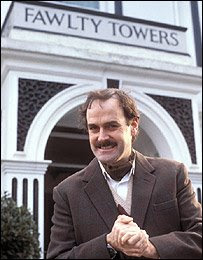
  4. Relationships drive everything. People are not idiots. If meeting their vicar feels like going ten rounds with Basil Fawlty, an authoritarian guardian of the sacred who appears to be having some kind of breakdown, they will draw their own conclusions. Where, however, as is usually the case, they find someone who is open, focussed and friendly, that’s fine. Biggest disappointments, say the marketers, were that so few churches follow up the relationship established on the day, and, interesting one, a slight disappointment that some vicars didn’t open up more about God and the vows during meetings.
  5. What is a Good Wedding? The punters say they are hoping for three things in their church wedding — that it will be:
    Proper — a real traditional wedding, not Mickey Mouse, with deep roots
    Special — personal for them, good humoured, recognising their hopes and humanity, joyfully engaged with the real people there
    Holy — carrying some sense of God, not a production line or School Assembly
I wonder how these principles translate into other things we do in Church?
Related Posts Plugin for WordPress, Blogger...