Thursday, 29 April 2010

dit-dit-dit-daah for Les Murray!

Challenged to tell the world what religious poet I would take to a desert island, I didn’t know where to begin. I could not have failed to mention Milton. His Paradise Lost is, after all, the greatest poem in the English language. Faced with interminable hours to explore on the beach, however, I thought I’d try something diferent. I want to join the Les Murray Liberation Front. Quite apart from anything else, Mr Murray was numbered in 1997 by the National Trust of Australia among its hundred Australian Living Treasures. How could a mere Secretary for Foreign Tongues compare with an official Living Treasure?

I’ve quoted extensively from Murray’s “Religion and Poetry” on the Guardian CIF site: But here is one of the first poems of Murray’s I read, ten years ago or so. It caught my eye straight away. What a legend! Murray calls poetry “the only whole thinking,” and this unassuming but amazing poem takes ordinary words and weaves magic. Theme, language, metre and rhythm fit together gloriously unpretentiously into one of the world’s great works of art. The best poetry is fabulous music that makes like you were there!

Morse

Tuckett. Bill Tuckett. Telegraph Operator, Hall’s Creek,
which is way out back of the Outback, but he stuck it,
Quite likely liked it, despite heat, glare, dust and the lack
of diversion or doctors. Come disaster you trusted to luck,
ingenuity and pluck. This was back when nice people said pluck,
The sleevelink and green eyeshade epoch.
Faced, though, like Bill Tuckett
with a man needing surgery right on the spot, a lot
would have done their dashes. It looked hopeless (dot dot dot)
Lift him up on the table, said Tuckett, running the key hot
till Head Office turned up a doctor who coolly instructed
up a thousand miles of wire, as Tuckett advanced slit by slit
with a safety razor blade, pioneering on into the wet,
copper-wiring the rivers off, in the first operation conducted
along dotted lines, with rum-drinkers gripping the patient:
d-d-dash it, take care, Tuck!
And the vital spark stayed unshorted
Yallah! breathed the camelmen. Tuckett, you did it, you did it!
cried the spattered la-de-dah jodhpur-wearing Inspector of Stock.
We imagine, some weeks later, a properly laconic
convalescent averring Without you, I’d have kicked the bucket...

From Chunking to Burrenjuck, morse keys have mostly gone silent
and only old men meet now to chitchat in their electric
bygone dialect. The last letter many will forget
is dit-dit-dit-dah, V for Victory. The coders’ hero had speed,
resource and a touch. So ditditdit daah for Bill Tuckett.

Tuesday, 27 April 2010

The Joneses: Life in a material world

Since the fifties, the key to suburban living has been keeping up with the Joneses. But just who, exactly, are the Joneses? I can’t say without giving the game away, so look away if you want to be surprised by the plot.

The Joneses are, in fact, way ahead of anything you will ever be. Mrs Jones is Demi Moore, heading up an ideal designer family along with David Duchovny, retired car salesman and failed golf pro, her “’enery the eighth” style ’usband.

Are they too good to be true? You betcha. These real people are living profoundly fake lives — but is it catching? The Joneses are in fact a marketing “unit,” seeded into the poshest of the ’burbs to live out a perfect life style, sowing envy and triggering sales left right and centre. As they work their way through their community’s various sociological subgroups like a toxic computer worm, they are monitored by a sinister Blonde Controller played with coonsummate believability by Catherine Dyer.

The family that gels together sells together. As the good times roll, suburban living becomes a manic Tupperware party on Steroids, saes stats mount on wings of eagles. Human nature will out, however, including the propensity of youngsters, and others, to place their affections where true joys cannot be found. Will the real people win through in the end?
video
The butt of the joke, which is wry than bellylaugh, is materialism. As the Truman Show and Pleasantville did before it, Derrick Borte’s film deconstructs a whole lifestyle, and raises the most basic question of all — “who’s fooling who?” The wrong aspirations lead to one of the most visually stunning lethal swimming pool shots since the opening of Sunset Boulevard.

Not everything clicks 100% all the time, but enough clicks enough of the time to keep ann audience logged on, and make this a very good, if not a great film. It works on pretty much all levels, narrative, character, place and pace. The Joneses is a great discussion starter that may not make you drop everything and get thee to a nunnery, but if it saves you entirely maxing out your Visa on Louis Vuitton bags and Audis, you’ll be glad you saw it. Four out of five.

Saturday, 24 April 2010

EDL Aylesbury: The Wingnut dilemma

In a week’s time, the English Defence League are coming to Aylesbury. For transatlantic readers, EDL is a protest movement against all things foreign and especially Islamic; a group who got chucked out of the far right BNP, for being too p’nutty. Now they’re heading for Aylesbury, of all places, on May Day.

We all enjoy some basic freedoms in this country.
  1. People should be free to get together with their friends, demonstrate and express their points of view, pretty much whatever they may be. That’s a basic freedom. It includes freedom to express contrarian points of view, even to sow fear, and aggravate dissension up to a point. But push it to the nth degree, and this freedom compromises other freedoms.

  2. People should be free to get on with their lives, conduct their businesses, enjoy their leisure on a bank holiday weekend, without their streets being hijacked by demonstrators.

  3. People should be free to be themselves safely in a country that has been diverse since the Bronze Age, subject to wave after wave of immigration and settlement, with corresponding interaction and synthesis. That is the basis of the Eglish language and culture that has, historically, thrived on its capacity to interact, adopt, adapt, modulate freely.

  4. People should be free to live in a law-abiding, stable, democracy, which works out differences together, not by setting people against their neighbours. If you want to change things, you know where the ballot box is. All you have to do is persuade others you are right, and off you go. If, however, you can’t persuade them, bully boy tactics are no substitute.
So there’s a balance of freedoms — the freedom of an astroturf organisation to coach in busloads of political chums has to be balanced against the freedom of people to get on with their lives, and their neighbours, in peace.

Here’s the rub. In a basically tolerant, peaceful town, what do you do about roving right wing nuttery? You could organise a left wing demonstraton — fight fire with fire. I could imagine circumstances where that could be necessary. Racism, ignorance and rampant prejudice are obscene, and rightly provoke passionate opposition. I’m happy to sign up to anything that makes that basic point. The fact is, the vast majority of people in Aylesbury are tolerant and law-abiding. That’s a very important part of what it means to be English for them. We know we’ve got our share of social problems, but these are best worked through and sorted between the people concerned as neighbours, not by bussing in extremists for a day out.

Therefore, after carefully and sympathetically considering options with community and faith leaders, under pressure to face down a right wing demo by what’s bound to end up a left wing demo, I can understand why people want to react like this, but I’m just not persuaded. Doing this is more likely to feed EDL’s hunger for significance, than to achieve anything positive here on this occasion. In collaboration with the Mayor of Aylesbury, I released this statement yesterday through AVDC:

Aylesbury is a peaceful, law-abiding town. Anything that turns it into a set for factional posing, left or right, is not helpful. Racist organisations don’t deserve the oxygen of publicity. The best way for people to stand up to racism is to show there’s a better way to live, by staying calm and getting on with their lives in mutual respect

The best traditions of our country include the Christian values of living in harmony, doing as we would be done by, loving our neighbour as ourselves. Whatever our neighbours’ race, religion or culture, we respect them and want them to have the same freedom to be themselves that we all enjoy.

That's why I support our town mayor’s call for people not to join any outsider-organised demonstrations on 1 May, and for outside activists please to leave us alone to get on with our life in peace.

The Town Mayor, Ranjula Tandokra’s, statement (the call I’m supporting) goes thus:
It is my opinion that Aylesbury has a peace loving community and on the 1 May, with most the shops and places of entertainment closed for the afternoon, it would be more profitable for Aylesbury residents to spend their time at home with their families and friends.

The fewer people there are in the town centre when the English Defence League hold their meeting, or for any other form of demonstration, the less likely it is that there will be any disruption to the life of the town.The best way to show the EDL that we do not support them is to avoid showing them any form of attention including any opposition event on the same day.

Let us celebrate our fun, friendly, peace loving multicultural society and united Town by letting them arrive, have their speeches and then depart peacefully. This will give Aylesbury the opportunity to celebrate our multicultural community at a time that suits us and on our own terms without provocation or threats.

Friday, 23 April 2010

Houston we have a problem...

VoxPop from the streets of Chicago in 2008 brings good news and bad news.

Good news is that 2,000 years into the resurrection, many people actually get it about Jesus, in spite of the distorting glass Christians have so often been in our blindness, folly and fallen nature.

Bad news is that the distorting glass is often bottle green and six foot thick.
video“We preach Christ Jesus as Lord and ourselves as your servants for Jesus sake.” Really? How?

video h/t Bethany

Thursday, 22 April 2010

True Leadership: getting real

We Brits have a maddening love / hate relationship with the NHS. We know, frankly, we’re damned lucky to have the services of some of the world’s best medical carers freely available at the point of need. The past thirty years in the UK has seen neonatal death plummet and that most basic statistic of all, life expectancy, increase — all this at a significantly lower cost in relation to GDP of private systems.

In a peculiarly British way many of us seem to be saying that the whole thing is terrible but the people are wonderful. We often express profound admiration for the people who actually look after us, but frustration with the system — bureaucratic, Balkanised, political (in a bad sense). Of course medical carers are not infallible, and some degree of snafu occurs in all human endeavours, but it has to be minimised when lives are at stake, and community hospitals are public places. Healthcare leaders, with their own stresses and pressures, prone to cynicism and denial, are always on stage. If people screw up in most industry and commerce, earnings per share dip. Get it wrong in yours, and people die. This can lead to a paralysing fear of failure that hobbles all effective leadership; a kind of defensive pact with mediocrity.

Cue the most inspiring leadership day I have spent in a long time — not a course, but a day visit with colleagues from Milton Keynes (where chaplaincy is in need of a reboot) to Wexham Park Hospital, which serves Slough and East Berkshire. Peter Blackshire, co-ordinating chapain, and colleagues gave generously of their time, and involved leaders within the hospital from palliative care and nursing services, along with the chair and CEO of the Trust.

It’s no simple Polyanna-ish story.

Heatherwood and Wexham Park Foundation Trust has had struggles and serious public failures in the not-so-distant past, and has undergone its own sometimes painful reboot.

If you’re trying to lead in a recovering organisation with limited resources, how does hope arise, and the ability to turn things round?

  1. The foundation of everything is realism about what’s amiss, but refusal to give in to it, blame others, or collude. It’s values not target driven, and works hard to connect people with the reasons they wanted to be practitioners in the first place, not synthetic goals. Again and again we were struck by openness and lack of management hype. At first this seemed weird, but as it became plain many people were interested in the unvarnished truth, everything came into focus. No boasting, no hype — just workmanlike pragmatism, and a dogged focus on values. We heard about the temptation to be driven by targets to the extent corners are cut. When you stop being target-driven, you actually take a hit — but the hit is an act of faith that if you stick with your values and resist cutting corners, in the end, you will do a better job. That takes real courage and, dare I say it, faith. I wish some churches felt freer to be honest about what’s not working, more rigorous in not cutting corners and tolerating crapada.

  2. Hospital Chaplaincy is not running a Church in a hospital, but delivering siritual care across the board in collaboration with others. Healthcare systems are like water systems — everything affects everything else. If there’s poison in the system, everybody gets poisoned. If different trades take hierarchy or status more seriously than the over-riding point of the exercise, or their part of the action more serously than other practitioners’, attention is distracted, the practitioner community compromised, and patients harmed. Managing chaplaincy isn’t about being nice to chaplains, but everybody respecting everybody else, and honoring everyone’s role in the delivery of the service. Everyone is a practitioner, and the task of everyone else is to maximise their own performance in such a way that all practitioners can function in an integrated, aware and self-aware, way. If you’re angry, use the energy to raise your own game, don’t turn it against someone else. The unity and integration of the whole depends on respect, fuelled by open communication.

  3. The most stressful and wearing place to work is somewhere where you can’t be yourself. In life, in healthcare, in Church, hypocrisy is like Japanese knotweed, or fire at sea. There is a continual drag towards it within the system (what Christians call “the fall”) and open communication with mutual accountability is the only medicine. Communication needs to be as clean as you can make it, remembering at all times that God gave human beings two ears and one mouth.
I came away with much to ponder, not only about hospitals, but about leadership and certainly about the ways we do Church. It also sowed real seeds of hope about a new kind of chaplaincy in MK.

Particular thanks to those who led us through the day; squirm and duck for the credits — It’s an unforgivable sin for some British to acknowledge other people’s work, especially in the public sector, without being cynical and/or nasty about them, but this is what I want to thank you for:
  • Peter Blackshire (Co-ordinating chaplain) — There’s lots to work out, but you’ve got a real team, and it shows. Many ministers, and healthcare professionals, say they want to work as a team — few acually do. Insecurity and Ego compromises their best efforts. Your clarity of purpose and consistency shone through. May your trolley arrive soon!
  • Clare Culpin (Director of Nursing) I found your awareness of everyone as a practitioner, courage and realism, refreshing and inspiring. I seldom meet anyone who has come through 20 years plus of leadership in medical care with such a focussed and lively sense of how things actually work together.
  • Fiona Lisney (Palliative Care Consultant) showed me how soft and hard skills (to use conventional distinctions) actually can work together to help patients at what could be the most awful time of life, the journey home. You actually demonstrated how to get a system working for patients.
  • Julie Burgess (Chief Executive) We were overwhemed by your realism, you will to listen and respond to anyone, your awareness of your context, along with your uncompromiseing commitment to your core values. The heart of your leadership seemed to be willingness to take risks in not cutting corners. I wish there were more of that kind of faith and courage around.
  • Chris Langley (Trust Chairman) Perhaps it comes from the retail background, but your will to take the people the trust serves seriously came over clearly. Assertive loudmouth leadership like the Apprentice on TV gets organisations so far — but to excel you need something very different — passion and humility, openness and rigorous commitment to making the syetem coherent and effective.

Tuesday, 20 April 2010

Weaving the Rainbow in Wycombe

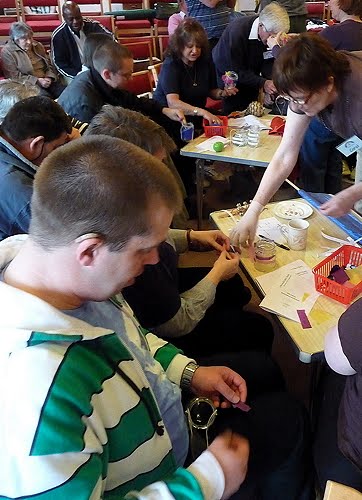
Rainbow Worship is a regular outfit based at St Birinus and St John High Wycombe, which started four years ago and increasingly draws in several dozen people with learning difficulties from all around, to network, celebrate, and worship. It’s a congregation that’s started from the other end, not so much trying to jam people into conventional observance as to allow simple and engaging expressions of love and prayer to emerge from a very diverse crowd.

RW is rumbustous and celebratory some of the time, but hushed and awed at others. Comments are chipped in from all around as things happen, like an ol’ time revival meeting. Craft actvities are built in, and the management has radically tried to break down the distinction between client and helper. On one occasion, as Noah’s Ark was revealed in all its glory, a loud voice cried from the back, “This is one I made earlier.”

Last night I confirmed six members of this community. It’s extraordinary how live it feels praying with people who have no “side” or pretensions, but simply respond instintively in the moment. Highlights included a Creed delivered to thunderous band in clubbing style, melding into a sea of friendly, open faces, dancing and banners, and losing myself in the joys of dance with a marimba. One of the first things I believe we will lose in heaven is self consciousness, which will be subsumed in self-awareness, and the tingling joy of being alive, as death is swallowed up in victory. That’s what we did last night anyway. A lot of us came away feeling we had had a trip to the cleaners — and that doesn’t always happen when we worship, does it?

I found it the experience of a lifetime to bless, anoint and confirm in such a place. There had been modest anxiety in the setting up about how some would cope with the touching and liturgics.
Actually, it was a liturgical stroll along a moving walkway, to call people by name into the kingdom, to anoint them as a sign that they are royalty with the King of Kings, to bless on the basis that “God has called you by name and made you his own...”

Although the language of inclusiveness is politically usable, I don’t actually think it quite covers such experiences. “Inclusiveness” assumes there is a some thing that really belongs to “us” (whoever we are) into which “they” (whoever they are) need to be “included” preferably by the things “we” do for “them.” This did not feel like that at all.

The truth is that we are all exceptional people, all fearfully and wonderfully made, with varying awareness and ownership of what makes us exceptional. Some people with learning difficulties have far more of this than the well-heeled. The real emergence of something heavenly occurs naturally when we all embrace our exceptionalities — why should we wish to be deceived? — and lose ourselves in the emergent transcendence.

One interesting little piece of inclusiveness though, was the inclusion of Morag who founded and leads the group. She was stuck in Switzerland waiting for a plane, so was skyped into the event on one of the worship leaders’ laptops.

It was the first tme I had seen that done in a confirmation, and it somehow affirmed the irrelvance of geography, as well as “disability” to the proceedings.

Many thanks to Steve the Vicar, Morag, Roger who led the talk, craft leaders, and Jay who led much of what geeks would call the Synaxis, and friends, including Scratch the Preacherman Dog.

When you get to heaven it will seem a more natural carry-on to you than it wll people who have been further up themselves on earth, because you will have been practising first.

Monday, 19 April 2010

It’s Lovely down in the woods today

Best days off take me out of myself with the nearest and dearest — so a gloriously sunny Saturday was spent together at Alton Towers. It’s weird not having any aviation noise, though. I hadn’t realised how ubiquitous aviation was until it was no more, and life must be especially weird around Heathrow. Currently the Eyjafjallajökull volcano (try saying that when you’ve had a few) still seems to be winning.

Our younger family members are more into theme parks perhaps than me, but with hearts high we headed for Britain’s largest Theme Park, Alton Towers — Rural Staffordshire and pity the neighbours — and the newly opened Th13teen.
This has been billed as the “Ultimate Rollercoaster” “Never has so much theme park technology been combined in one fantastically thrilling ride,” gushed the blurb, backed by late night TV advertising.

For an hour and a half we waited in line.
Tension built slowly, as portentious organ music swelled, a bit like Church. Meanwhile, a nubile soloist languidly sang lines from The Teddy Bears Picnic in a minor key (I kid you not). Then she counted slowly up to Thirteen (geddit?) in a dusky sotto voce that the unordained might associate with dirty phonecalls.
Thank the Lord for Amazon Kindle on the iPhone. Then...

Actually, I hate to say it — Th13teen was OK but, perhaps, just a tad lame. There was a substantial but not major iggly wiggly rollercoaster through the woods, with only a lap bar, then a hi-tech bit in a tomb thingie with a few jerks and screams and some laser stuff, then you whizz backwards in the dark for 10 seconds or so. Fair enough, but Lord knows why it all cost £15 million. Perhaps I lack imagination, or 20+ years of being a vicar have insulated me against screams and plastic bats. I did like the wraiths, though — kind of sackcloth dirty old monks. If they sold the outfits in the gift shop I might have been sorely tempted.

To check out whether we had lost our taste for being centrifuged, we headed for Lucy’s all time favourite rollercoaster, Air. This simulates flying around on your tummy wiggling your toes, and a right old sensation it is, too. It’s a classy ride, very smooth, and greatly improved if you get to float over Staffordshire without screams. Rolling gently over and upward into the sun like dead ants with your best beloved by your side brings you closer to heaven than a poke in the eye.


We took Anna for the first time on Rita Queen of Speed, a name that’s fun to ennunciate in thick Glaswegian. Rita accelerates you from 0-60 in 2 seconds. She offers a particularly orgasmatronic experience for us Brits, because her Queue to Thrill ratio is One hour to 18 seconds.

Finally, we all went on Nemesis, which is very iggly wiggly, like this:
video
You Barrel roll in and out of a few holes in the ground for 22 seconds, shooting 3-4G on the loop the loop bit. All most acceptable. I usually look like I'm nodding off in the pix, but on our Air ride, I look I’m casting eyes up to heaven, and Lucy looks insanely happy, like she’s got there already. Perhaps we have, after almost 26 years of marriage. The very nice lady at MacDonalds on the way home (I know, I know — first time in years) complimented Lucy on our childrens’ politeness (an unanticipated bonus). Proof that the family that plays together outlays together. Back to school next week. And planes overhead, perhaps.

Friday, 16 April 2010

Cemetery Junction: Gravely Flawed

I really wanted to like this film. I carefully excluded from my mind local knowledge from having lived in and around Reading for twenty years, and resolved to enjoy one of the first nostalgic portrayals of the eighties. I had an idea that Ricky Gervais, master at drawing comedy out of banality, would pull off a major coup applying inside knowledge to the town of his birth. I was disappointed by a Curate’s Egg of a film. Superb acting, with flashes of comic genius in the script, was entirely let down by some big structural weaknesses.

Let’s unpack that statement. Acting was wonderful. I believed in and liked everybody, personally. The threesome at the centre of the action all did a superb job, individually and together. Felicity Jones’ performance was wonderfully engaging, utterly superb in achieving a “Gregory’s Girl” balance of intelligence, wit and naivity. Ralph Fiennes made a masterful Bourgeois Voldemort. The props were fine, and the script showed some promise. One scene involving Ricky Gervais’ character and his mother in law had some sparks of real Johnny Speight class, and actually wrung a couple of wry chuckles from the audience.

However, the bonfire never ignited, not in our cinema. The problem with this film is far more fundamental than acting ability. At the first pub lunch of the project some basic questions needed sorting – is this Reading? If it is, how do we make it seventies? If it isn’t how do we weave a credible place together? Is it about the place or the firm, or the family or the girl? Who are these people? How and why do they matter and know each other and what are the implications? Sadly a lot of these basic questions were not answered, or answered ineptly, and the result is to sabotage the whole film.

The actors’ best efforts are wasted on a sloppy, inept, half-baked script which is perilously short on laughs for a conception with no consistent sense of character or place to redeem itself. Whoever picked some of the locations needs to be shot — but if they didn’t know what they were looking for anyway, you can hardly blame them for not finding it. Reading is a very average place. It did a passable imitation of fifties Croydon in Let Him Have it (1991), and anyone in doubt about the culture of the place at the time has only to watch Paul Watson’s groundbreaking 1974 BBC documentary The Family.

So, Locations shouldn’t be a problem, but they are. You walk out of a tiny three cell lock up, with its two rural policemen exhibiting an extraordinary tolerance of being beaten up by youths. You find yourslf in what is obviously Woodstock, a Cotswold Stone village built around an eighteenth century palace. It might just make Middlemarch. Over on the left is a large urban night club, just like the Top Rank Suite that any Reading resident of the seventies would recognise. But what is it doing in the middle of a Cotswold Village? and so on and so on. Look, the whole story hinges on the damned place. Therefore it matters desperately that the originators had no coherent sense of place, or didn’t know how to string locations together convincingly to produce one. They either have to sell us the set in the way Woody Allen sells Manhattan, or at least make it a believable enough crap town for us to understand why people have to get out of it. Confusion about place is a fatal flaw in this particular story.

Add to this prime basic weakness the occasionally half-baked depiction of character. What 12 year old doesn’t know his girlfriend’s father’s job? Is the nicely drawn Insurance Bash the reward of hottest salesmen, or a geriatric dinner dance? What man from the Pru wouldn’t know if one his clients had just died and claimed on a policy? and so on, and so on. The writers would have done well to follow the advice of one of their own characters — “if nothing happens to you when you’re walking down the road, keep it to yourself.”

Last obvious nail in the coffin is the occasional failure of the script to follow the most basic rule of all drama — don’t tell them, show them. Nobody actually says in a job interview “You went to a low-grade State Secondary School typical of the poorest parts of Southern England that produces people who are not ever expected to make anything of their lives. I know. I went there too.” Who is the character actually talking to anyway? You need to establish character and place early on, granted, but not in such a crass and obvious way — and you can use pictures to do so. That’s the whole point of film.

This film’s basic structure just hasn’t been clearly thought out enough for excellent, nay stellar, character performances to redeem the mess. Brilliant actors wasted on a muddled, half baked script lead to a tragically naff result. I liked the characters, though, and I’d love to see this lot in a properly thought out film. Two out of five.

Thursday, 15 April 2010

UK General Election: bringing it on

History is on the march. Tonight sees the first UK television debate in a general election. As a Christian leader I want to encourage people to seek the common good, to get out, engage and vote. In addition to the CTBI Faith in Politics briefing, I recommend the Ekklesia Ethics election initiative for jaded electoral palates, as well as its resources briefing. Among declarations promoting faith in the public square the Faithworks 2010 declaration seems to me the most positive and realistic.

So far however, I regret to say, the story I’ve been picking up has been fairly massive public indifference to the whole business, certainly compared to other elections over the past forty years. Public participation rates have been sinking since the sixties. A recent poll in the Times reported that more voters want a hung parliament than government by any of the three established parties. You can drive along whole swathes of road without seeing any evidence that there’s anything going on at all.

It may be that everything will ignite tonight in Manchester — midget wrestling has a curiosity value, if nothing else. However there are three massive facts about UK general elections which may go some way towards accounting for the absence of public interest:
  1. Such is the UK parliamentary voting system that the vast majority of results may be assumed before the thing begins. Whilst politicians piddle about with constituional reforms that are, frankly, irrelevant, like the composition of the House of Lords, they mask the fact that the system for electing the House of Commons renders the majority of votes cast irrelevant. The problem began with the abolition of the old Victorian multi-member constituencies, and has been acknowledged since the 1930’s, but it’s never been in the interest of the political nomenklatura to do anything about it. Sure it’s not fair, but they’d rather the other lot won for a season, as long as they got their shot at what Lord Hailsham called “elective dictatorship” another day. Not very surprisingly, the public become jaded about a process in which 25 million of their votes seemingly make no difference to the result. Polls consistently exhibit an eerily similar majority in favour of electoral reform to the proportion who opposed the Iraq war — around 60%. Frankly, the outlook is not encouraging. There’s a website which can tell you how powerful your vote is here. On it I discover that the average UK voter has five times more chance of their vote making any difference than I do.This fact in itself is not exactly going to bring people out onto the streets, is it?

  2. People think they see a professional political class getting fat on ther earnings, and this breeds cynicism. Actually I don’t think this is entirely fair — most MP’s point out they could have earned as much and more money doing something else, but the expenses scandal revealed an astronomic degree of public anger and frustration. This is about more than just garden gnome allowance. It was instructive to hear Mrs Blair asked why she needed six houses. Her answer was that the Blairs, in fact, only have five houses. They had bought six, but one was far too small, and had had to be bashed into the one next door. Talk about missing the point.

  3. Looking at the manifestos, the contest is not about where the ship is going, as much as how the ship is running. The manifestos are basically management pitches, and, frankly, my dear, most people don’t ignite about such stuff, especially now UK governments have developed a whole web of agencies, quangos and outsourcing to avoid taking any real responsibility for anything. They all talk the same language about public services. They all refuse to be honest about their values or lack of them. They all get bogged down in policy detail and there is some evidence that people have no idea whose policy is what. A recent Times Poll discovered that voters could only identify 50% of key pledges with the correct party. I learnt yesterday, for example, that if I vote Conservatve they will “use pupil level annual school census data to include service children for a pupil premium in schools ensuring they attract extra funding.” It’s not quite the Gettysburg address.
PS The 1960’s midget wrestlers names are all genuine, and any similarity to any Politician is merely coincidental.
Related Posts Plugin for WordPress, Blogger...