Showing posts with label Politics. Show all posts

Tuesday, 10 January 2012

Thatcher: Puccini or Sylvie Krin?

It’s always fascinating but unsettling to see living people walking around on the big screen — Stephen Frears’ masterful portrait of The Queen springs to mind.

It’s disturbing to think that the person concerned, along with their nearest and dearest, must be watching this.

I gather the Thatcher clan sat this one out, wisely I think, but they may have sneaked a few peeks through the cracks between their fingers.

This is non-political non-historical Thatcher; indeed all that is missing is music by Signor Puccini to accompany the verismo libretto of “Signora Thatcher e Denis”. The curtain rises to discover our heroine in a Pooter-Chic apartment full of pictures of herself, the sort ordinary people would have to had to Photoshop, mulling over her glory years. Age has wearied her, and the years condemn. June, a maid, hovers cheerfully in the background, whilst her slightly dog-eared daughter Carol performs the functions of a faintly exasperated maid. Meanwhile, 6,000 miles away, the adored Boy Mark drifts on, heedless.

The other principal in the tale, is the shade of Denis, who is not entirely buffo. He flits in and out between arias with kindly but piquant saloon-bar comment.

There goes the Falklands war, and in a furioso aria, La Thatcher tongue-lashes an Argentine dictator, a US Secretary of State, and her own lily-livered crew.

As the aria fades, Denis slides gently onto the sofa behind MT and says something like “well, that saved your bacon, didn’t it old girl.”

You get the idea.

At heart la Thatcher is an ordinary human being with a penchant for occasional Churchillian verbal spasms. Early on she stages an epic breakout, and gets as far as the paper shop where she discovers, horrore! milk is now 49p a pint. This treatment is kindly to the point of patronising, a kindness for those of us still traumatised by her Spitting Image. It’s free with the facts but that could be its greatest strength.

What about Thatcherism, though?

Well what about it? Nothing to it, really. That could be why, in real life, her foundation went bust a few years ago.

Mrs Thatcher’s lifetime achievement turns out to have been holding on tight to the memory of a much-admired father, and living up to his instincts and slogans courageously through an escalating variety of challenges — a thoroughly decent thing to do, but hardly the basis for a new kind of world government.

In 1964 Geoffrey Barraclough observed
contemporary history can only justify its claim to be a serious intellectual discipline and more than a desultory and superficial review of the contemporary scene, if it sets out to clarify the basic structural changes which have shaped the modern world. These changes are fundamental because they fix the skeleton or framework within which political action takes place.
This film is no work of contemporary history. It does not clarify the structural changes that have shaped the modern world. As  various chickens come home to roost, sending the wheels flying off the whole neo-liberal free market panjandrum Mrs Thatcher and her friends honestly believed in and represented, perhaps the same can be said of “Thatcherism” itself. But that’s a judgement for historians a few years hence. For now, just enjoy the show.

Meryl Streep's performance is as amazing as everybody says, and if your taste runs to opera verismo in a Barret Home, Signora Thatcher e Denis could well be the production of a lifetime.

Tuesday, 25 January 2011

Leadership Secrets of Alastair Campbell

I have some trepidation about the cult of leadership, because the effectiveness of any outfit really does depend on the systemics and context as much as a single leader's gifts and commitment. However, continuing the discussion begun here yesterday, my eye was taken last week by some principles about leadership from an unlikely source — Alastair Campbell, Tony Blair’s great Spin Doctor in the Sky, whose diaries are now appearing in print.

These may well become the prime source for political historians of the Blair years in the way Alan Clark’s did for Thatcher. Some will like Mr Campbell more than others, indeed his partner says he’s been much nicer to live with since he finished work as a spin doctor, but he’s a perceptive information hound who observed world and goverment leaders closely for ten years. He pulls no punches. In a Times interview he concludes these are the qualities that make an effective leader in this day and age:
  1. Clarity of objective and strategy. Only then go tactical.

  2. The best team leaders are the best team players

  3. Boldness

  4. Adaptability

  5. Staying calm in a crisis. Listen but lead, not listen and lead

  6. Patience. Take your time if you have to.

  7. Set the media agenda. Don’t let them set it for you.

  8. Get your head above the parapet when the s***t’s flying

  9. Encourage enterprise and ideas at all levels of your organisation in a non-blame culture.
Discuss?

Friday, 22 October 2010

Obamarama (Savoy Opera Version)

Every now and then something comes along that is completely silly, but essentially delightful. I’m not a major Gilbert & Sulivan nut, but like most students of late 19th century British society and politics, I have studied the lads’ œvre. Operetta buffs may recall that HMS Pinafore was so extensively ripped off around the US that The Pirates of Penzance opened simultaneously in New York and London. The excellent execution of this piece is, in itself, a work of art that deserves exposure this side of the pond.

h/t Ronnie Butler jr

Friday, 1 October 2010

Magical Mystery Election Candidates?

I promise I’m almost through with General Synod elections but I want to thank various people for emails and other messages about ways to make the process simpler, more informative and transparent. There’s a way to go, but a few simple steps with the right technology would go a long way to help, but not till next time round.

I just want to share finally, however something I would find it hard to believe if several people whose judgment I trust had not told me it was so. Apparently an elector at an election meeting asked candidates to state to which relevant organisations they belong. All but one candidate did the obvious and said, but one who shall be nameless simply refused to answer the question. Only having a tiny number of electors present makes this kind of sheer arrogance possible.

It also takes those of us a certain age straight back to the eighties, and the Old Labour Militant Tendency. Their whole entrist technique was to cover their tracks by issue-based campaigning astroturf organisations, whilst refusing to state their Trotskyism. Voters thought they were voting Labour, whilst they were actually putting in Trotskyists who wouldn’t say, because they knew perfectly well they would never have been elected if the voters had known.

I have no idea what campaign groups this particular candidate belongs to, nor, as this amounts to negative comment about a particular candidate will I out him.

However one essential reform in the process must surely be a requirement on all candidates to disclose to voters their membership of relevant campaigning groups. Without that, the whole process, inevitably, is reduced to a Magical Mystery...

Monday, 27 September 2010

Why so Crypto?

Before leaving the question of politics, I have been wondering why some of the English have such a fascination with secrecy, and such a horror of public discussion? What’s wrong with vigorous public discussion of points of difference?

Why so much crypto and secrecy?

The Bible is full of open disputation. In Galatians Peter and Paul have a technicolor public row. In the Acts various apostles fall out with each other and take their separate ways. In the gospels disciples vie with one another in front of all the others (or at any rate their mothers do) for hot spots in the Kingdom of Heaven.

All this is done without shame, or any particular feeling that it would have been very much better if the elite had stitched everything up behind closed doors. The only attempt to do this (the Council of Jerusalem in Acts 15) was a brilliant day out, but its conclusions didn't last five minutes — soon enough Christians were eating non-kosher food anyway, and Peter and Paul arguing as forcibly as ever.

We all, of course, have deeply personal, random and inconsequential thoughts that don’t belong in public. Privacy is precious because it enables us to achieve intimacy and friendship with our friends and families, in a privileged environment where much can be taken for granted. Depth is sometimes only accessible to the solo scholar slogging away in the stacks. we all need space for meditation, solitude and desert experiences.

Also, it is only really possible for to allow particular friends into our full confidence with the security that comes from having invited them. A hot blazing eyeballs world of full exposure disallows this very important aspect of human friendship. So I am not against proper privacy.

However, I suspect we Home Counties Anglicans could allow ourselves a little bit more room for openness, especially about publicly significant issues. Here are some distinct advantages to public discussion, especially if it can be conducted by people who listen to each other with mutual respect and a longing to understand:
  • Openness prevents people treating questions as settled before, in fact, they are. Premature closure breeds immaturity in a community, and privileges reductionism.

  • As we discover with open source software, openness is the precondition of collaboration. When I am open I trust others with thoughts that matter to me, and, if they do the same with me, our relationship grows. Modelling a world where you can like and value people with whom you disagree witnesses to the possibility of a kingdom based on transformed relationships.

  • Openness stops people taking hierarchy seriously in the wrong kind of way. In a public discussion peopl's last idea is as good as their last job, which pricks the bubble of hierarchy and gives opportunity to shine to the person with the best idea, which can then be acknowledged

  • As Benedict points out in the rule, the youngest and most improbable person sometimes has the best idea — without being open to this the whole community is stunted.

  • Being open forces me to try and be consistent. If I go round saying to one closed clique that I think the C of E is all washed up and morally bankrupt and to another that I think it’s a marvellous national mission with a big moral message for society, I suggest both cliques going out for a drink together to prick the bubble of hypocrisy and force me to say what I really think to both.

  • being open forces theoretical thinkers to earth their wisdom in human reality, and test it in an open forum. It brings together people who are big on ideas and those big on pragmatism.

  • Open discussion privileges the kinds of people who like to think out loud, indeed cannot develop ideas without sharpening them up in a group discussion. That means it disciminates against reflective learners, who need space to develop their thinking before they feel it worth brining into the light of day. That’s why you need some conventions, disciplines and routines; to protect thinking space, and prevent either kind of thinker from stealing the show.

  • The Holy Spirit sometimes reveals his will, Quaker style, in a gathering of people, when a deep conviction emerges among them through processes of open debate. This communal activity transcends the arrogance of individual primacy, and expresses the corporate nature of authority in the Christian tradition.

  • Public debate builds trust. Stitch ups breed cynicism.

  • What is public belongs to the public. If a community knows not only what was decided but how it came to that conclusion, it can move on to the next decision with understanding, and own what has happened.

  • Public life destroys the myths of perfection. People interacting publicly show their weaknesses and absurdities as well as their shining intellectual process, or lack of it. In a Hungarian public bath earlier this year, splashing around with the family and several hundred people of all sizes, ages, shapes and proclivities, I noticed how everybody is absurd, but everybody is also, in their own way beautiful.

Saturday, 25 September 2010

Holiness and (Church) Politics

Anything involving people interacting means politics — one of the most suspect words in the English language. Latin cultures have much less suspicion, historically, of the talking, plotting and shenanigan that goes on in the public square of the polis. Yet things must be decided and done, and this means some element of power among any group of people, hopefully mainly elective. Vote for the best people. But how do you decide who they are?

You could say you vote entirely for the person not the policy, so it doesn't matter what the latter is as long as the former is holy, committed and humble. This can easily turn into the secular game of voting for the politician who shows best evidence that s/he loves puppies and hates mean things, regardless of the crazy notions they would implement if elected.

Anyway, as Erika pointed out in the comments yesterday, the two realities, person and policy, are connected, however tenuously. I agree. I couldn't, for example, vote for a fascist candidate just because of their supposed personal qualities; nor could I easily imagine a candidate with the kind of qualities I’m looking for in my representatives wanting to be a fasist in the first place.

What then are we to say? That the only people you should ever vote for are people who would be too humble, reflective and other worldly to stand in the first place — landing us up with an assembly of people who are inadequate in all of those vital departments. See the problem?

I was puzzling through all this, and wondering how to square the necessary demands of holiness and politics, when I came across these words of Richard Rohr, which I find helpful:

Remember this: there are always two worlds. The world as it operates is power; the world as it should be is love. The secret is how can you live in both for a while, which gradually allows you to loosen your grip on the first, as you see the inadequacy and weakness of power as domination.

However, you normally have to have a bit of power to let go of that very power.

Actual powerlessness is never an asset, except in the way that the Twelve-Step program speaks of it.
Power apart from love leads to brutality and evil; but love that does not engage with power—and become a whole new kind of power—is mere sentimentality. It often becomes a destructive kind of powerlessness. True love is not naïve, but is a conscious and intelligent gift of the self.

Adapted from Jesus’ Plan for a New World, p. 41

Friday, 24 September 2010

General Synod: Karma Chameleons?

I have now spent two evenings hearing election adddresses from candidates for houses of Clergy and Laity. Lesley Fellows’ top ten tips for General Synod Election Addresses strike deep chords within me
1. I'm dyslexic, do me a favour, keep it to one side of A4, use a font like Arial and font size 12. Simple. Oh, and I like pictures.

2. Be open and honest. If you are against Women Bishops, say it, don't make me glean it out of clever phrases.

3. Tell me what five or six issues you feel will come up at the next synod, and which way you are inclined to vote. (Without lots of words as to why, and what a jolly good chap you are).

4. If you want, tell me one legislation that you would like to see come up and why.

5. If you can, give me evidence that you are good at politics and lobbying.

6. Tell me if you are associated with any groups that aid you in your politics and lobbying.

7. Don't give me 25 points of things that are important to you. Just tell me your top three (and make it real rather than bull shitty). I will roll my eyes if you say you are passionate about mission - what does that mean?

8. I don't care whether your hobbies are paragliding or stamp collecting - really - I don't care.

9. I don't care whether you have been a priest 100 years or you are a curate.

10. I don't care whether you are single, divorced, married with 17 children.
In both local meetings there has been a lot of talking dirty about mission and Extreme Being Nice. “Can two walk together except they be agreed?” asks the Prophet Amos. Well, apparently they can, in England anyway. That’s nice.

Like Lesley, I looked for trenchant Conservative conviction, and have to say I picked up a curious mood music from semi-professional church politicians, appealing to rather than contesting inclusivity as a value. Better late than never, I suppose. A visitor from another planet would never have known, on the basis of what was said, that any candidate did not bleed for radical inclusivity.

Mindful of Lesley’s top ten tips, one speech stood out head and shoulders for me. It suggested what synod is about apart from Extreme Being Nice — a place to become aligned to our gospel values, and to articulate them to outsiders. In sheer hard headed terms I found this very much the Gettysburg Address of both evenings, from my learned friend, chaplain, and local Vicar Rosie Harper. Having covered Lesley’s points (3) (4) and (6) in her written paper, this is what she said:

Good evening. I’m Rosie Harper, the incumbent here and also Bishop Alan’s chaplain. I had a real wake-up call a couple of weeks ago.

A group of us were working with a very senior consultant around the nature of our institutional processes. It fell to me to give him a lift to the station at the end of the session -so of course I asked him what he made of what he had learnt about us.

This is what he said: ‘It seems to me that you are working as if you didn’t actually believe in what you are doing.’

Scary or what?

We all know that fabulous stuff is going on at the local parish level, and here in Bucks we are trying to be an Archdeaconry which models a very high degree of actually doing what we believe.

But………

General Synod undoubtedly sets the tone in the country -mostly because of its fairly high media profile. What the country hears are not our gospel values; they hear that we don’t do equality, we are locked into archaic financial systems, and there is still a considerable lack of transparency.

But, you might want to say -we are all equal in the church -well yes -so long as you are white, middle class, straight, male and preferable with at least one degree. Whilst this remains the case our integrity is so severely compromised that –to be frank -anyone with any sense struggles to take us seriously.

The good news is that we can change all that. We can preach a gospel that is good news for Everyone. We can get grown up about the way we do money and we can begin to put our passion and energy in to what the Lord requires: to act justly, love mercy and walk humbly with our God.’ Micah 6.8

I would like to be one of the sensible people at General synod — forward looking, a bit radical and full of faith that God will continue to build his church. To do that I need your vote. Please!

Friday, 14 May 2010

Christian values in Germany

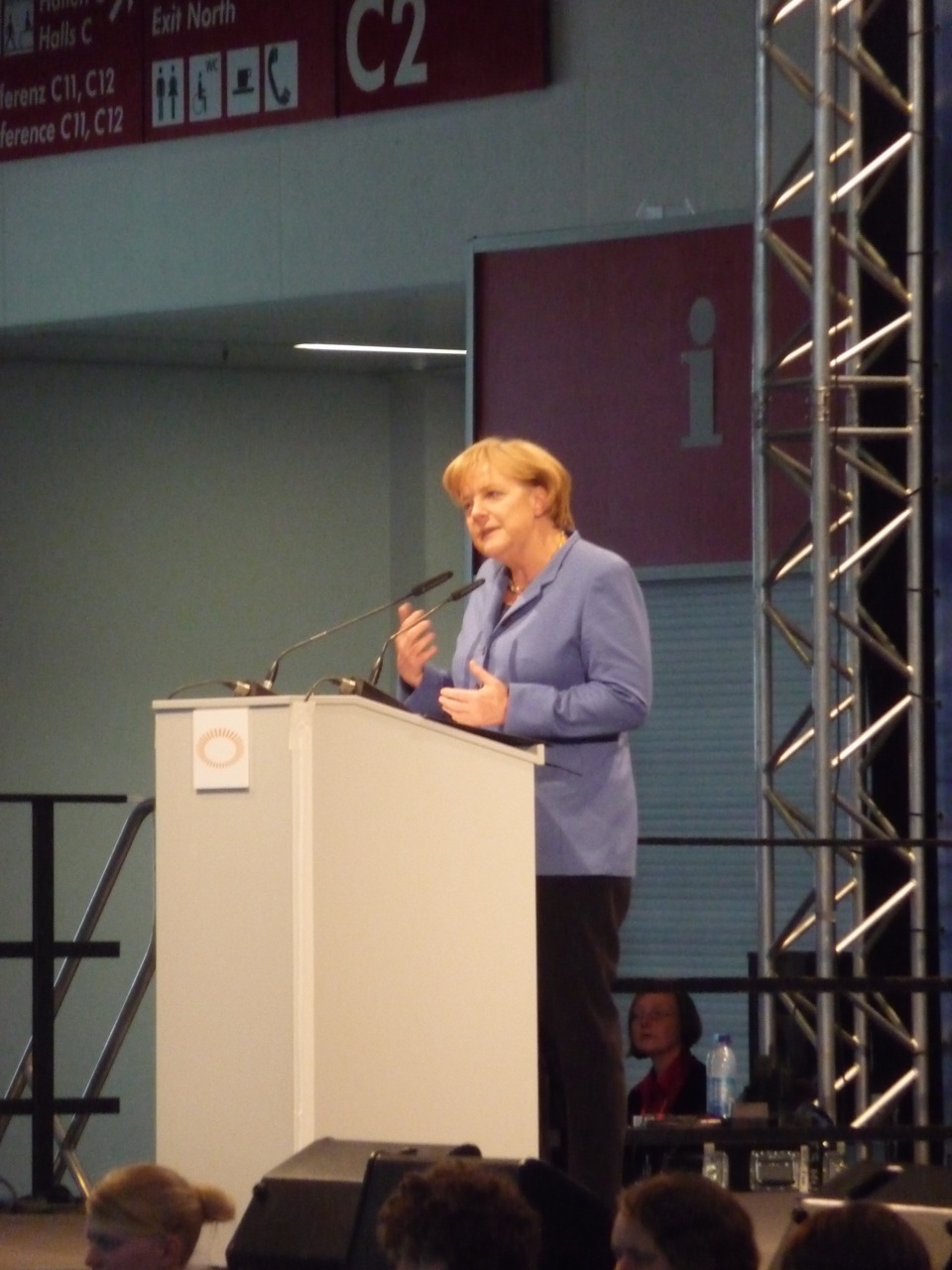
Christianity is a fundamental root of societal values in Germany. Official. I just heard it from the Bundeskanzlerin herself. Speaking in Munich to 6,000 people, the Prime Minister of the largest democracy in Europe acknowledges freely and imaginatively the significance of Christianity as one of the great root of her country’s social values. She is not saying these humanistic concepts could not have been developed in other ways, but the fact is it was from and through Christianity that they have been.

Here in Bavaria there is a refreshing absence of crude secularist rant, along with scare stories got up by the right wing press to suggest that any departure from Victorian morals and dogma means the end of Christianity and ruin of society. Those fears and fantasies are expressed on the margins of society, where they belong.

Neither do I detect the lazy old English idea you “leave morality to the bishops”. Mrs Merkel calls for a dialogue between churches and society, where both engage closely and bless each other and are willing to be changed according to their values and experience — so no crude monopolies of truth, no slippery slope panic, no fear that engagement between churches and society will corrupt the Churches or Confessionalise the State. Freedom is a Christian value, but not egoistical freedom from taking responsibility. Christian freedom is the use of possibilities to follow values as a way of supporting others — another one of Mrs Merkel’s core Christian values.

All she is saying is that there needs to be respect, realism, self-awareness and truthfulness. In this context, Mrs Merkel is just announcing €60Bn of cuts between 2011 and 2015, asking around various possibilities. She isn’t claiming a godlike command of all possible answers, but owning up to a serious problem, addressing pragmatic reality, asking for hep and obviously winning some respect for her candour. How refreshing! How grown-up!

Politicians, even controversial ones with cuts to announce, seem to be held in higher respect in Germany. Wondering why I am told they have a more realistic mandate from a more fully democratic voting system, and that there is a higher value of corporate civic life here. They are not thought to behave that much better, but they are held to account more tightly over their views as well as their expenses. They have to treat people more like grown ups, partly because there is a very direct relationship between how many votes and how much power. There is often a higher degree of historical awareness and pragmatism, with less simple sloganising. By comparison, much UK debate about Church and society, such as it is, simply bears out the old maxim that Clichéd words reveal clichéd thought. There has to be a better way!

Tuesday, 11 May 2010

Gordon Brown: Der Untergang

Fully Democratic voting systems deliver 36% of the power for 36% of the votes. This is boring for career politicans, but it’s also predictable. Most European politicians have to exercise skills to work together in the national interest more than once every 36 years plus remembrance day. As the only way to more power is to win more votes, they have to work harder with the public, and are generally more respected for it.

As it is in the UK, ninety years of cruising around in the belief that 36% of the vote entitles our political masters to 100% of the power has scarce prepared them for an hour such as this. Although they are being uncharacteristically soppy-stern and polite, they don’t seem to know how to talk with each other, rather than at each other. One optimistic hope is that they will learn, and this will be good for us all. The problem has been acknowledged since the 1860’s, and the kind of solution we need an open secret since the Royal Commission of 1908-10. They can hardly say they weren‘t warned.

And as the great Poker Game in the Sky grinds on around Westminster, first man down is Gordon Brown. How will historians see him?

Two interesting counterfactuals could be run:
  • What if John Smith had lived another ten years?

  • What if Brown had cut and run in 2007 to establish his legitimacy?

To Brown’s credit, probably, is his performance as a very British iron chancellor. His staunchest opponents will have to grudgingly admit he held his nose and did what probably had to be done about the credit crunch, and competently. His tax credits scheme was a way of redistributing income without raising income tax. He generated shedloads of cash to throw at education and health after thirty years of cuts. Yes, there’s a comparatively high peacetime public debt, but everyone’s got one of those coming out of recession, whilst economic historians will point out that as a proportion of GDP it’s actually lower than for most of the tweniteth century.

Brown was a Roundhead at Tony Blair’s Cavalier party. When Blair and Brown met at the Loch Fyne Fish Restaurant, or wherever, they carved up the next 13 years of the governance of Brtain between them. The process was probably much swifter and easier than what has been going on since last Thursday, and considerably more lasting.

However, as Blair swigged the champagne, Brown gagged on his Irn Bru. Therein lies tragedy.

Once Brown had gotten over the joy of playing with the real levers of power at Number 11, he probably hated the party, but hung on in there for the joy that lay ahead. How sad that it was so joyless when he got it. Nobody knows at what point Blair and/or Brown bricked up the corridor from Number 11 to Number 10, but his estrangement from his ertswhile dinner companion was disastrous. Brown, as a man of genuine rectitude, probably found it hard to believe what some of his less puritanical colleagues were up to.

But Brown was a genuine conviction politician. I remember his appearance at the Lambeth Conference. He obviously knew and owned the Millennium Development Goals without cue cards. He actually belived in that stuff.

Colleagues from all over the world, who believe the English to be clever but devious, were impressed by his obvious sincerity and passion. Not quite English. Scots, in fact.

Too passionate, not emotionally intelligent enough? How about what they are already calling Bigot-Gate? Other politicians suggest they would never call a voter anything as rude as “that woman.” When the great bin of emails is emptied out on the day of doom, and the secrets of all hearts shall be disclosed, I believe it will show other politicians have, in fact, called voters, and their colleagues, considerably ruder things and got away with it. But not with the microphone on.

And after all those complaints about Tony Blair’s addiction to spin, it’s ironic and sad, in some ways, that Brown’s “Lion in Winter” style was such a rat sandwich to Fleet Street, if not all the British public.

Blair danced for us and we tried to dance, with all the finesse Btits bring to that activity. Brown wept for us and we would not wail. He’s almost certainly done the decent thing politically. I think history will be kinder to him than the Sun. Let’s see who’s next.

Saturday, 8 May 2010

Out of the Thick of It...

comes Learning? As various politicians catch up on much-needed beauty sleep and decide what to do this weekend, there’s a distinct feeling in the air that the whole game is up for the old politics, but nobody quite knows how, or what to do about it. I’ll be off this stuff tomorrow but as a trained historian, I wonder what the three main parties could learn from their various disappointments of the past 76 hours.
  • Labour:
    The whole New Labour Thing has rather run out of steam, holed below the waterline by the moral legacy of the Iraq War and an uncomfortable feeling that some labour people had grown disturbingly fat out of government. Secular New Labour 1997 messianism is a gone coon. Gordon Brown is a man of genuine passion and commitment, but to make himself electable he would need to turn back the clock to the weeks after he assumed power, and hold that snap autumn election he never did...

  • Conservative:
    The party is still in serious transition, but in a direction that might make for majority government one day, with a popular leader. The overwhelming likelihood of DC becoming PM brings the opportunity to demonsrate skill and responsibility, and a collaborative leadership style that fits contemporary mores and aspirations. In Boris Johnson’s wonderful phrase the Meat in the Sausage, morally, should be Conservative. In terms of Tory tradition, they need to develop a way of doing Disraeli for Today, not Stanley Baldwin dressing-up games or Thatcherism, which is as repellent as ever — the Tory gone coon.

  • Liberal Democrat:
    A terminally frustrating night for LD’s! Their popular vote very modestly increased, but they suffered badly from third party squeeze in many places in the South. The Voting pattern is becoming far more volatile, quirky and granular than ever and this is beginning to hurt rather than promote the Liberal Democrats on their way up the greasy pole. Think of last Thursday as a big stretch up, followed by a greasy slip down to where, formally, they were when they started. Ouch! The silver lining in their cloud is that a large majority voted for parties which were willing to question our rather deadbeat and now clearly ineffective voting system. Time to dust down the Royal Commission on Proportional Representation of 1918, and actually do something about its conclusions. Ninety years is a long time in politics! Lib-Lab pacts, however, have a long but toxic history...
Many will be relieved by the ailing performance of right wing minority parties. The experience of BNP in local government has plainly shrunken their appeal.

The biggest challenge for anyone who cares has to be those people who couldn’t or wouldn’t vote. It must be time to take serious steps to draw younger (= under 30) voters into the frame, perhaps by developing a system for internet or mobile phone voting. Almost anything would be more secure than present postal voting, but this would not be anything like as easy as it may sound. However there must be no repetition of the banana republic scenes outside, and even inside voting stations in Sheffield and London. Our present practice is too narrow and remote for the needs of this generation...

Friday, 7 May 2010

Mind Games for Politicians

Various bleary eyed politicians are now nodding off on TV. Time for them to sleep, perchance to dream.

Fact is, Everyone has slightly underperformed. There has been a substantial swing to the Conservatives, especially in England, but with a very erratic granularity. Turnout was very slightly up, by 4%, but from one of the lowest ever. Time to consider internet voting?

So the options to ponder over the cornflakes in eight hours’ time are rather fascinating.

I think I bet on the power of inertia to produce a minority administration, elected on a slogan of “time for change!”— not quite, morally, what Michael Gove calls a “strong, stable, Conservative-led government.” Perhaps this would be followed by another election before five years are up. However there is no necessity for this. Constitutionally, Gordon Brown could do what Ted Heath did in 1974, and try to form an alliance with Liberal Democrats.

How Democratic is all this? A minority government could not, morally, be presented as the will of the people. Indeed UK minority governments have not been particularly strong. It’s actually the will of 38% of 62% = 24% of the voters. More people didn’t vote at all than voted for anyone. And, actually, far more people voted for second and third parties than for the winning party. This leaves two options for the future, and it will be interesting to see what our politicians can get their heads round, or not:
  • Some people may say “38% of the votes — you deserve 38% of the power. If you want more power, get more votes.” There’s nothing undemocratic about such a notion; indeed it would be the European norm.

  • But politicians, esoecially those from the largest party, do have the option of saying “38% of the votes, so, in our elective dictatorship, we get 100% of the power, and everyone else gets another pop at it in 5 years time.” Eyes down, lads, for a full house.
I think the political classes probably don’t have the imagination and collaborative capacity to do the former, especially all bleary eyed in the morning. You could read the tealeaves to say people wanted Change, includng Gordon Brown out, but not quite David Cameron in as El Supremo. The decision lies in the heads, hands and imaginations of our politicos — something that of course, we are always assured can’t happen in a first past the post system. It just has. Spoonbending times!

Thursday, 6 May 2010

Save Politicians from Dole Queue

General Election Day. Politicians have been trying to convince us this is a grave day of decision for most of the populace, who, by and large, seem to feel it isn’t, really. It’s a matter of articulating distinctive selling points against the backdrop of a large public narrative, fuelled by expenses scandals and media cynicism, that says “they’re all the same.”

This is especially hard to do with a voting system which, as the Electoral Reform Society points out it, produces 600,000 players and an audience of 25,000,000. 600,000 people happen to live in marginal seats, so they get a real election, complete with politicians who take them serously, whilst the other 25 million of us, merely watch the floats go by. 385 seats are a done deal before the show begins. The only political animal 95% of us can aspire to be is a sheep:

You don’t need to be Sherlock Holmes to see that, however exciting this may all be for the lucky 600,000, the other 25 million shuffle in their seats.

All politicans agree people ought to get out and vote, and profess dismay at the way turnout has collapsed over the past twenty years and among the young. If they mean what they say, an alien inquirer might wonder, why not do the obvious and bring the disenfranchised 25 million onto the stage? It’s not rocket science.

Or perhaps it is
  1. Changing the voting system means turkeys voting for Christmas. Why would they? The present system suits the political nomenklatura, because it creates a landscape they can manage without much reference to ordinary people. So we have a burgeoning professional political class that squashes its personal discretion and conviction in order to keep on message. It’s the price of power. Anyway, it would be a fearful bore and rather expensive to engage with 44 million. It’s as much as they can do to talk to 600,000.

  2. Furthermore the present system means politicans sometimes lose, but it’s worth sticking with the game because only by doing so can you win it. And when your turn comes, Bingo! you can live for five years in bright sunlit uplands where you don’t have to listen to or take other politicians seriously, let alone the public.

  3. This leads to rather unresponsive government. To give just one example someone mentioned to me this week, against the clear opposition of 60% of the population you can start an illegal war that kills half a million innocent civilians. Legitimacy is a vague, slippery concept. It won’t lose you an election.

Meanwhile, one thing that has well and truly got our daughter Steph’s goat is the Sun’s take on the election — especially one story yesterday that showed 16 Page Three models pleading “Save these girls from Dole Queue.” This did not sound like the kind of thing a nice little bishop should be scanning, but in the interests of political esearch, and finding out what the best selling newspaper in Britain has to say for itself, I pressed on.

I am a doctor.

SIXTEEN Page 3 Girls in all their glory represent the very image of freedom in this country. But if Labour or the Lib Dems win the election, this could be the last time they are allowed to pose together.

Scary stuff. One of the girls, Poppy, explains:
The basis of Lockean thought is his theory of the Contract of Government, under which all political power is a trust for the benefit of the people. His thinking underpins our ideas of national identity and society
Poppy’s words call into serious question Locke’s observation (in the Essay concerning human understanding) “that in bare naked perception the mind is, for the most part, only passive.” If Poppy does end up in the dole queue, it won’t be long before a University Philosphy Department snaps her up. Lecturers get the kind of regular salaries that will enable her to buy herself some nice clothes, including, perhaps, some underwear. So what’s the Sun trying to say to us? “You don’t have to be a Dirty Old Man to vote Tory, but it helps?” Now that is off message...
Related Posts Plugin for WordPress, Blogger...