 Rowan Williams’ lecture in Rome marks an interesting reframing of ecumenical futures
. There is, of course, the conventional RC model. The Church achieves the Unity for which Jesus prayed when every Christian in the world submits to it as a Divinely sanctioned
Imperium. Or try the
Protestant version. Structural and organisational convergence will somehow produce a complex multiplanar hybrid. Everyone trades in their old but coherent structural and accountability models to the shining new one. Unity remains a future goal, and we all have to make it happen.
 Those two notions have their finer points
. The retro-RC one has the virtue of coherence and vertical accountabioity lines, allbeit a coherence that many of its own followers ignore. It does actually exist. The Liberal Protestant one respects the value of every strand and models mutuality, consent and fellowship but, here comes the twist, it doesn’t exist. Furthermore, like its Roman colleague, it has a tendency to homogenise everything into what it wants them to be, rather than taking the trouble to understand the particularities which make up any Church. Surely these amount to more than simply a ghastly mistake on God’s part.

What the last thirty years has revealed, however, is that
a simple binary unity based on Imperium or Liberal democracy raise questions as well as answering them. The great ecclesiologists of Vatican II have established a great deal of common ground theologically, but considerable divergence organisationally and politically. At which point, enter
Cardinal Kasper with a model I think is fundamental to what we are trying to do in England today. In a vitally important address delivered in St Albans in 2002, Cardinal Kasper suggested we accept the old Structural/bureaucratic ecumenical quest had gone as far as it could in its own terms, and it was time for fresh thinking. He suggested what he called
Receptive Ecumenism.
This means that everyone lays gently on one side the dream of Homogenised unity, and concentrates on seeing how they can be a gift to the whole company of Christ’s faithful people. Equally tellingly, we try to develop attitudes and practice in receiving the others as gift not threat. Do that for a bit, and see where it gets us.
So out go big merger schemes based on fudge, and quests for imperial hegemony. In come processes of Appreciative Inquiry and clarity.
How is Rowan sharpening up these questions?
He’s asking what the great degree of theological convergence revealed by the work of the past thirty years amounts to. He’s diagnosing two principles inherent in the life of the baptized — a Conciliar horizontal plane, and an ordained vertical line of accountability. He’s asking how these integrate in the actual lives Churches and Christians live, as well as the notional sructures within which they find themselves. Catholic is both a macro-concept, but also an inherent dimension of local, micro Christian life.
Playing one off against the other is foolish, wherever you’re coming from.  Catholic Unity isn’t something humans create by obiterating others. God created it on Good Friday, and it’s inherent in the Unity of Christ.
 Is Christ divided? When Jesus prayed for Unity, did God say “no?” or did God decide that the effectiveness of the whole enterprise depends on ecclesiastical politics come right? Or did he say yes,
create a spiritual unity by the death and resurrection of Jesus, clothe Jesus’ followers in it by baptism, and ask them to make sense of Unity, not as a goal on the distant horizon to be achieved by diplomacy or conquest, but a resource to be realised in an emergent way by faithfulness in a multiplanar reality we call “communion.” The submission required is necessary but mutual, not one-way. The obedience is primarily to God in Scripture, mediated through the whole life of all the baptised...
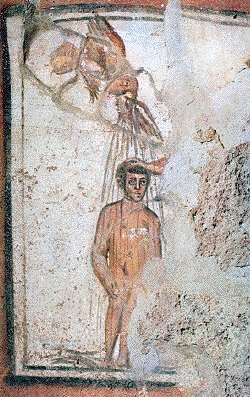 Image via Wikipedia
All I have been attempting to say here is that the ecumenical glass is genuinely half-full – and then to ask about the character of the unfinished business between us. For many of us who are not Roman Catholics, the question we want to put, in a grateful and fraternal spirit, is whether this unfinished business is as fundamentally church-dividing as our Roman Catholic friends generally assume and maintain. And if it isn’t, can we all allow ourselves to be challenged to address the outstanding issues with the same methodological assumptions and the same overall spiritual and sacramental vision that has brought us thus far?

 Over 10 years, I've never stayed at Saint-Wandrille this late in the year. Winter is a wonderful time for de-fragging. This year I decided to take a complete break from the Internet and all its works. In comes all the stuff and information from the year, and, as you enter a world of marked time measured by the psalter, everything begins to float towards its own level. Monastic life is paced by Scripture, not phone and screen. The psalter, as ever, articulated and absorbs an incredible range of feelings in an immensely varied range of emotional tones. So, over a week, everything begins to decompress, anxieties are acknowledged but not absolute, and a sense of God begins to emerge from the ordering of time.


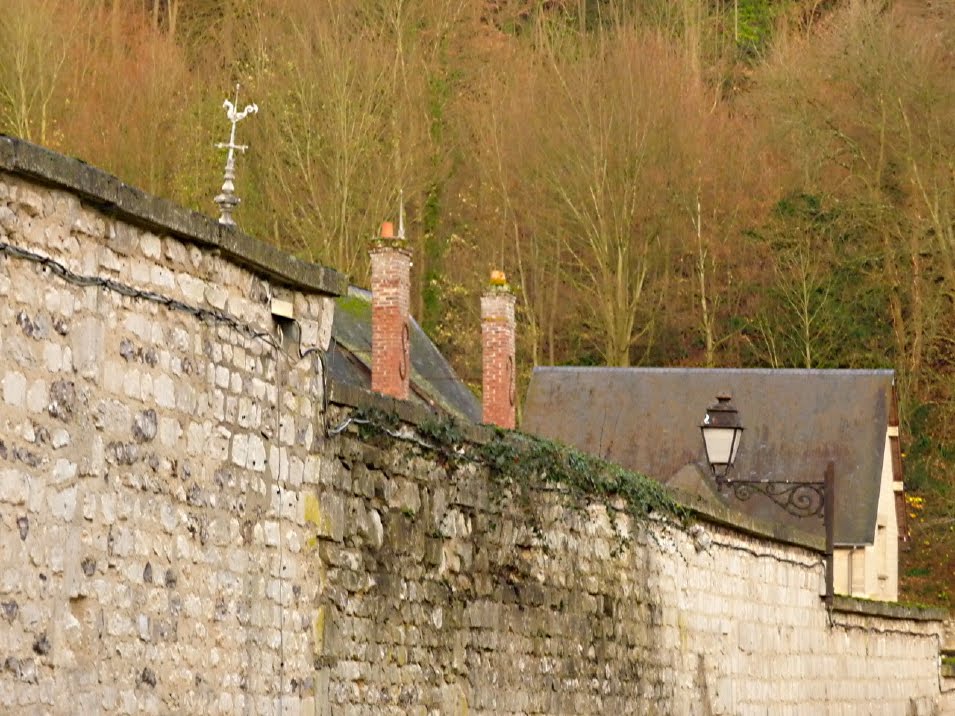 The liturgy is absolutely plain in the last week of the year — a flatland before Advent. Benedict’s line about Monastic life being a continuous Lent, something about simplicity and refreshment, comes very much into its own. That meant a week of the traditional “stir up” collect, that feels gloriously straightforward in the Latin (Excita, quaesimus, Domine tuorum fidelium voluntates, ut divine operis fructum propensius exsequentes, pietatis tua remedia maiora percipiant...). This meant an easy ride through the psalter — especially to be appreciated in the early mornings!


 The Monastery itself is approaching the barest it can be in the year. I was especially struck by the stick-like desolation of a glorious avenue of limes. If you»ve seen them in July they freshen the whole Courtyard with their soft verdant leaves and goo. Now they were so many sticks, with strangely bright spiky red tips. The hillside is equally plain, relieved only by occasional confiers (I could only count two or three) and, more sinister ivy strangling one or two tree trunks up the slope. The Vine is doing well in its own house, though. There are occasional green survivals on some trees, which makes me wonder whether the house is ever entirely leafless.


 As to content, even though Advent felt further away than it was, you can’t ever get away from the Incarnation in an Abbey. The purpose of Christ being formed in me, however resistant material, is foremost. I spent some extended study time in the forites of the Rule, which I haven’t done before. As a new model Terms and Conditions of Service Tsar (!), I thought it might be good to work through Benedict on competencies and accountability, around RB46. It’s a part of the rule where Benedict innovates and simplifies considerably over and above the Rule of the Master, and I came back with a pile of fresh ideas, some of which may turn out not to be silly...


![Reblog this post [with Zemanta]](http://img.zemanta.com/reblog_e.png?x-id=7f7f593d-7854-4cb4-9555-8f6fa55559de)


![Reblog this post [with Zemanta]](http://img.zemanta.com/reblog_e.png?x-id=154b04fc-5b4c-43c6-b41d-0429351146f9)


![Reblog this post [with Zemanta]](http://img.zemanta.com/reblog_e.png?x-id=de6f8f37-5ae0-40f4-b90b-cbc47d7e4a14)

![Reblog this post [with Zemanta]](http://img.zemanta.com/reblog_e.png?x-id=c46d55bf-1fdd-4b03-9e65-7368102df92d)


