Showing posts with label Kirchentag. Show all posts

Friday, 3 June 2011

Doing God in Dresden...

...is very interesting for anyone who grew up with the Simplicissimus (“We were right so everything we did was right.”) English black & white movie narrative of World War 2. But that's another story, best told, perhaps, in resurgent stone Baroque which contrasts strangely with Socialist Realist 1960’s blocks that doughnut the centre.

For the first (and probably last) time in my life, I looked along the row yesterday morning at a Bible Study, to find Dr Christian Wulff (CDU), President of the Bundesrepublik.

So, no name dropping you understand, there was I a few feet along from the head of state of the largest democracy in Europe...

So, it’s OK for politicians to do God in this country, including by a Roman Catholic politician who turns up at a Protestant Bible Study as participant. I wasn’t too wowed by all the childish nonsense in the UK press about Tony Blair and what denomination he could join.

But a further bit of doing God happened slightly later when the President was up on the stage with young people and educators concerned with integration and civil society. As a warm up, the interviewer asked everybody a personal question — “do you pray and, if so, to which God?”

The Christian Wulff answer, for what it’s worth, was that when he is on the road he enjoys some time out in Churches and similar places, and personally, he prays every night as part of his bedtime routine. He prays to “Jesus as described in the Bible.”

But what was interesting was what happened next, or rather what didn’t. Nobody suggested he was a nutter. Nobody suggested his new Economic wheezes were the product of either God or the Devil, being foisted on the public within a secret theocratic agenda. Nobody suggested that he was merely making it up to gain votes.

Indeed, Chicken Licken, the sky did not fall. And that was the difference between the way such a question is handled in the public square our side of the channel and pretty much everywhere else. Where grown-ups live.

Monday, 17 May 2010

Why is our Christianity so Immature?

I’ve just sneaked back home under a volcanic ash cloud. The Munich Passport Contoller who said the flight was cancelled was wrong.

I’ve said various things about Kirchentag, but it is remarkable how the Germans do serious theology on a mass scale.

Equally remarkable was the age breakdown of 167,000 people a day doing this:
. 7,68% Unter 12 Jahren
. 13,74% 12 bis 17 Jahre
. 16,45% 18 bis 29 Jahre
. 7,77% 30 bis 39 Jahre
. 19,07% 40 bis 49 Jahre
. 18,12% 50 bis 59 Jahre
. 7,34% 60 bis 65 Jahre
. 9,83% über 65 Jahre

Think about it.
Incidentally, where were the 30-39’s?

Thoughts such as these, Nick Baines’ reaction to the Hans Küng / Jurgen Moltmann evening, struck me again and again —

This evening was remarkable. Thousands arrived early to ensure a place in the auditorium – I got there for 6.30pm thinking it began at 7pm only to find it was scheduled to start at 7.30pm and didn’t in fact get going until 8pm. More people were locked out than could get in. The excluded crowds chanted ‘Wir wollen rein’ (‘We want to come in’) to listen to these two elderly men talk together about church.

Can you imagine that ever happening in Britain? Most of the excluded were young people eager to garner the wisdom of these two theologians. Why? Because their theology is neither dry nor ‘merely academic’, but engages with the real world of economics, politics and culture. They bring to their subject the intellectual rigour that is associated with German philosophical thinking. Yet, they speak with simplicity, clarity and passion – eschewing theological cleverness in order to communicate accessibly with all-comers: they are remarkable men who show no sign of being ego-driven.

This brings to mind a disturbing question posed by Richard Rohr, Franciscan priest and spirituality wonk, about why the way we do Christianity in the West is so childish and discombobulated by rushes to judgment:

All spiritual teachers tell us “DO NOT JUDGE.” For those of us raised in a religious setting, this is very difficult. In a strange way, religion gave us all a Ph.D. in judgmentalism. It trained us very early in life to categorize, label, and critique. It told us all about worthiness and unworthiness. This judgmental mind told us what is right and wrong, who is gay or straight, and who is good or bad. This sort of mind never creates great people, because everybody has to fit into our way of thinking. At an early age our grid was complete. We had decided who fit in and who did not fit in. We fashioned our own little world.

Christianity that divides the world in this manner and eliminates all troublesome people and all ideas different from our way of thinking cannot be mature religion. It cannot see the multiple gifts of each moment, nor the dark side that coexists with it. This mind does not lead us to awareness, and above all, this mind will find it impossible to contemplate. To practice awareness means you live in a spirit of communion; your world becomes alive and very spacious, and not divided by mere mental labels.

Friday, 14 May 2010

Christian values in Germany

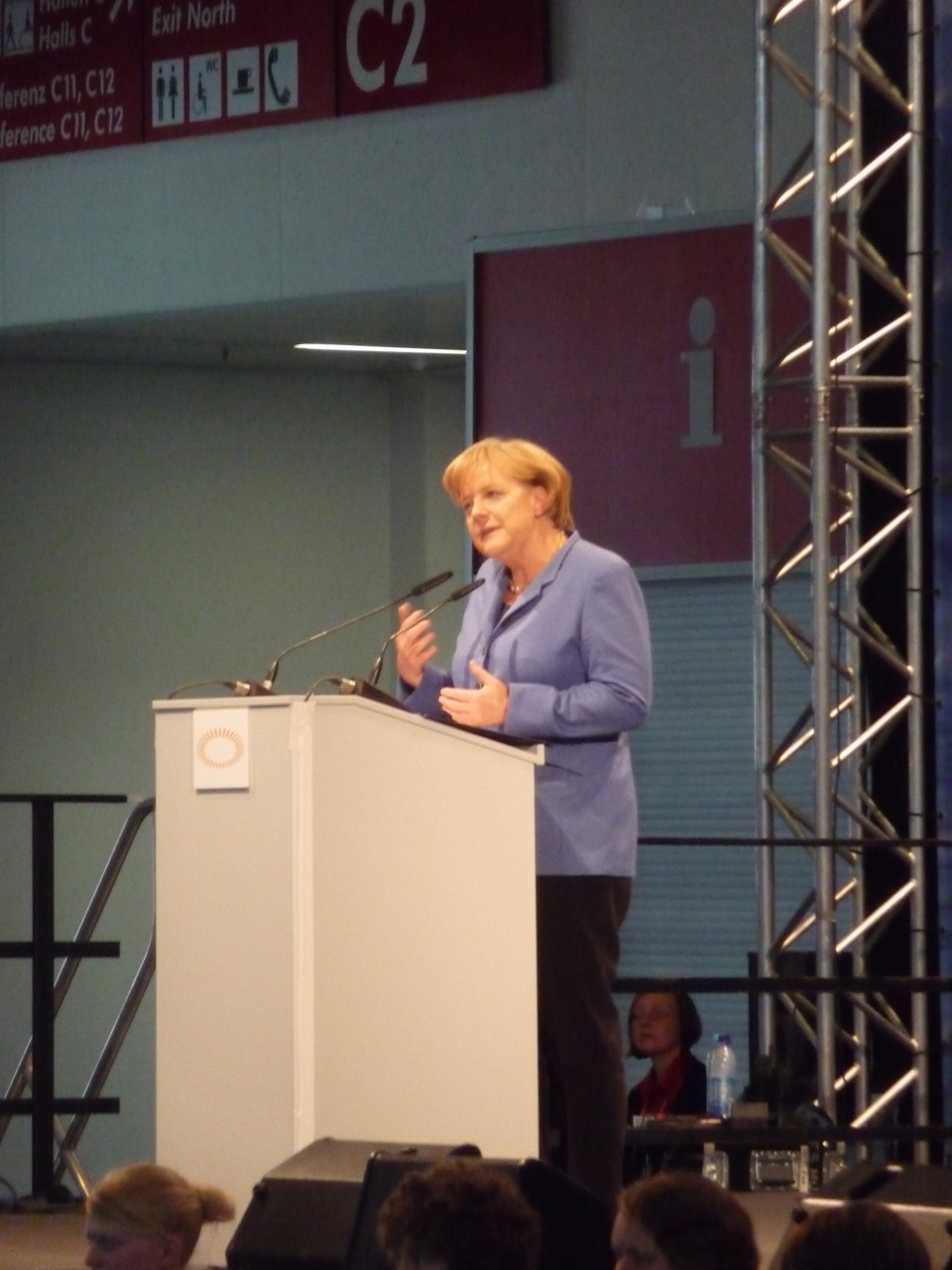
Christianity is a fundamental root of societal values in Germany. Official. I just heard it from the Bundeskanzlerin herself. Speaking in Munich to 6,000 people, the Prime Minister of the largest democracy in Europe acknowledges freely and imaginatively the significance of Christianity as one of the great root of her country’s social values. She is not saying these humanistic concepts could not have been developed in other ways, but the fact is it was from and through Christianity that they have been.

Here in Bavaria there is a refreshing absence of crude secularist rant, along with scare stories got up by the right wing press to suggest that any departure from Victorian morals and dogma means the end of Christianity and ruin of society. Those fears and fantasies are expressed on the margins of society, where they belong.

Neither do I detect the lazy old English idea you “leave morality to the bishops”. Mrs Merkel calls for a dialogue between churches and society, where both engage closely and bless each other and are willing to be changed according to their values and experience — so no crude monopolies of truth, no slippery slope panic, no fear that engagement between churches and society will corrupt the Churches or Confessionalise the State. Freedom is a Christian value, but not egoistical freedom from taking responsibility. Christian freedom is the use of possibilities to follow values as a way of supporting others — another one of Mrs Merkel’s core Christian values.

All she is saying is that there needs to be respect, realism, self-awareness and truthfulness. In this context, Mrs Merkel is just announcing €60Bn of cuts between 2011 and 2015, asking around various possibilities. She isn’t claiming a godlike command of all possible answers, but owning up to a serious problem, addressing pragmatic reality, asking for hep and obviously winning some respect for her candour. How refreshing! How grown-up!

Politicians, even controversial ones with cuts to announce, seem to be held in higher respect in Germany. Wondering why I am told they have a more realistic mandate from a more fully democratic voting system, and that there is a higher value of corporate civic life here. They are not thought to behave that much better, but they are held to account more tightly over their views as well as their expenses. They have to treat people more like grown ups, partly because there is a very direct relationship between how many votes and how much power. There is often a higher degree of historical awareness and pragmatism, with less simple sloganising. By comparison, much UK debate about Church and society, such as it is, simply bears out the old maxim that Clichéd words reveal clichéd thought. There has to be a better way!

Thursday, 13 May 2010

MK on the Isar

Here, in the Agora of the largest Christian Get-together in Europe, Milton Keynes Ecumenical Partnership have taken a stall. It’s dominated by Mrs Lazarus, by local sculptor David Moore. She was aspin off from Robert Koenig’s Odyssey project, which celebrated the East European relatives he never knew, some of whom had perished in the holocaust, and some of whom he had not been allwed access to as young man because of the divisions of Europe.

Mrs Lazarus has graced the Church of Christ the Cornerstone, on and off, for the past two years. She gained her name from the sculpotor's mpother, who kept returning from death’s door. The last eighteen months of her life, she picked up the name and it suck. She died at the age of 94 in March this year.

Like Lazarus, Mrs Lazarus is wrapped, with only her feet showing — the message is “we’ve only just begun” on the Ecumenical journey. The unwrapped portion of the bandage carries specific photographs and messages about inclusion, surprising new relationships, the joy of coming in many colours, and the challenge of faith-keeping. Text cards are also being distributed with quotations from pope Paul VI, Dom Helder Camara, and Fr Harry Williams, CR. The last is particularly significant:
God’s Love for me is his love for the world,
and so is mine for God,
if it is genuine.
Everything will be revealed when Mrs Lazarus returns to Milton Keynes, including the host of messages she has collected during her time in Munich. Sjould you be one of the 300,000 people celebrating hope in MInich, she can be found at stall A6 D09 in the Messe.

Monday, 13 July 2009

What’s really going on out there

Timothy Garton Ash is one of the very few people around with the depth and breadth of historical understanding to produce genuine contemorary history. His new Book, Facts are Subversive, contains short essays, mostly originally written for newspapers, but far too good to let go for tomorrow’s fish and chip wrapping. At this year’s Kirchentag I was struck by the skill, good humour and perspective TGA brought to a shared seminar with Bundeskanzlerin Angela Merkel. He knows his way round the issues of the age, and has real critical insight about Europe (“If the EU were to apply to join the EU it would be refused”) without losing his grasp on the positive achievements of the whole project.

These essays range from big questions of definition and identity (“Islam in Europe”) to well known flashpoints (“The strange toppling of Slobodan Milosevic”, “9/11”) and contemporary predicaments (“Beauty and the Beast in Burma”). His main interests, as Oxford professor of European Studies, have been foreign policy — there is an extraordinary insider’s account of an attempt to brief George W. Bush about Yoorp, and another about Obama’s inauguration. To every subject he brings deft precision, like a peanuts cartoon — inscape in context.

TGA’s standpoint is classically Liberal
. He articulates what the word could and should mean as more than just a hysterical reactionaries’ catch-all ra-ra term of abuse.
Only when we are prepared to allow our own most sacred cows to be poked in the eye can we credibly demand that Islamists, Turks and others do the same. This is a time not for erecting taboos but for dismantling them. We must practise what we preach.
TGA is also highly articulate about the difference between secularism and new model atheism.
I do not believe there is a God and therefore assume that some 2007 years ago a couple called Joseph and Mary just had a baby. But what a man he turned out to be! Like the great Swiss historian Jacob Burckhardt, I can’t get anywhere with Christ as God, but as a human being Jesus Christ seems to me a constant and wonderful inspiration — perhaps even, as Burckhardt put it, “the most beautiful figure in world history.” And some of his later imitators didn’t do so badly, either.
As historians get down to work on Bush foreign policy, TGA draws up a preliminary balance sheet, measured against the administration’s stated aims at the outset. He is no knee-jerk anti-Republican, indeed much of his journalism as I remember from the period tried to encourage people to stand back and give Bush what benefit of the doubt they could. As the roll begins to be called up yonder, however, as a former advisor to Bush, he has to conclude:
In every vital area of the wider Middle East, American policy over the last five years has taken a bad situation and made it worse
He then forensically sketches the whole “amazing bloody catastrophe ” —
  • Afghanistan worse (more dangerous and hospitable to terrorists),
  • Pakistan worse (even more unstable, radical and effective as a clearing station and training camp for terrorists from all over the world)
  • Iraq worse (now radicalised and unstable),
  • Iran worse (newly prestigious, confident and dabbling in WMD),
  • Israel worse (more worried, less secure and self-confident),
  • Palestine worse (with a new radical terrorist government)
  • Lebanon worse (Bush scored an accidental early goal in the Cedar revolution, but latterly managed to muck it all up by undermining the very government he had supported, so, on balance, less stable).
  • Egypt, the Islamists are now scoring at the ballot box as well as with their AK47’s: worse.
The score is 8-1, then. The 1 was Gaddafi. We can credit Bush with a phenomenal performance, especially when his team was the only superteam in the league, with no serious opposition. Again and again, he played blinders, kicking the ball into his own net, stunning the occasional goalkeeper in the process. Hucknall Town played Manchester United and after 90 minutes the score is 8-1 to the giantkillers, 7 of them own goals, and the Manchester goal itself is a cracked and wobbling ruin with bigger holes in the net. Such is the trainwreck courageous and innocent young men and women are now dying to try and recover, as, tragically, horribly, the coffins come home.

For me, the jewels in the crown of this collection, however, are TGA’s essays on Gunther Grass and George Orwell. Most of the pieces are very short. Keep this book for train journeys and occasional reading. Agree or disagree with his conclusions, it flags up the real issues, remarkably consistently for a collection of occasional pieces. TGA lays out in historical order the events and alarums of our age in a way nobody else has yet managed, and I salute it as a tremendous and surprisingly readable achievement.

Monday, 1 June 2009

Planting an apple tree in Bremen

A few stray shots do no justice to what was, overwhelmingly, the largest and most impressive learning gathering for Christians in Europe this year. Dancing around the streets to 20 samba bands with 250,000 others is, indeed, an unusual thing to be able to do. There’s a great account of the event by Martin Flower, a member of St Anne & St Agnes Lutheran Church in the City of London, who went to entrely different things from me, here.

One challenging phrase was quoted incidentally, however, at 3 events I attended. It is one description, by Martin Luther, of what it means to have real faith:
Auch wenn ich wüsste,
dass morgen die Welt zugrunde geht,
würde ich heute noch
einen Apfelbaum pflanzen.
Which being translated means
Even if I knew that the whole world
was going to smash tomorrow,
Still, I would plant an Apple Tree today.


Saturday, 30 May 2009

Intercommunion: finding a way home

Interesting personal coments on Eucharistic exclusion as a tool of ecclesiastical diplomacy. I take Steve Hayes’ useful point about the dangers of Church Consumerism, about which I generally agree with him, but I need to say that Dr Steffensky was coming from somewhere entirely different in Bremen.

Steffensky was emphatically not saying “You should have it because you want it and have a right to choose.” He was starting at the other end, with the nature of the Eucharist, as that which constitutes the Church. To have a category of Christians who are grudgingly acknowledged to be so but excluded from table fellowship is a wrong answer to St Paul’s fundamental question “Is Christ divided?” By his death and resurrection Christ has broken down every dividing wall; then we go and build a few of our own. Steffensky objected to anything that turns unity into a human and institutional achievement, rather than something Christ has made by his death and resurrection. He was trying to take fully seriously the forward-looking and sacramental meaning of Communion. A modern Club mentality was exactly the thing to which he most deeply objected. His ground conviction was that the Eucharist makes the Church, far more than the denomination defines the Eucharist, and that’s why, he would say, real liturgical terrorism is making a holy Sacrament into a weapon in the ongoing historic game of denominational cowboys and Indians — unworthy and destructive behaviour.

I’m reminded of words that struck me years ago, about a correspondence between Henry Westall and the Bishop of London as the Church of England attempted to enforce an insitutional ban on the use of reservation, portable lights [candles accompanying Gospel processions] and Incense, in 1900. Bishop Creighton had said:
I always wonder what horses think about a coachman. I imagine that they think him stupid, unjust, particular about unnecessary trifles, and always checking them needlessly. But his business is to get the coach along without upsetting it. He is on the box and he sees more than anybody else. He is not responsible for the obstacles in the road, and if he could regulate all the traffic, he could make things easy all round. But alas he is limited to the obscure and ignoble duty of steering his own vehicle to the best of his power.
Bishop Mandell Creighton to Henry Westall, 3 April 1900.

‘True, My Lord,’ Mr Westall might have replied, ‘but in a fog the coachman, from his box, sees no further than anyone else can, while the horses (poor unreasoning beasts) can at least feel the solid ground under their feet, and sometimes their instinct will lead them safely home.’
W.Scott, “An ‘advanced’ view of the ‘Church Crisis’,” Nineteenth Century, April 1901, p 692.
The other great discovery of this post and comments has been students at Lampeter are being introduced to Dom Gregory Dix, whose classic Anglo-Catholic view of the Eucharist I have often reflected about ever since I first came across it 30 years ago:
[Jesus] had told his friends to do this henceforward with the new meaning ‘for the anamnesis’ of Him, and they have done it always since.

Was ever another command so obeyed? For century after century, spreading slowly to every continent and country and among every race on earth, this action has been done, in every conceivable human circumstance, for every conceivable human need from infancy and before it to extreme old age and after it, from the pinnacles of earthly greatness to the refuges of fugitives in caves and the dens of the earth. Men have found no better thing than this to do for kings at their crowning and for criminals going to the scaffold; for armies in triumph or for a bride and bridegroom in a little country church; for the proclamation of a dogma or for a good crop of wheat; for the wisdom of the Parliament of a mighty nation or for a sick old woman afraid to die; for a schoolboy sitting an examination or for Columbus setting out to discover America; for the famine of whole provinces or for the soul of a dead lover; in thankfulness because my father did not die of pneumonia; for a village headman much tempted to return to fetish because the yams have failed; because the Turk was at the gates of Vienna; for the repentance of Margaret; for the settlement of a strike; for a son for a barren woman; for Captain so-and-so, wounded and prisoner of war; while the lions roared in the nearby amphitheatre; on the beach at Dunkirk; while the hiss of scythes in the think June grass came faintly through the windows of the church; tremulously, by an old monk on the fiftieth anniversary of his vows; furtively, by an exiled bishop who had hewn timber all day in a prison camp near Murmansk; gorgeously, for the canonisation of S. Joan of Arc – one could fill many pages with the reasons why men have done this, and not tell a hundred part of them. And best of all, week by week and month by month, on a hundred thousand successive Sundays, faithfully, unfailingly, across all the parishes of Christendom, the pastors have done this just to make the plebs sancta Dei – the holy common people of God.

Dom Gregory Dix, The Shape of the Liturgy, (London 1945), p744.

Thursday, 28 May 2009

Liturgical Terrorism or the future?

Fifty years ago, most denominations had some degree of closed communion — people were generally nice about it, but the denomination was the gatekeeper. Since the 1950’s this rather Brethren way of doing Church has largely broken down in the West.

People who are not personally excommunicated are admitted on the basis of baptism, and the whole Church, not the denomination is the medium of the Sacrament. The institutional denomination is only trustee for the Lord, to whom the Sacrament belongs.

In the good old days saying the Lord’s prayer with other Christians was a mortal sin for Roman Catholics, but that was many years ago. Conciliar theology has a structure to support Eucharistic hospitality, which is only offered in certain closely defined circunstances.

In Hanover in 2005, my eyebrows raised as the (now retired) Cardinal Archbishop of Mainz described the current restructions in his denomination as a “thorn in the flesh.”

In Bremen I stayed with a delightful Catholic host, who told me the hot ticket for Saturday morning’s Bible Study was Fullbert Steffensky, Professor Emeritus at Hamburg.

He was now a Lutheran, having started out as a monk of Maria Laach — the place Adenauer found sanctuary from the Nazis in 1934 (though that’s not quite the whole story of the monstery at that time).

The Bible Study considered Genesis 16 and Hagar the slave woman. She is not entirely outside God’s blessing, and we were led into considering the probem of religious absolutism and the inability of some Christians and others to believe God has blessed anyone but their in-group. He leapt straight from there to an incident at the Berlin Kirchentag in 2003, where large crowds had been banned from intercommunion. What right had ecclesiastical authorities to try and deprive the people of God of hope? As I mentally fell off the seat, given the style distance between the presentation and our customary stately Englsh ecumenical quadrille, the preacher continued.

The basis of Communion is the mercy, gift and call of God, not what he scathingly called “die Einheitlichkeit in einigen Sätzendes Bekentnisses. (loosely, “the oneness of a sit-down of acquaintances”) It was pointless for ecclesiastical authorities to say the Church wasn't ready for such a thing, if all they meant was that they weren’t. Now, Ecumenical diplomats, sit down somewhere comfortable and pour a stiff drink, as I quote the published text:
Wir können nicht darauf warten, bis die letzten fußkranken Mitglieder von Kirchenleitungen angekommen sind und das Mahl für erlaubt. (very loosely, “We can’t wait for the last lame duck Church leaders to catch up and join us at the table...”)
Dr Steffensky very much hoped that at future Kirchentage people would just go ahead and eat as the Lord commanded, concluding
Auf Dauer werden die Bischöfe schon fördern, was sie nicht verhindern können. ( loosely, “The Bishops will soon enough require what they can’t prevent.”)
Boooom! Right, my English Ecumenical Chums. This is certainly Provocative stuff that you wouldn't hear in a gathering of 125,000 Christians in England.
Is it “Liturgical Terrorism” or the Future?
Related Posts Plugin for WordPress, Blogger...