Thursday, 29 July 2010

Charity and Daily Bread

A busy, foodie week, in the worlds of media, local charity, and academia. A lot of time has gone into work with my friend and colleague Carole Peters, devising and preparing the BBC Radio 4 Sunday morning service next week on Lammas — the original havest festival. Our theme has been Bread of heaven, with music, readings and a meditation — all UK insomniacs not in Church at 8·00 next Sunday welcome!

Meanwhile, yesterday, I spent a morning with Sue Wall, who runs Milton Keynes Food Bank. I’ve often noticed the food pantry ministryies of US Churches and wondered why they didn't happen more in the UK. Perhaps, I thought, it’s because the welfare state means the need is less. That’s a nice thought, but way off base with reality.

It’s a disturbng fact, but even in an outwardly prosperous city like MK, many ordinary people, especially at times of crisis, struggle to feed themselves and their families. We live in a welfare state, but the largest single cause of temporary need is delay in benefit payment; for example if someone on benefit gets a part time job, it can take two weeks and more whilst benefit is adjusted, whilst they have no money coming in at all.

MK Food Bank provides a limited number (up to 6) short term (3 day) packs of simple but high quality food, made up to a standard nutritional specification. It began as a ministry of MK Christian centre, a thriving non-denominational Church in the city, and now engages all sorts of volunteers, mainly but not exclusively from the whole range of churches.

People are referred through a variety of agencies, and parcels can be collected from various local collection points. The work began in a Church cupboard, moved into a sea container, and now has its own warehouse unit in Stacey Bushes. Food comes from donations, including some from leading supermarkets. Local businesses, especialy Mercedes Benz, whose HQ is in the city, have also backed the project with sponsorship and services. So far this year over 4,400 packs have gone out. MKFB began as part of, and still operates in close collaboration with the Trussell Trust, an Evangelical Christian chatity that fights Poverty, deprivation and despair in the UK and abroad. It was an immensely moving privilage to spend a morning with Sue and some members of her team, to see how many parallel lines our passion run along, and to pray together.

Finally, yesterday, an afternoon teaching in the Business School of the University of Buckingham, where a wonderful colleague, Andrew Lightbown, is conducting fascinating doctoral research with which I’ve been helping into the meaning and dynamic of Agape (Love). After my lecture we reviewed his work together, including an emerging working definition of Charity which struck me as relevant to MKFB, as to all expressions of Christian love in action:
To exercise Charity is to act intentionally to promote wellbeing in solidarity with, and reverential response to the other.

Thursday, 22 July 2010

Scripture as Spiritual Reading

One of the great illusions about prayer is that you have to abstract yourself on your own from everything that really matters to you, light up a few tea lights, engage a soapy “spiritual” gear and hope for the best. Many would like to enrich their praying lives, in a way, but suspect they’ll never manage.

What we all need is a bit of encouragement and a few pointers that engage us where we are.

Fr William Mills is rector of an Orthodox parish in Charlotte, NC. His 30 Day Retreat, billed as “a personal guide to spiritual renewal” is a tool to get you going on Lectio Divina using a few minutes each day spread over a month. He takes well known Bible passages from the gospels and Paul, and invites the reader to slow down, chew over them and reflect. Each section ends with some practical questions and follow up Bible reading. This book could work very well for a group that read daily, whose members kept some personal notebooks, and met weekly like a book club.

Fr Mills’ approach is practical rather than narrowly academic, but its author does happen also to be an a professor of philosophy of religon. His experience with students gives extra resonance to his rather homsepun comment. Written by an Orthodox priest, published by a Roman Catholic publishing house, this book is broad guage classic Christianity rather than anything narrowly denominational. As a get-you-going guide for groups or individuals who want to explore well-known Scriptures as a Spiritual resource, what you see is very much what you get. There are some helpfully surprising questions, though, for a book aimed foursquare at Christian believers — “what irritates you about Jesus?” for example. The book should prove a significant help for those suffering from what the author calls Dusty Bible Syndrome, as well as people who’ve not engaged with Scripture as spiritual reading as much as they would like.

Tuesday, 20 July 2010

Rev: Faith, hope and charity

Adam Smallbone, the new BBC Rev., is engaging, with real spiritual depth. At last the BBC has moved beyond The Vicar of Dibley. She engaged millions with woolly jumpers and chocolate silliness, with a good humoured take on life, the Universe and everything. Rev. is engaging in a very different way, much closer to where many urban vicars are, in fact.
People talk of the Church of England as an institution, forgetting it isn’t anything of the sort — just a ragbag of around 20,000 trusts and bodies, loosely aligned, that has evolved over the past 1600 years. Its ties bind in all kinds of intriguing elasticated ways. Describing life in such a place is no light task.

It’s easy for any outsider to critique the detail of any TV depiction of anything. Years ago the BBC broadcast Sergeant Musgrave’s Dance. Next Day a retired military gentleman complained that “the Buffs in fact had seven buttons down their tunics not nine as portrayed by the BBC last night.” As any ful kno. This kind of complaint is rarely as clever as it seems to the person who makes it. We all know that few Archdeacons cruise round London in Taxis wearing Gestapo surplus leather gloves, but that’s not the point. The point is that’s how it feels.

On a personal and emotional level, Rev: is remarkably sure-footed. It brings back vividly for me memories of ten years’ urban ministry — trying to be a Christian and pray, feeling rather bemused often, filling the diary, trying to love people in the face of my own inadequacy, the size of the task, and the vagaries of human nature. Rev: has a clutch of improbable vicarage characters I could match almost name for name, as, I suspect, could anyone who’s ever been an urban vicar for any reasonable length of time.

For all its tendency to self-parody and caricature, I like Rev. It’s a noble enterprise. Those who wrote it know whereof they speak. Adam sits in his Church trying to pray the office, wishing God would bloody do something, but secretly suspecting he won’t until his unworthy servant has made it through the next funeral. It’s a ministry that resents all the distractions, until it realises that the ministry is the distractions.

There’s holiness in the unglamorous, haphazard, but profoundly kind and patient way C of E vicars do urban ministry, even in some of the crazier characters vicars encounter. It’s highly implicit, always understated, rarely obvious. Light very occasionally streams in serendipitously, but the grind is always there. You just have to pray for people, and try to help them make the best of themselves, and never give up.

There is, actually, courage, resilience, faith and even holiness wrapped up far more than thousands of urban vicars will ever know in their ministries. It deserves more understanding and respect than it sometimes gets, and this show does acknowledge its reality and worth. For all Rev:’s occasional TV simplification, full marks to writers, cast and crew for trying to capture it, and occasionally succeeding.

PS: I studied in Shoreditch thirty years ago. St Leonard’s was an amazing place, and it’s good of the telly people to give the old dump its own TV show.

Monday, 19 July 2010

Equity and Faith belong together

St Wandrille in July is almost unnaturally lush, green and leafy. It seems a completely different place to the austerity of November. I greatly value these weeks away from the internet, emails, etc. — indeed I have now spent 3 months of my life here, spread over the past few years. On my first visits I used to take a pile of books, but these days everything centres naturally on the office and the Church.

One theme that has been jumping out of the psalter for me this week is “equity.” Some people talk as though justice and equality issues facing the Church were some kind of imposition from secular culture, to be treated with suspicion as a post-enlightenment racket.

The insistence of the psalter that God is a God of equity and justice, whose people should strive to reflect these qualities gazumps this whole illusion. If, quoting Michael Ramsey, “The Church exists that Christ may reign,” our life should be characterised not by weird exceptionalism, but intentional striving for equity and justice. What equity means pragmatically differs from age to age. However the challenge remains constant. God’s justice may transcend that of the world, but it has to be at east as just. And after a week praying the collect, much more elegant in Latin than Engilsh, that Christians may reject those things that do not fit with the name we claim and choose those that do, it just doesn’t make any sense to suggest that basic issues of justice and equity are marginal or secondary, or merely secular impositions. They spring, in fact, from the core of our faith, as reflected in the psalms.

Monday, 12 July 2010

Off for a few Monastic days

Abandoning what some speak of as the smoking ruins of the General Synod, I’m off for a week in a monastery. Reports and notes will follow, but I do turn off the Internet at St Wandrille, and won't be blogging again until next weekend.

I’m not sure the ruins of the General Synod are smoking, even if the next steps remain to be discerned on ordaining women to the episcopate. The Archbishops had a right to do as they did and suggest another way forward, although I can understand some synod members feeling the procedure gazumped due process. The synod had the right to decide it didn't quite buy the deal. C’est la vie. The Holy Spirit is able to work through the human processes of the General Synod...

Howbeit, one doughty layman of a traditionally Conservative outlook suggested to me at a recent do, you can't really have a situation where the blacks are allowed on the bus but only because there's a whites only section at the front where, as long as the passengers don't look round, they can feel as though nothing’s changed. It’s for everyone to decide what their consciences will and won't wear, but we each and all have more or less tuned consciences, and therein lies the complexity. He thinks they all need a bit of moral courage, now. Further paralysis and funk is the worst option of all, surely, for everyone. Time for a bit of faith.

Wednesday, 7 July 2010

Faith, Fear, Freedom, Pharisaism

Morning Prayers at the Senior Management Group in Oxford yesterday, led by Nigel Wearne, our head of finance. How fortunate are we to have a head of finance who leads creative worship as well as keeping the books?
He brought a wonderful poem for a summer’s morning, by e.e.cummings:
i thank You God for most this amazing
day:for the leaping greenly spirits of trees
and a blue true dream of sky; and for everything
which is natural which is infinite which is yes

(i who have died am alive again today,
and this is the sun's birthday; this is the birth
day of life and of love and wings: and of the gay
great happening illimitably earth)

how should tasting touching hearing seeing
breathing any--lifted from the no
of all nothing--human merely being
doubt unimaginable You?

(now the ears of my ears awake and
now the eyes of my eyes are opened)
I was also struck by the wisdom of the traditional morning Collect we also used, which perfectly addresses an age of anxiety. Anxiety, which is never understandable (“where is your faith?” asks the Lord) begets defensive and uncharitable attitudes tending towards Pharisaism. By their fruits you know them. The only alternative is faith in God, which begets an infectious, naturally missional love of “everything which is natural which is infinite which is yes”
O God, who art the author of peace and lover of concord,
in knowledge of whom standeth our eternal life,
who service is perfect freedom:
Defend us thy humble servants in all assaults of our enemies;
that we, surely trusting in thy defense,
may not fear the power of any adversaries;
through the might of Jesus Christ our Lord. Amen
The press has been full of stories about the possibility of Dr Jeffrey John becoming bishop of Southwark. He was nominated as Bishop of Reading at the time I was as Bishop of Buckingham, and personally, I would have been perfectly happy to serve with Jeffrey as an episcopal colleague. His rule of life was, as far as could be told, entirely consistent with the discipline of the Church and still is. I’ve heard reactions from the pews since Sunday’s Telegraph story ranging from “Oh not again” to “this is a great opportunity to redeem a nasty injustice.” If Jeffrey were to be nominated, the reaction would be an interesting sign of how things have moved on, or not, since 2003.

The only sane bottom line has to be that this is simply an appointment and if those whose job it is to discern the truth see in Jeffrey the gifts and calling to undertake the work (and most who know him and the Southwark diocese well seem to think these are pretty obvious), why, apart from steamy politics, why, apart from fear, wouldn’t they appoint the best person for the job?

pictures from the flower festival at Wingrave last week, with special thanks to Neil who organised it, and his team.

Sunday, 4 July 2010

Summertime and the living is easy

Having spent a spectacularly mellow sunny morning off (after 8.00 BCP, a long conversation with Stephanie in the garden about film, and a couple of levels of Angry Birds with Stewart), I cook lunch. Now it’s give my touchy-feely side the serious attention it deserves — aided by a guru of gurus, Swami Jeff, a mellow fellow if ever there was one. Here he discovers in his own psychodynamic way how Fathers find it so hard to be fully in tune with the Universe...

Saturday, 3 July 2010

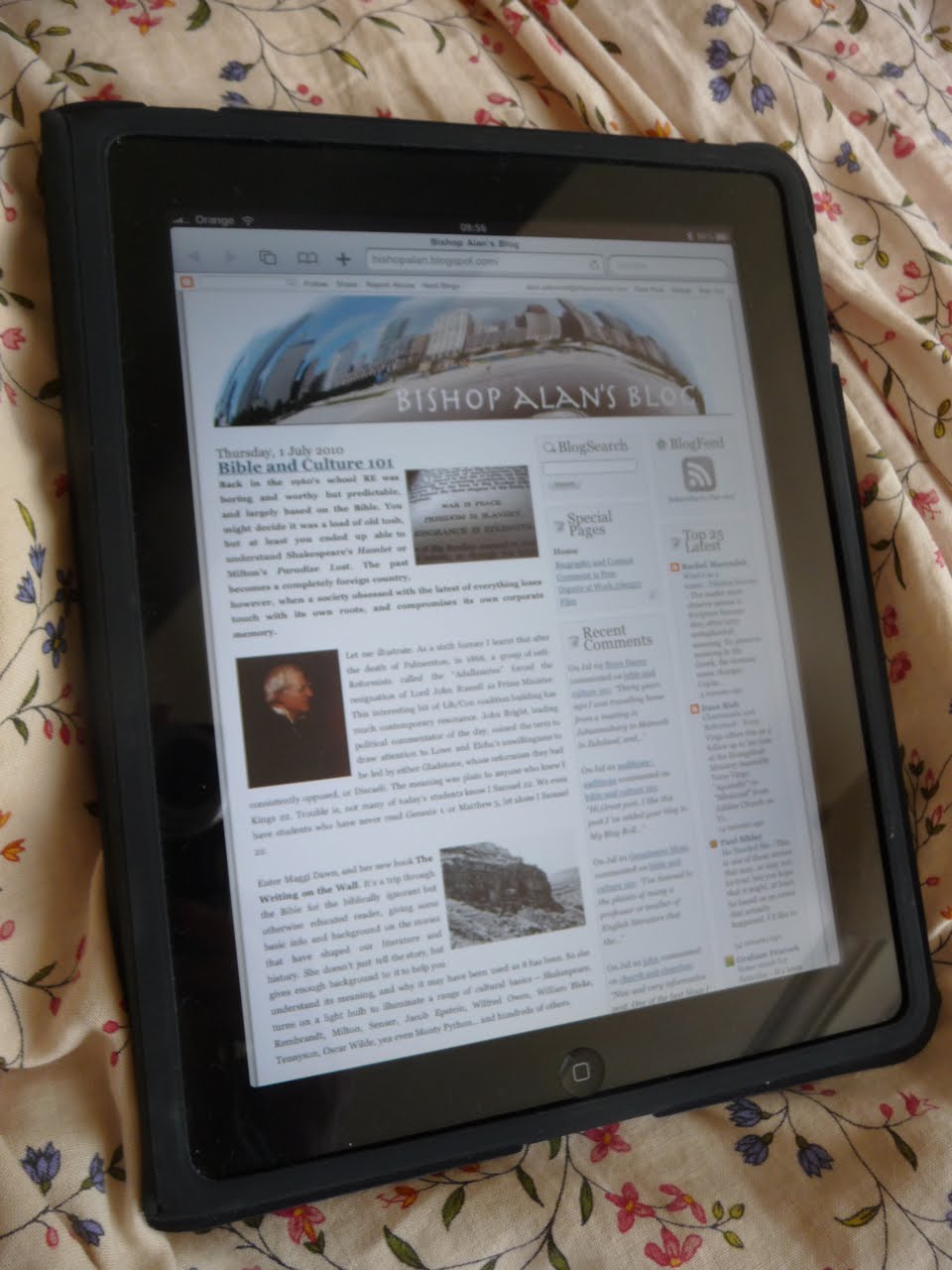
iPad: Unobscure Object of Desire

After a few days of use, how is the iPad? I’m coming to terms with fear of being mobbed or robbed, and it certainly is very much lighter, slicker and more lust-evoking than other devices. It is particularly strong as an eReader, not only for the reading experience itself, but also because it straddles the various formats superbly. Video is wondrous compared to other techtoys.With the number of developers out there, and the low price of apps for it, the future seems bright.

The screen is delightfully bright and clear, if too easily subject to the aesthetic ravages of iggy-wiggy fingermarks. Operational basics come as no surprise to horny-handed iPhone users like me. The user experience is breathtakingly simple and elegant. Doutbless it will require considerable software bells and whistles to be all it could be, but the basic idea is sound. Software developers may indeed start working towards apps that will make it function more and more as a business tool, and such software is out there, in embryo, already.

What can I do I couldn’t? Not a lot, perhaps, although I am revelling in having a Hebrew Bible (proper Biblica Hebraica 4th Ed) with on-screen analysis of words — touch the word and up comes the BDB. This feature would, in itself, have saved me at least a term as an undergraduate! But these are obscure pleasures. Whatever your game may be, this gadget is going to raise it, as well as impress your teenage offspring durch technik.

Is it ethical to own such a thing? What about poor working conditions in the Foxconn factory in China? I’m afraid mine was winging its way before the media had splashed this story, and now there are various contested narratives around it, including a story from Foxconn that the suicide rate among its 800,000 workers (13 attempts this year) is, in fact, significantly lower than the Chinese national average. Interpreting the data is not easy, and my main impression is of how ignorant I am about Chinese cuture and society.

Apple itself is almost certainly as embarrassed about this story as Nike was over the one a few years ago about its subcontractors’ factories in the Philippines. It certainly lifts the veil on a major aspect of current Western production practice, and it’s hard to know whether the rumoured Foxconn plan to transfer its operations to Taiwan is good or bad news. There is something questionable about the whole economic model we are using for production these days, perhaps, and all of us in the west are implcated up to our armpits. Time for a bit of badgering on Facebook, perhaps, but the whole model everyone is using may be smelling slightly fishy, and worthy of further investigation. How will the development of a new middle class raise standards in China? In this new industrial revolution, it’s a question worth asking about all our techological objects of desire.

As to the bigger picture, I note that the value of Apple surpassed that of its auld enemy Mirosoft on 26 May ($223 Bn over Microsoft’s $219.3 Bn) — Deep joy, that this was achieved by design-led engineering.

Jonathan Ive and colleagues deserve the credit; the English may have lost their touch for footie, but they can still do design.This device, above all, shows the power of simplicity.

Is there no limit to the iPad’s artfulness? Practically speaking, it needs multitasking and, perhaps a clearer way of showing where it stores files. There is also some kludginess about file transfer to solve, and battery life could always be extended. There is a major need to develop productivity software before it can quite substitute securely for a laptop,. You do really need a £49 bluetooth keyboard before you’ll want to write your next novel on it with iWork or similar.

All this is small fry, however, compared to the wonderful way the device brings together engineering and function-led simplicity so elegantly into a convincing single device. At launch, however, I have to give it five out of five strawberries, as well as take a mental note to pay more attention to the soft underbelly of production ethics in future.

Thursday, 1 July 2010

Bible and Culture 101

Back in the 1960’s school RE was boring and worthy but predictable, and largely based on the Bible. You might decide it was a load of old tosh, but at least you ended up able to understand Shakespeare’s Hamlet or Milton’s Paradise Lost. The past becomes a completely foreign country, however, when a society obsessed with the latest of everything loses touch with its own roots, and compromises its own corporate memory.

Let me illustrate. As a sixth former I learnt that after the death of Palmerston, in 1866, a group of anti-Reformists called the “Adullamites” forced the resignation of Lord John Russell as Prime Minister. This interesting bit of Lib/Con coalition building has much contemporary resonance. John Bright, leading political commentator of the day, coined the term to draw attention to Lowe and Elcho’s unwillingness to be led by either Gladstone, whose reformism they had consistently opposed, or Disraeli. The meaning was plain to anyone who knew I Kings 22. Trouble is, not many of today’s students know I Samuel 22. We even have students who have never read Genesis 1 or Matthew 5, let alone I Samuel 22.

Enter Maggi Dawn, and her new book The Writing on the Wall. It’s a trip through the Bible for the biblically ignorant but otherwise educated reader, giving some basic info and background on the stories that have shaped our literature and history. She doesn’t just tell the story, but gives enough background to it to help you understand its meaning, and why it may have been used as it has been. So she turns on a light bulb to illuminate a range of cultural basics — Shakespeare, Rembrandt, Milton, Senser, Jacob Epstein, Wilfred Owen, William Blake, Tennyson, Oscar Wilde, yea even Monty Python... and hundreds of others.

So, here is an ideal present for the sixth former in your life who seeks some background to our culture. Its clarity and sense of perspective may also help the busy preacher. No cave of Adullam, though. Now someone’s done Literature, could it be History next for this treatment?
Related Posts Plugin for WordPress, Blogger...